Battle of Lincoln (1878)
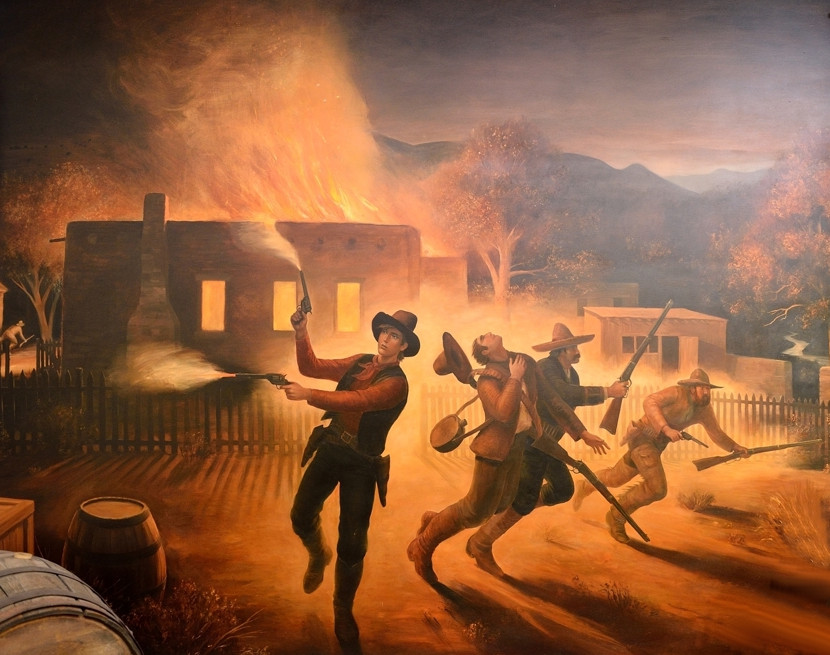
On the night of July 18, 1878, someone set the McSween house on fire. Inside, ten men waited with rifles, knowing that stepping out meant death. Outside, a posse hired by the Murphy-Dolan faction held positions around the adobe building, waiting for the flames to flush their enemies into the open. When Alexander McSween finally emerged the next morning, he was cut down in a hail of gunfire. But one man made it out. William Bonney, not yet famous as Billy the Kid, led a desperate charge through the flames and into the darkness. The Five-Day Battle of Lincoln was over. The legend was just beginning.
A War Over Beef and Dry Goods
The Lincoln County War was, at its root, a fight over economic control of a vast and sparsely populated territory. On one side stood Lawrence Murphy and James Dolan, who ran a mercantile empire known as The House. They held contracts to supply beef to Fort Stanton and the Mescalero Apache reservation, and their store was the only significant retail operation for a hundred miles. On the other side stood John Tunstall, an ambitious young Englishman, and his partner Alexander McSween, a lawyer. They opened a competing store and bank, challenging The House's monopoly. Tunstall also began acquiring cattle, threatening the beef contracts. The business rivalry turned personal, then violent. On February 18, 1878, a posse led by Murphy-Dolan allies intercepted Tunstall on the road and shot him dead. The war had begun.
The Regulators Ride
Tunstall's murder galvanized his supporters into forming a vigilante group that called itself the Lincoln County Regulators. Led by Richard 'Dick' Brewer, the Regulators included men who would become legends of the Old West: Doc Scurlock, Charlie Bowdre, Big Jim French, and the young William Bonney. They obtained warrants for Tunstall's killers and set out to serve frontier justice. Within weeks, they had killed Sheriff William Brady on the streets of Lincoln and gunned down several Murphy-Dolan men. The territorial government declared them outlaws. By summer, both sides were recruiting fighters, and Lincoln County had descended into open warfare.
Five Days of Siege
On July 15, 1878, Alexander McSween returned to Lincoln with roughly forty supporters. He placed ten men, including Bonney, inside his own house, while others took positions in nearby buildings. The Murphy-Dolan faction, led by Sheriff George Peppin, arrived with their own force and surrounded the town. For four days, the two sides traded gunfire across Lincoln's single main street. At least five Murphy-Dolan men were wounded in the initial exchanges; the Regulators suffered no casualties. Residents cowered in their homes. At some point, word reached Fort Stanton, and Lieutenant Colonel Nathan Dudley marched a column of cavalry and artillery into town. His arrival changed everything.
The Burning House
Dudley claimed neutrality, but his troops effectively shielded the Murphy-Dolan forces while their artillery threatened the Regulators' positions. One by one, McSween's supporters abandoned their defensive posts and slipped away. By the night of July 18, only the men inside the McSween house remained. Someone, accounts differ on who, set the building on fire. The flames spread room by room through the night. At dawn on July 19, McSween led a group out the back door and was immediately shot down. Bonney and a handful of others made a break for it, sprinting through the smoke and gunfire. Against all odds, they escaped into the darkness. The war's climactic battle was over, but its consequences would echo for years.
Aftermath and Legend
The Battle of Lincoln effectively ended the organized conflict, though sporadic violence continued. By September, Lew Wallace, the future author of Ben-Hur, arrived as territorial governor with orders to restore peace. He offered amnesty to most participants but made an exception for Billy the Kid, who had become too notorious to pardon. Wallace tasked Sheriff Pat Garrett with hunting down the remaining outlaws. Garrett tracked Bonney across the territory, captured him, and watched him escape from the Lincoln County courthouse in a jailbreak that killed two deputies. On July 14, 1881, Garrett found Bonney at Pete Maxwell's ranch in Fort Sumner and shot him dead. The Kid was twenty-one years old. The battle that made him famous had happened just three years earlier, in the burning ruins of a lawyer's house on a dusty street in Lincoln.
From the Air
Lincoln, New Mexico lies at 33.49N, 105.39W in a narrow valley along the Rio Bonito at approximately 5,700 feet MSL. The town is small, essentially a single historic street, and appears as a cluster of buildings in the valley below the Sierra Blanca range to the west. Fort Stanton, the military post that intervened in the battle, lies about 4 nm southwest. Nearest airports are Sierra Blanca Regional (KSRR), approximately 20 nm south, and Roswell International (KROW), about 50 nm east. Terrain rises sharply to the west toward the Capitan and Sierra Blanca mountains; maintain safe altitude. The Lincoln Historic Site preserves several original buildings from the battle.