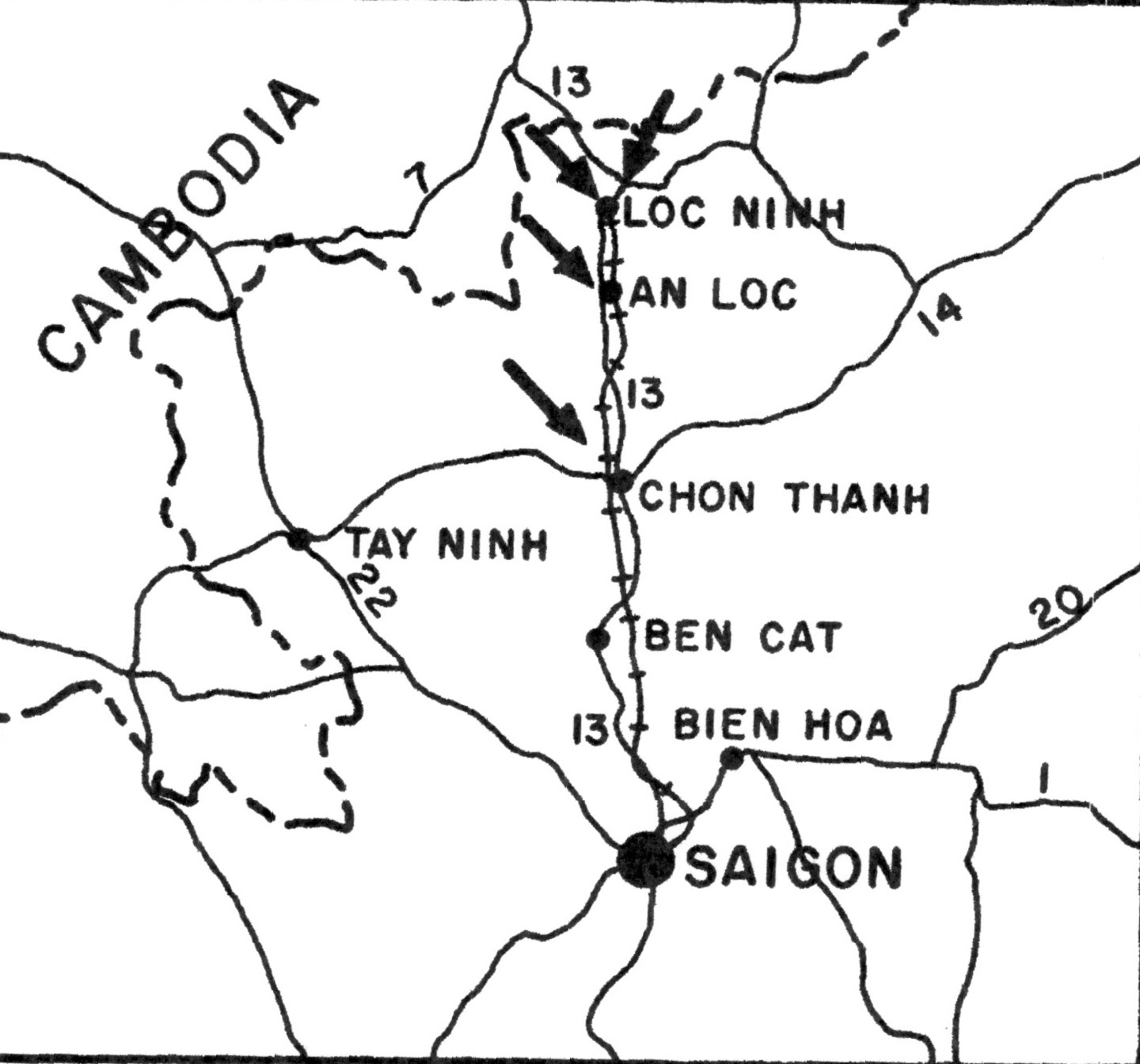
Battle of Loc Ninh
The French owner of the Cexso Rubber Plantation noticed the field telephone lines first. Sometime in early April 1972, he reported to the South Vietnamese army that the Viet Cong had strung communications wire through the rubber trees northwest of Loc Ninh, a small district town in Binh Long Province. The warning went largely unheeded. Within days, a full division would pour across the Cambodian border, supported by tanks, artillery, and rockets, and the battle that followed would expose both the desperation of South Vietnam's defenders and the fractures in their own chain of command.
The Easter Gambit
By late 1971, North Vietnam's leadership had decided on a radical departure from the guerrilla tactics that had defined most of the war. The defeat of South Vietnamese forces during Operation Lam Son 719 emboldened Hanoi to launch a conventional combined-arms offensive -- tanks, heavy artillery, massed infantry -- with the goal of destroying ARVN units and seizing territory to strengthen their position at the Paris Peace Talks. On 30 March 1972, the PAVN 304th and 308th Divisions smashed across the Demilitarized Zone, overwhelming South Vietnam's northernmost provinces. Quang Tri City fell on 28 April. But the DMZ offensive was only one prong. In Binh Long Province, north of Saigon, the Viet Cong 5th Division and PAVN formations were massing across the border in Cambodia, preparing to strike at the rubber plantation country along National Highway 13.
Three Days in the Rubber Trees
At 06:50 on 5 April, the VC 5th Division crossed the Cambodian border and opened with a barrage of artillery, rockets, and mortar fire on the headquarters of the ARVN 9th Infantry Regiment. VC infantry, supported by roughly 25 tanks, attacked from the west. ARVN artillerymen, in an act of improvisation born from desperation, lowered the muzzles of their 105mm howitzers and fired point-blank into enemy formations advancing through the rubber trees. American air power arrived quickly: F-5s, A-37s, AC-130 gunships, AH-1 Cobras, and carrier-based strike aircraft from the South China Sea converged on the district. The air support was devastating to VC formations but could not dislodge them. By nightfall on April 5, the ARVN defenders had been compressed into small compounds at the north and south ends of town, cut off from resupply by heavy anti-aircraft fire that made helicopter flights suicidal.
A Commander Who Wouldn't Fight
The battle revealed a crisis of leadership on the South Vietnamese side. Colonel Nguyen Cong Vinh, the ARVN regimental commander, showed signs of collapse almost immediately. When he ordered the 1st Cavalry Squadron to withdraw from Fire Support Base Alpha to reinforce Loc Ninh, its commander Lieutenant Colonel Nguyen Huu Duong refused, saying he would surrender his unit instead. American Captain Mark A. Smith reportedly threatened to destroy the squadron with air strikes if it did not fight, and from that point Smith effectively controlled the ARVN forces. Meanwhile, Vinh himself was deteriorating. On the evening of April 5, he ordered soldiers to open the compound gates -- an apparent preparation to surrender or desert. By April 7, as VC tanks and infantry massed for a final assault, Vinh stripped off his uniform, told his troops to give up, and ran out the gate with his bodyguards to surrender. Smith stopped another ARVN officer from raising a white T-shirt as a flag of surrender, and the remaining defenders fought on until they were overwhelmed by sheer numbers.
The Fall
On the morning of April 6, another wave of 25 T-54 and PT-76 tanks struck from the south. VC infantry breached the ARVN lines, though air strikes from AC-130s prevented a complete collapse. By that point, the 9th Infantry Regiment had been reduced to roughly 50 combat-effective soldiers, with 150 wounded packed into a hospital bunker. That night, PAVN artillery scored a direct hit on the bunker, killing many of the wounded. A follow-up strike detonated the ammunition storage facility. Task Force 52, ordered north to relieve the garrison, was ambushed at the junction of Highway 13 and Route 17 and forced to withdraw. By 16:30 on April 7, the Viet Cong held complete control of Loc Ninh District. Of the ARVN forces committed to the defense, more than 3,000 soldiers were killed or captured. Only about 50 made it to An Loc, the next objective in the VC offensive.
Capital of a Revolution
The speed of the victory surprised even the attackers, who had expected the South Vietnamese to hold longer. Loc Ninh became the seat of the Provisional Revolutionary Government -- the symbolic capital of "liberated" South Vietnam. All seven American advisers in the district were captured, along with French journalist Yves-Michel Dumond. They were taken to a prison camp in Kratie Province, Cambodia. Dumond was released in July 1972; the Americans were freed in February 1973 under the Paris Peace Accords. As Loc Ninh fell, the VC 9th Division was already turning south toward An Loc, the provincial capital 32 kilometers away. The soldiers of Task Force 52 would spend a week infiltrating through enemy lines along Highway 13 to reach it, and the siege that followed would become one of the most brutal battles of the entire war.
From the Air
Located at 11.419N, 106.270E in what was Binh Long Province, now Binh Phuoc Province, approximately 120 km north of Ho Chi Minh City (Saigon). The area is flat rubber plantation country along National Highway 13, close to the Cambodian border. Tan Son Nhat International Airport (VVTS) is approximately 120 km to the south. Bien Hoa Air Base (VVBH), significant in the battle, lies about 90 km southeast. The terrain is low-lying and green, with the Cambodian border visible to the west. Best visibility in the dry season (November-April).