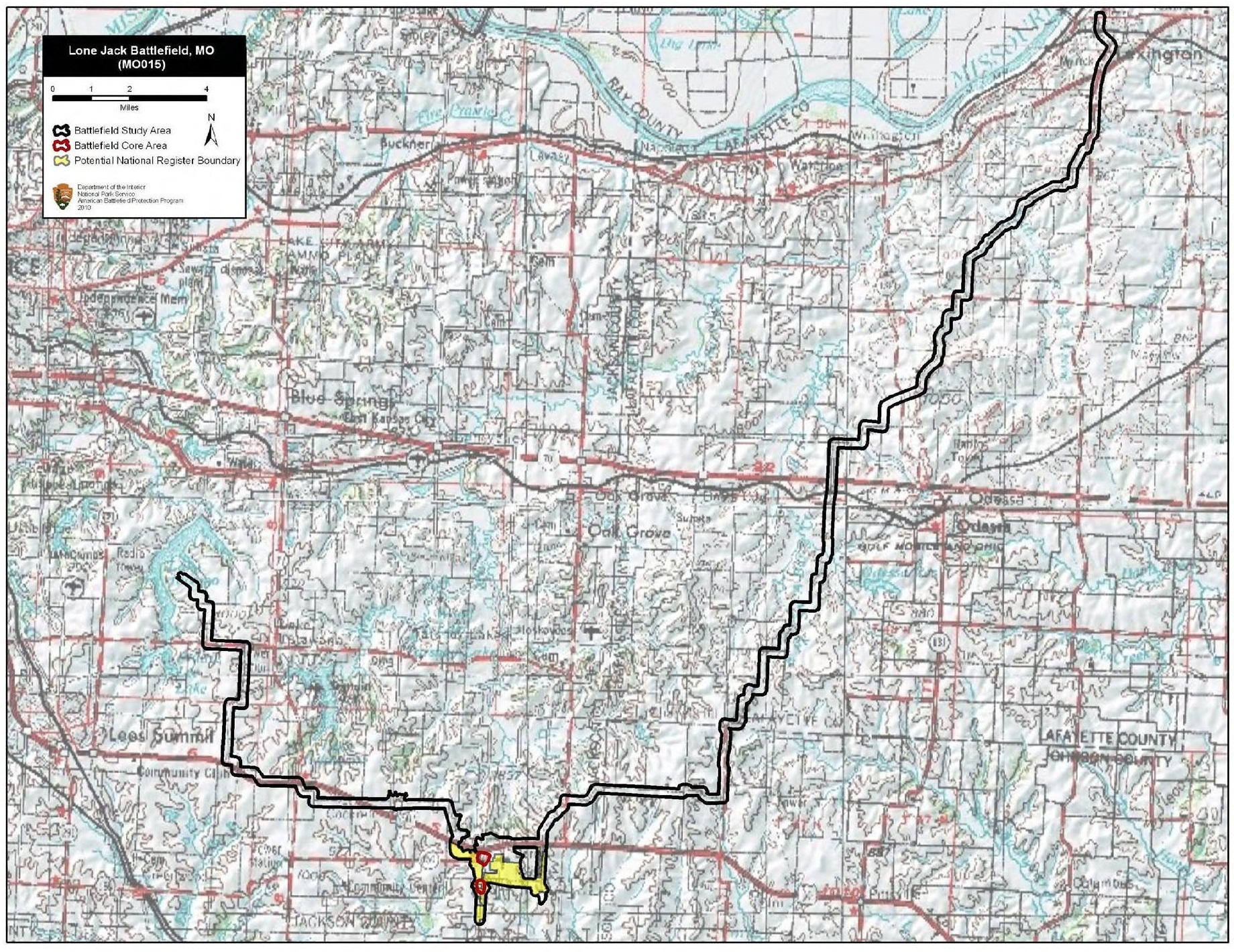
Battle of Lone Jack
Eighteen-year-old Cole Younger shoved Dr. Josiah Hatcher Caldwell out of the cabin. Caldwell was a ranking Confederate officer and Younger's own ally, but the doctor had come to execute the wounded Union Major Emory S. Foster, who lay bleeding inside. Younger would not allow it. Years later, when Younger sat captured after the failed Northfield, Minnesota bank robbery, it was Foster -- by then editor of the St. Louis Evening Journal -- who publicly argued for clemency. The Battle of Lone Jack, fought on August 15-16, 1862, produced many such strange entanglements of violence and mercy in the small crossroads town of Jackson County, Missouri.
Cannon Fire at Midnight
In the summer of 1862, Confederate and Missouri State Guard recruiters were flooding into Missouri from Arkansas, replenishing depleted ranks across the Trans-Mississippi theater. Captains and colonels -- Jo Shelby, Vard Cockrell, John T. Coffee, Upton Hays, and others -- operated semi-independently throughout western Missouri, with no clear chain of command. When Independence fell to a combined force of Colonel John T. Hughes, William Quantrill, and others on August 11, Union General John Schofield ordered General James Totten to concentrate forces against the threat. On August 15, Union Major Emory S. Foster led 740 men from Lexington to Lone Jack. Reinforcements under General James G. Blunt (2,500 men) and General Fitz Henry Warren (600 men) were en route, but days away. Foster received intelligence that 1,600 Confederates were camped nearby. When revised estimates reduced the enemy to 800, he attacked at 11:00 p.m., scattering the camp. But the roar of his cannon in the darkness was his undoing -- it alerted Colonel Vard Cockrell and every other rebel command in the area to his exact position.
Five Hours Along the Main Street
Foster's exhausted men rested along the town's main street. At dawn on August 16, Confederate commanders Cockrell, Hays, Jackman, Hunter, and Tracy launched a coordinated assault to overwhelm the smaller Union force. Hays attacked late, spoiling the element of surprise, but his dismounted charge from the north, combined with Tracy's pressure, crumpled the Union right flank. The fighting collapsed onto the artillery in the center of town. Union Captain Long's cavalrymen, concealed behind a hedge row of Osage orange trees, poured crossfire into the Confederates, temporarily repulsing them. But ammunition ran low on both sides. Hunter abandoned the field to resupply, exposing Jackman's flank. The two James Rifles at the center of the Union line became the pivot of the entire engagement. The guns changed hands multiple times as Confederates and Federals charged and countercharged across the dusty street. Foster himself recaptured the artillery a final time before being severely wounded.
The Bloodiest Crossroads
After five hours of relentless combat and with Foster down, the arrival of Colonel Coffee's fresh 800 men north of town forced Captain Milton H. Brawner, Foster's successor, to order a withdrawal. The Federals left in good order, hastily spiking and hiding the cannon before retreating to Lexington. The Confederates held the field, but the approach of Blunt's and Warren's forces compelled them to withdraw by August 17. The human cost was appalling for such a small action. Brawner reported 43 killed, 154 wounded, and 75 missing or captured -- a casualty rate of 34 percent that was almost certainly understated. Colonel Hunter reported burying 119 Federals and 47 Confederates, though true losses remain unknown. At least 55 Confederates are listed as killed by name, with others dying of wounds later. The fear that Quantrill's Raiders were present -- men known for brutality toward prisoners -- drove the Federals to fight with particular ferocity.
Echoes in Popular Memory
Future Secretary of War and U.S. Senator Stephen B. Elkins fought his only Civil War battle at Lone Jack, and was forever changed by it. Walking the field afterward, he saw 'the blood, the cries for water and death, the naked bodies stripped of their clothing, the dead horses which served for ramparts,' and declared it gave him 'a disgust for war.' Colonel Cockrell recovered the two Union cannon and spirited them back to Arkansas, where one later fired the shot that disabled the steamer Queen City on the White River. The Confederate recruits, as many as half of whom had been unarmed before the fight, gained a substantial quantity of needed firearms. The battle even found its way into Hollywood: in the 1969 film True Grit, John Wayne's Rooster Cogburn claims he lost an eye at Lone Jack, calling it 'a scrap outside of Kansas City.' Today, the battlefield preserves monuments to both sides, and the Lone Jack Civil War Battlefield Museum keeps the memory of that savage August day alive in the quiet Missouri countryside.
From the Air
Located at 38.87N, 94.19W in Jackson County, Missouri, roughly 30 miles southeast of Kansas City. The Lone Jack battlefield site is visible from altitude as a small rural community surrounded by farmland. Nearest airports include Lee's Summit Municipal Airport (KLXT, roughly 15nm northwest) and Kansas City Downtown Airport (KMKC, roughly 30nm northwest). Recommended viewing altitude: 3,000-5,000 ft AGL. The terrain is flat to gently rolling prairie. Interstate 50 passes nearby.