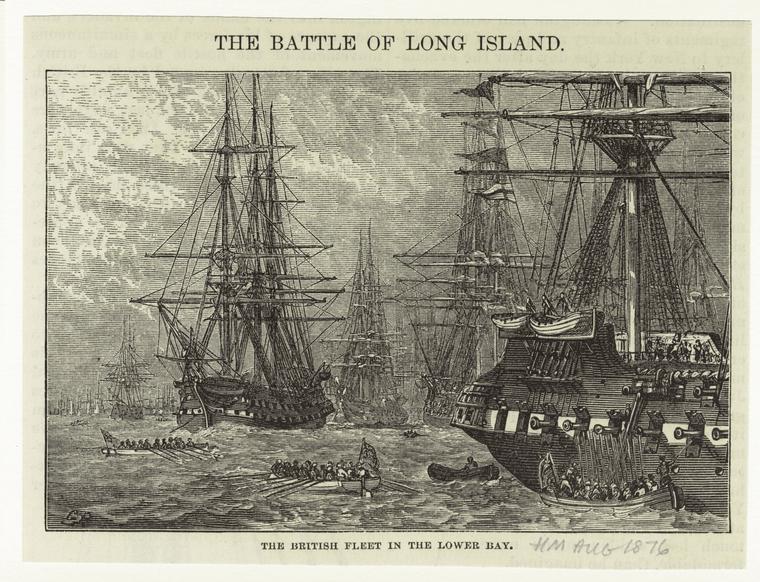
The Battle of Long Island: Washington's Worst Day and Greatest Escape
Wagon wheels wrapped in rags. Soldiers forbidden to speak. Nine thousand men moving through darkness toward the Brooklyn waterfront while the British army slept a few hundred yards away. The night of August 29, 1776, produced one of the most extraordinary retreats in military history, but the day that preceded it was a catastrophe. The Battle of Long Island -- the first major engagement after the Declaration of Independence, and by far the largest battle ever fought in North America at that time -- ended with Washington's Continental Army surrounded, outmaneuvered, and pinned against the East River. What happened next would determine whether the American experiment survived its first summer.
An Army That Had Never Fought
Washington's troops were farmers, shopkeepers, and tradesmen, most of whom had never fired a musket in battle. The British force that sailed into New York Harbor in the summer of 1776 was the largest expeditionary force Britain had ever assembled: professional soldiers, Hessian mercenaries, and a fleet that choked the harbor with masts. Washington split his forces between Manhattan and Brooklyn, a decision that military historians have debated ever since. The Brooklyn defenses were manned by largely inexperienced generals who misread the terrain and the enemy's intentions. When the British attacked on August 27, they executed a flanking maneuver through the unguarded Jamaica Pass that caught the Americans completely by surprise.
The Maryland 400
As the American lines collapsed, one unit held. A regiment of roughly 400 Maryland soldiers, under the command of Lord Stirling, charged repeatedly into a vastly superior British force near the Old Stone House in what is now the Gowanus neighborhood of Brooklyn. Washington reportedly watched from a redoubt on Brooklyn Heights and said, "Good God, what brave fellows I must this day lose." The Marylanders' stand bought critical time for the retreating army to fall back to the fortified positions on Brooklyn Heights. Of the 400 who charged, more than 250 were killed or captured. Their sacrifice is commemorated by a Corinthian column near the eastern edge of Prospect Park's Long Meadow.
Trapped on the Heights
By the evening of August 27, the Continental Army was penned in on Brooklyn Heights with the East River at their backs. General Howe chose not to storm the American positions -- perhaps remembering the terrible cost of frontal assault at Bunker Hill the year before. Instead, the British began digging siege trenches, inching closer to the American lines day by day. Rain fell. Washington's raw troops huddled in the mud. From a purely military perspective, the situation was hopeless: the British controlled the land approaches, and the Royal Navy dominated the East River. The revolution appeared to be ending before it had properly begun.
The Midnight Crossing
On August 29, Washington made the decision to evacuate. He gathered every flat-bottomed boat and sloop he could find along the East River shoreline. Beginning at nightfall, troops began filing silently from the defensive lines to the ferry landing at what is now Fulton Street in Brooklyn. The operation required extraordinary discipline from an army that had just been badly beaten. General Mifflin's Pennsylvania regiments held the outer lines as the rear guard. At one point, a miscommunication nearly unraveled everything: Mifflin's men began marching toward the boats too early. Washington rode up in the darkness and confronted Mifflin directly. "Good God, General Mifflin, I am afraid you have ruined us," he exclaimed. Mifflin marched his men back to the lines. By dawn, all 9,000 troops had crossed to Manhattan without losing a single soldier.
What Remains in Brooklyn
The British were stunned to find the American positions empty. King George III awarded General Howe the Order of the Bath for his victory, but the prize -- the destruction of the Continental Army -- had slipped away in the night. Today, the battle's traces are scattered across Brooklyn. On Battle Hill in Green-Wood Cemetery, the highest point in the borough, a bronze statue of Minerva gazes directly at the Statue of Liberty in New York Harbor. In 2006, the Minerva statue was successfully invoked in a legal battle to prevent a building from blocking that line of sight. The Prison Ship Martyrs' Monument, a Doric column in Fort Greene Park, memorializes the thousands of captured American soldiers who died on British prison ships in Wallabout Bay -- starved, diseased, and denied medical attention. As few as half the prisoners taken at Long Island survived. In Prospect Park, a granite boulder at Battle Pass bears a brass plaque marking where the outnumbered Americans tried to hold the line.
From the Air
The Battle of Long Island was fought across what is now southern Brooklyn (40.665N, 73.981W). Key landmarks visible from altitude: Green-Wood Cemetery on Battle Hill (highest point in Brooklyn, with Minerva statue), Prospect Park (Battle Pass markers), Fort Greene Park (Prison Ship Martyrs' Monument, a tall Doric column). The Old Stone House is reconstructed in J.J. Byrne Playground, 5th Avenue and 3rd Street, Park Slope. Nearby airports: KJFK (John F. Kennedy, 18km SE), KLGA (LaGuardia, 17km NE), KEWR (Newark Liberty, 15km W). Best viewed at 3,000-5,000 feet AGL.