Battle of Lookout Mountain
Ulysses S. Grant dismissed it as "one of the romances of the war," insisting there was "no such battle" worthy of the name. The quartermaster general who watched from a distant hilltop called it the Battle Above the Clouds. The truth lay somewhere in between -- and it lay in the fog. On November 24, 1863, ten thousand Union soldiers under Maj. Gen. Joseph Hooker assaulted the slopes of Lookout Mountain outside Chattanooga, Tennessee, fighting uphill through mist so thick that neither side could see more than a few dozen yards. Observers across the valley heard the rattle of musketry echoing off the rock but saw nothing. By nightfall, the Confederates were retreating under cover of a lunar eclipse, and the siege of Chattanooga was breaking apart.
Starving in the Shadow of a Mountain
The Army of the Cumberland was trapped. After its devastating defeat at the Battle of Chickamauga in September 1863, forty thousand Union soldiers under Maj. Gen. William Rosecrans had retreated into Chattanooga, where Gen. Braxton Bragg's Confederate Army of Tennessee promptly besieged them. Bragg's troops held the high ground on two imposing ridgelines -- Missionary Ridge to the east and Lookout Mountain to the south -- and from these positions they controlled the Tennessee River and every supply road into the city. Soldiers were put on half rations, then quarter rations. Artillery horses starved and died. The Union government, alarmed, sent reinforcements and a new commander. On October 17, Ulysses S. Grant took charge of the Western armies and replaced Rosecrans with the methodical George H. Thomas. Within ten days, Thomas launched an audacious amphibious operation at Brown's Ferry that reopened a supply route -- the famous "Cracker Line" -- saving the army from starvation.
The Mountain's Deceptive Strength
Lookout Mountain looked impregnable. Rising at a steep forty-five-degree angle from the Tennessee River, it culminated in a sharp point high above the water. Two-thirds of the way up, the slope leveled into a wide natural bench before steepening again into a sheer rock face called the palisades. Confederate artillery on the summit commanded the river below. But the mountain's strength, as historian Thomas L. Connelly later wrote, was "a myth." The guns on top could not be depressed enough to reach the bench, which was exposed to Union artillery at Moccasin Bend. Numerous trails on the western slope made the bench accessible to any determined attacking force. Bragg compounded the weakness by stripping defenders from the mountain to reinforce Missionary Ridge after a Union probe at Orchard Knob on November 23 caught him off guard. By the morning of the assault, the Confederate force on Lookout Mountain had been reduced to about 8,700 men under Maj. Gen. Carter L. Stevenson -- facing Hooker's fresh ten thousand.
Fighting Blind
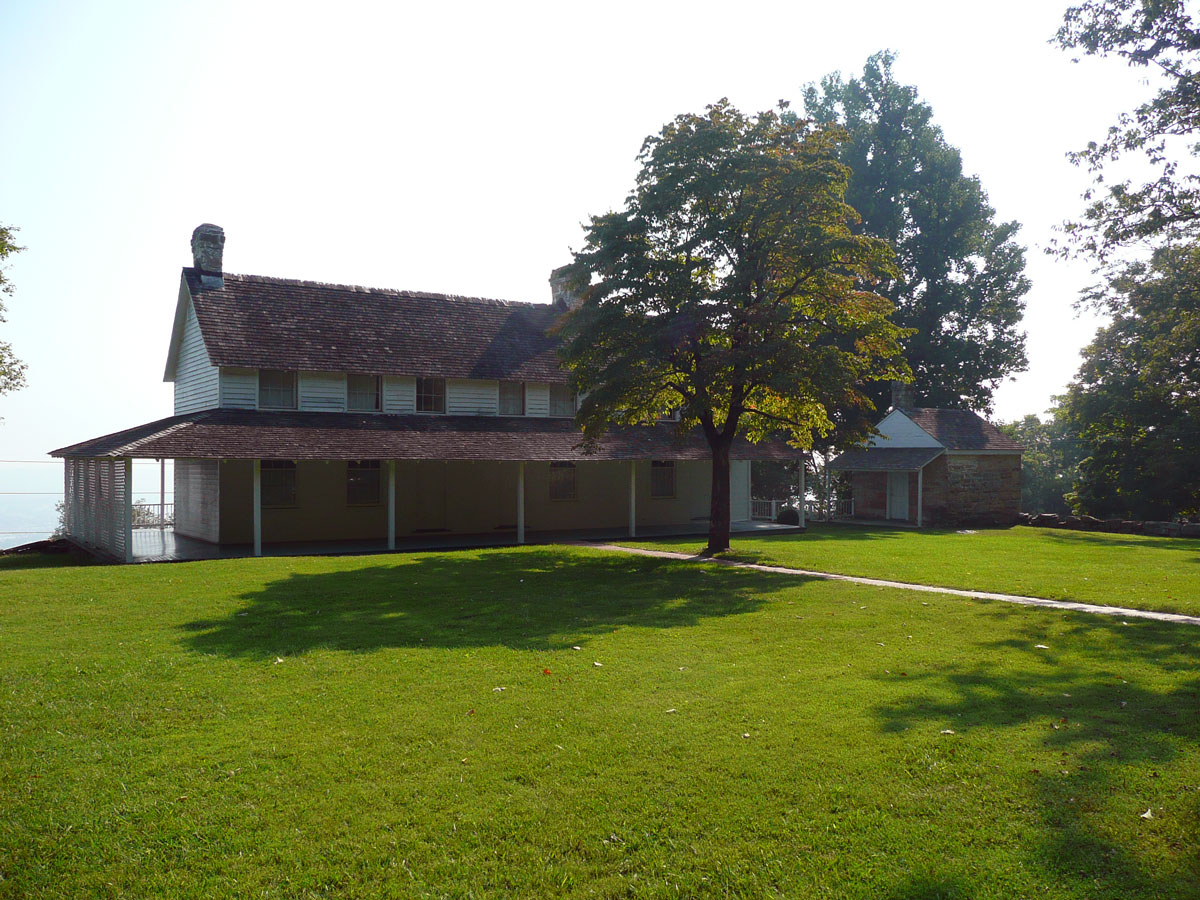
Hooker's assault began at 8:30 a.m. on November 24, delayed by high water at Lookout Creek. Brig. Gen. John W. Geary's division crossed first on a footbridge, formed a battle line, and advanced through fog and mist that clung to the mountainside. By 10 a.m., Geary's skirmishers had pushed a mile into the Confederate picket line commanded by Brig. Gen. Edward C. Walthall, whose 1,500 Mississippians were outnumbered and falling back. Around 11:30 a.m., Walthall's reserve made a stand near the Cravens house, a stone farmhouse on the bench, repulsing one Union assault before being overwhelmed by a second. The fog made coordination nearly impossible for both sides. Union brigades intermingled as they pressed forward. Confederate commanders sent confused messages. Brig. Gen. John C. Moore's Alabamians fired into the mist at a hundred yards, briefly halting the advance, but they were outflanked when additional Union brigades surged up the slope. By mid-afternoon, Hooker was sending Grant alternating dispatches of triumph and alarm.
Withdrawal by Moonlight
Through the afternoon and into the evening, sporadic fighting flickered across the bench as Confederate regiments from Alabama held on in the fog, buying time for their comrades on the summit to escape via the Summertown Road. Neither side could see well enough to press an advantage. By midnight, Lookout Mountain had fallen silent. At 2 a.m., the last Confederate brigades received orders to march off the mountain. Postwar veterans on both sides later wrote of a brilliant full moon that night -- a moon that slipped into the blackness of a total lunar eclipse, screening the Confederate withdrawal in sudden darkness. Bragg, stunned by the loss, asked his corps commanders whether to retreat from Chattanooga entirely. Breckinridge talked him into standing and fighting on Missionary Ridge. It proved a fatal decision. The next day, November 25, Thomas's troops overran Missionary Ridge in one of the war's most dramatic assaults, sending the Army of Tennessee into headlong retreat and cracking open the gateway to the Deep South.
Poetry, Not Battle
Casualties at Lookout Mountain were light by Civil War standards: 671 Union and 1,251 Confederate, more than a thousand of the latter captured or missing. Grant, whose attention had been fixed on Missionary Ridge, later belittled the engagement in his memoirs, calling it "all poetry." But the quartermaster general, Montgomery C. Meigs, watching the fog-shrouded slopes from Orchard Knob and hearing the gunfire he could not see, had given the fight its enduring name: the Battle Above the Clouds. Whatever Grant thought of it, the action secured the Tennessee River, endangered the entire Confederate position on Missionary Ridge, and freed Hooker's divisions to strike Bragg's flank the following day. Portions of the battlefield are now preserved as part of the Chickamauga and Chattanooga National Military Park, the nation's first national military park. The Cravens house still stands on the bench where the fighting was fiercest.
From the Air
Located at 35.02N, 85.34W just south of Chattanooga, Tennessee. Lookout Mountain is a dramatic terrain feature visible from miles away -- a narrow ridge rising sharply from the Tennessee River with a distinctive pointed summit. The Chickamauga and Chattanooga National Military Park preserves portions of the battlefield on the mountain's slopes. Missionary Ridge runs parallel to the east across the Chattanooga Valley. The Tennessee River makes a dramatic bend at Moccasin Point just below the mountain. Nearest airport: Chattanooga Metropolitan Airport (KCHA), approximately 8 nm to the east. Lookout Mountain is a VFR landmark. Caution: mountain terrain and potential for fog/low clouds mirroring the conditions of the 1863 battle. Best viewed at 3,000-4,000 ft AGL to appreciate the mountain's prominence over the river and the city.