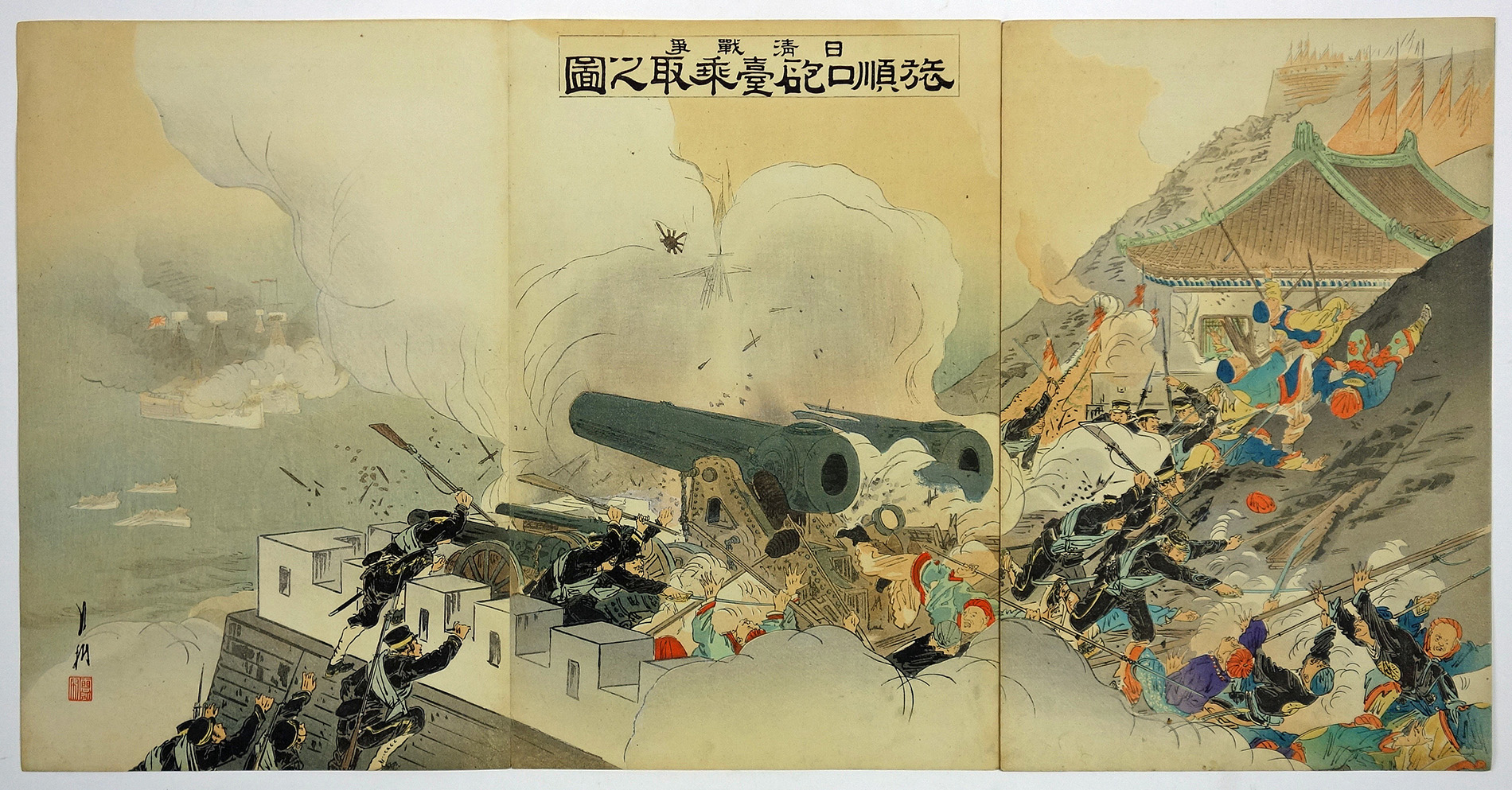
Battle of Lushunkou
The defenders of Lushunkou had every advantage a garrison could hope for: sixteen years of fortification, hills bristling with heavy artillery, minefields guarding the approaches, and the only dry docks in China capable of repairing modern warships. On 21 November 1894, the Japanese Second Army overran all of it in less than a day. What followed was not a celebration of victory but a massacre of civilians that would haunt Japan's international reputation for decades.
The Impregnable Fortress
By the 1890s, Lushunkou -- known to the West as Port Arthur -- was the jewel of China's Beiyang Fleet. The Qing government had spent sixteen years transforming this harbor at the tip of the Liaodong Peninsula into a naval stronghold considered superior to Hong Kong in its facilities. Guarding the entrance to the Gulf of Bohai, the base controlled the sea approaches to Beijing itself. Its fortifications included dozens of heavy guns ranging from 120mm to 240mm, positioned across a network of forts and batteries that exploited the hilly terrain. The base housed China's only modern dry docks, making it irreplaceable for fleet maintenance. Without Lushunkou, the Beiyang Fleet would lose its ability to repair any warship damaged in combat. The fortress appeared, to observers both Chinese and foreign, utterly impregnable.
Collapse Before Contact
The Japanese campaign began with a landing at Pikou on 24 October 1894. General Nogi Maresuke took the walled town of Jinzhou on 6 November with almost no resistance, sealing off the peninsula at its narrowest point -- barely two and a half miles wide. The next day, Nogi marched into the port town of Dalian to find it abandoned. The fleeing defenders had left behind something astonishing: the complete plans for Lushunkou's minefields and defensive works. Meanwhile, Viceroy Li Hongzhang had ordered the Beiyang Fleet to withdraw to Weihaiwei rather than risk battle, stranding the garrison without naval support. The fleet's flagship struck rocks during the retreat and had to be beached -- at a port whose only capable repair docks were the ones the fleet had just abandoned. Skirmishing on the outskirts began on 20 November, and panic spread through the garrison. Most Qing officers fled on two small boats still in the harbor, leaving their soldiers leaderless.
One Day, Two Legacies
The final assault began after midnight on 21 November. Japanese troops stormed the landward defenses under heavy fire and had captured every major position by noon. Shore fortifications held a few hours longer before falling by late afternoon. That night, the surviving Chinese defenders deserted, leaving behind 57 large-caliber and 163 small-caliber artillery pieces. The dockyards, coal supplies, and fortifications fell to Japan largely intact. Chinese casualties were estimated at 4,000 killed; Japan lost 29 men with 233 wounded. Western observers regarded the speed of the victory as a turning point in the war and a devastating blow to Qing prestige. The Chinese government responded by denying the base had fallen at all and stripping Li Hongzhang of his official titles.
The Shadow of Massacre
When Japanese troops entered Port Arthur on the afternoon of 21 November, they discovered the mutilated remains of fallen comrades. What followed has become known as the Port Arthur massacre. Soldiers turned on the remaining inhabitants of the city in a rampage that lasted days. News of the killings spread through the Western press, severely damaging Japan's carefully cultivated image as a modernizing, civilized power. The reports nearly torpedoed Japan's ongoing negotiations to revise the unequal treaties with the United States. Some Western correspondents initially denied the events out of fear of Japanese reprisal, but the evidence proved overwhelming. The massacre remains one of the most contested and painful episodes of the First Sino-Japanese War, a reminder that the people who suffered most in this contest of empires were neither generals nor diplomats but the civilians caught between them.
From the Air
Located at 38.84N, 121.28E on the southern tip of the Liaodong Peninsula in northeastern China. The natural harbor of Lushunkou is visible from altitude, nestled among hills. Nearest major airport is Dalian Zhoushuizi International (ZYTL), approximately 35 km northeast. Best viewed at 3,000-5,000 ft altitude for the peninsula geography. The Yellow Sea lies to the southeast and the Bohai Sea to the west.