Battle of Maastricht: The Bridges That Blew Too Late
Forty-seven names. That is the human ledger for the Dutch side of the Battle of Maastricht: two officers, seven NCOs, thirty-eight corporals and ordinary soldiers, almost all of them killed within a few hours on the morning of 10 May 1940. They were a thin force - light infantry, two anti-tank rifles between them at the most contested bridge, a few machine guns at the sluice complex at Borgharen. They were trying to do what their orders said to do: hold the eastern entrances to the city long enough for the bridges across the Maas to be blown. Some of those bridges came down. Some came down a few minutes too late. One came down with German soldiers already on it.
Why Maastricht
Maastricht stands on the Maas - the same river the Belgians call the Meuse - at a narrow lobe of Dutch territory called the Maastricht Appendix, wedged between Germany and Belgium. To reach Fort Eben-Emael and the Albert Canal bridges to the south, the German Army had to cross this strip of Dutch land first. The whole German plan in the north - Erich von Manstein's feint to lure the best French and British divisions deep into Belgium while the main thrust came through the Ardennes - depended on Army Group B moving fast through the Low Countries. Fast meant intact bridges. Maastricht's bridges were the first ones the Wehrmacht needed to seize before turning south to Eben-Emael.
Saboteurs in Civilian Clothes
The Germans tried to take the bridges by trickery first. Teams disguised as civilians slipped into Maastricht ahead of the assault, tasked with cutting the demolition wires before the bridges could be blown. They were spotted. They were arrested. When they tried to run, they were shot. That single paragraph in the historical record covers an early-morning encounter with no survivors to add detail - young men in plain clothes, Dutch soldiers and police suddenly confronting an attempt at the bridges hours before anybody understood that war had arrived. The conventional assault then began with motorcycle reconnaissance patrols approaching the eastern guard posts at first light.
The Sluice at Borgharen
Just north of the city, at the Borgharen sluice complex, six German motorised infantrymen on a reconnaissance patrol approached the eastern guard post in the early hours. The Dutch lieutenant ordered them to stop. Four surrendered. Two ran. The lieutenant told his men to stay ready. Within minutes more Germans came on motorcycles. The Dutch held fire until the riders were fifty metres out, then opened up with two machine guns and every rifle in the squad. The Germans pulled back, brought up reinforcements, and overran the position. At the sluice itself the Dutch held longer, but the squad covering the northern road into the city collapsed when its machine gun jammed. The gap let the rest of the German column through, and the outer defences of Maastricht were turned within an hour.
The Bridges Go Down
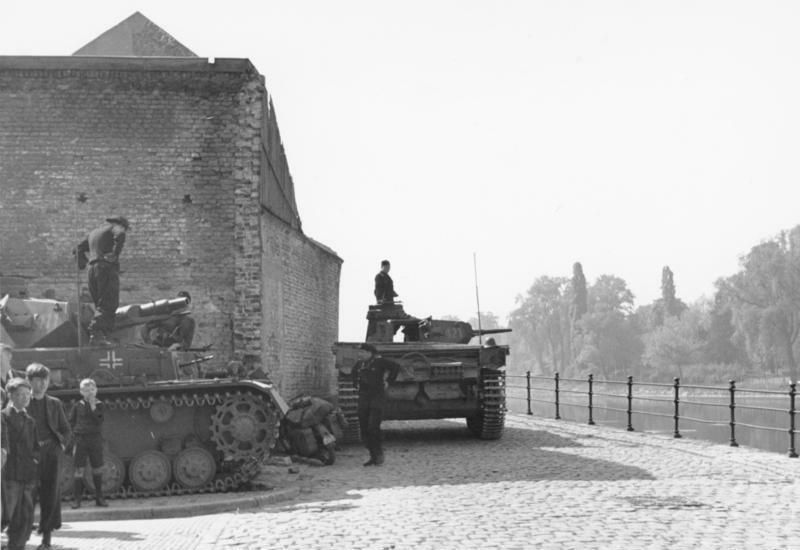
South of the city, the 4th Panzer Division ran into resistance around Gulpen that delayed it for hours. A faster column came at the city from the south through Heugem; the Dutch unit there pulled back over the Maas as instructed when the outer ring failed. A rearguard destroyed two armoured cars and bought a little more time. By mid-morning all the road bridges across the Maas in Maastricht had been blown. Only the railway bridge still stood. It was defended by thirty-five Dutch soldiers. As the Germans began to cross it, the charges fired and the span fell into the river. The Saint Servaasbrug and the Wilhelminabrug were already down. After that, the rest of the morning was Dutch units in pockets across the city firing whatever they had at any German attempt to cross.
Snipers in the Towers
At the destroyed road bridges, the Dutch had snipers in the bridge towers and small parties at strategic points along the west bank. When the Germans placed an anti-tank gun in front of the destroyed bridge to engage the adjacent Sint Servaasbrug, the snipers killed the crew. A second crew replaced them and was shot down too. A handful of rubber boats trying to cross the Maas were torn up in the water. At the broken railway bridge, the heaviest fighting went on for hours. Two armoured cars and a light tank were knocked out by the Dutch anti-tank rifles before three more armoured cars arrived. One of the two anti-tank rifles was destroyed. Many defenders were killed or wounded. Then headquarters called: the order to resist had been rescinded.
The Decision to Stop
Luitenant-Kolonel Govers, the Territorial Commander of Limburg, called a meeting later that day. A captured German document had laid out the full battle plan, every unit, every route. An entire panzer division was already in southern Limburg. Govers had two companies left, no artillery, no anti-tank guns of consequence. The ancient city around him - its cathedrals, its medieval houses, its civilians - could not absorb a real fight. He decided that further resistance in and around Maastricht, the last standing Dutch positions in Limburg, would end. He walked to the Wilhelminabrug himself under a flag of truce. By that evening Dutch troops in Maastricht had capitulated. Dutch dead: 47. German dead: an estimated 130 to 190; 186 bodies were counted afterwards. Nine German armoured cars and tanks lay wrecked across Limburg, and ten German aircraft - mainly Ju 52s and Ju 87s coming and going from the Eben-Emael operation - had been brought down.
From the Air
Maastricht lies at 50.85N, 5.68E, on the Maas (Meuse) river at the southern tip of the Dutch province of Limburg, where the Netherlands narrows to a sliver between Belgium and Germany. From the air, the river bend through the historic centre is the key landmark; the modern bridges - including the rebuilt Sint Servaasbrug and Wilhelminabrug - cross at the same points where the 1940 defenders blew the spans. Fort Eben-Emael lies 10km south. Nearest airport: Maastricht-Aachen (EHBK) 10km northeast; Liege (EBLG) 30km south; Brussels (EBBR) 95km west.