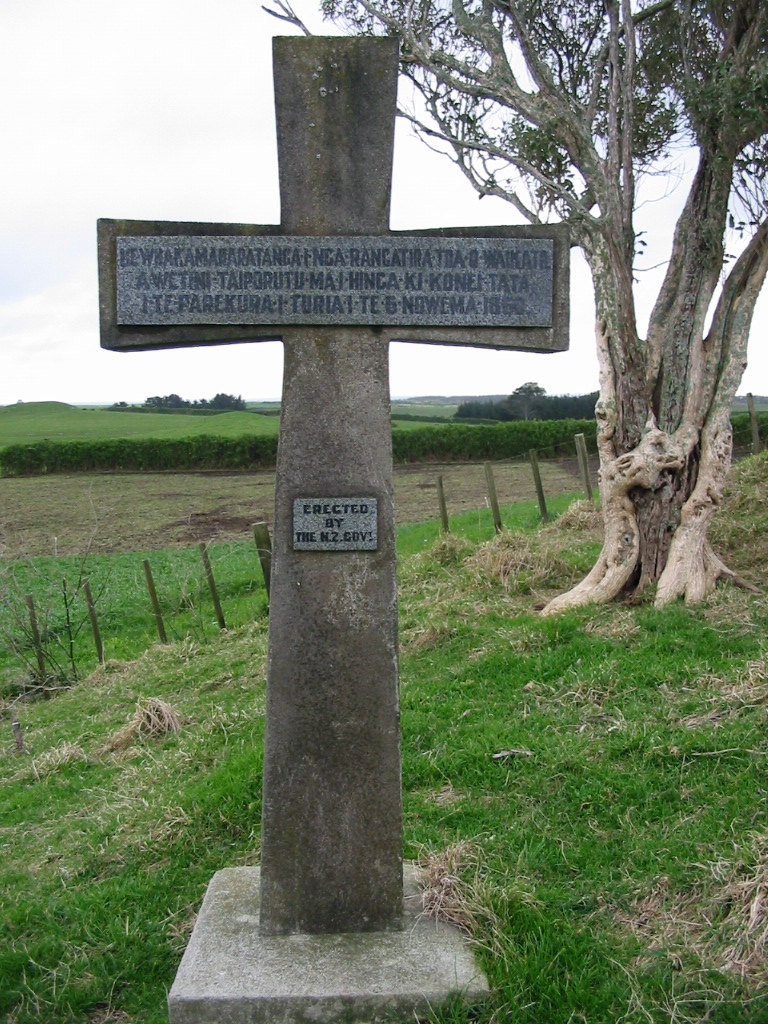
Battle of Mahoetahi
Te Wetini Taiporutu wanted a fight, and he wrote a letter to make sure he got one. In November 1860, the Ngati Haua chief -- a passionate supporter of the Maori King Movement -- led 150 warriors from the Waikato to the Taranaki coast, crossed the Waitara River, and planted himself on a small volcanic mound surrounded by raupo swamp along Devon Road, the lifeline between New Plymouth and Waitara. Then he sent word to the British assistant native secretary, Robert Parris, daring the soldiers to come meet him. It was an act of extraordinary courage. It was also, by any military calculus, suicidal.
A Hill Between Two Settlements
War had broken out in Taranaki eight months earlier, in March 1860, over the question that would define New Zealand's colonial conflicts: land ownership. Mahoetahi sat along Devon Road, the primary communication line between the European settlements at New Plymouth and Waitara. The site was a small volcanic mound, once used as a settlement by Te Ati Awa after their migration to Taranaki in the early nineteenth century, but by 1860 little remained beyond a few eroded terraces and embankments. By coincidence, the British had already planned to build a stockade there on 6 November. When a preliminary repair party from Waitara encountered Te Wetini's force on the 5th, a skirmish broke out. One soldier of the 65th Regiment was mortally wounded. The outnumbered British retreated to Waitara and sent urgent word to New Plymouth.
The Pincer Closes
Major General Thomas Pratt, commander of British troops in Australasia, responded with overwhelming force. He assembled two columns designed to converge on Mahoetahi simultaneously: one from New Plymouth, 684 strong, which he would lead personally, and a second from Waitara under Colonel Thomas Mould with 307 men. The New Plymouth column alone included soldiers from the 12th, 40th, and 65th Regiments, the Taranaki Volunteer Rifles, local militia, mounted volunteers, Royal Artillery with two 24-pounder howitzers, and Royal Engineers. A contingent of about 100 allied Maori accompanied them but did not fight. Against this force of nearly a thousand, Te Wetini had his 150 warriors and the terrain -- a hill, a swamp, and the element of concealment.
Eight-Thirty in the Morning
Both columns left their garrisons timed to converge at 8:30 on the morning of 6 November. Pratt arrived first and found the hill apparently empty -- no new palisades, no earthworks. But the memory of Puketakauere, where Maori fighters had hidden among fern and swamp to devastating effect earlier that year, kept the soldiers cautious. At the last moment, Captain Harry Atkinson requested that the Taranaki Volunteer Rifles lead the assault, and Pratt agreed. The volunteers and the 65th Regiment advanced without artillery preparation. Only when they reached the scrub at the base of the hill did the Maori reveal themselves and open fire. The defenders retreated through the bush and pre-dug crawl tunnels as the howitzers threw shells into the hillside, churning dirt but causing little real damage.
Over the Crest
When the British charged over the hilltop, they found Te Wetini's warriors dug in on the reverse slope. Both sides fired at close range before the fighting collapsed into hand-to-hand combat. The volunteers swung right as they pushed downhill, and Mould's Waitara column arrived from the east. Te Wetini's force was being squeezed from three sides, forced toward the swamp to the south. The encirclement never fully closed -- the men of the 65th crowded the hilltop instead of completing the hook, and the volunteers held their fire, mistakenly believing allied Maori had been positioned on their flank. Even without this confusion, the converging columns created a deadly crossfire risk. Many of Te Wetini's warriors escaped through the swamp. Many did not.
What Remained
Four British soldiers died and seventeen were wounded, most during the bayonet charge -- the 65th Regiment alone lost two killed and eleven wounded. The Maori dead were collected and buried in a mass grave at the battle site. The British took seven prisoners, six of them wounded; four of those prisoners died within days. The sole unwounded captive identified the fallen, including Te Wetini himself and two other chiefs. A granite memorial was later erected in St Mary's Churchyard in 1930, and a cross placed at the battle site in 1941. Colonel Mould remained at Mahoetahi with 300 men to build the stockade that had been planned before Te Wetini's challenge turned a construction project into a battlefield. The hill that had briefly belonged to 150 warriors from the Waikato became another British fortification in a war that would grind on for years.
From the Air
Located at 39.02S, 174.19E along Devon Road between New Plymouth and Waitara on New Zealand's North Island. The battle site sits on flat coastal terrain with a small volcanic mound visible among farmland. Mount Taranaki rises dramatically to the south. Nearest airport is New Plymouth Airport (NZNP), approximately 8 km southwest. The Waitara River is visible to the north. Recommended viewing altitude 2,000-4,000 feet for terrain detail.