Battle of Majorca
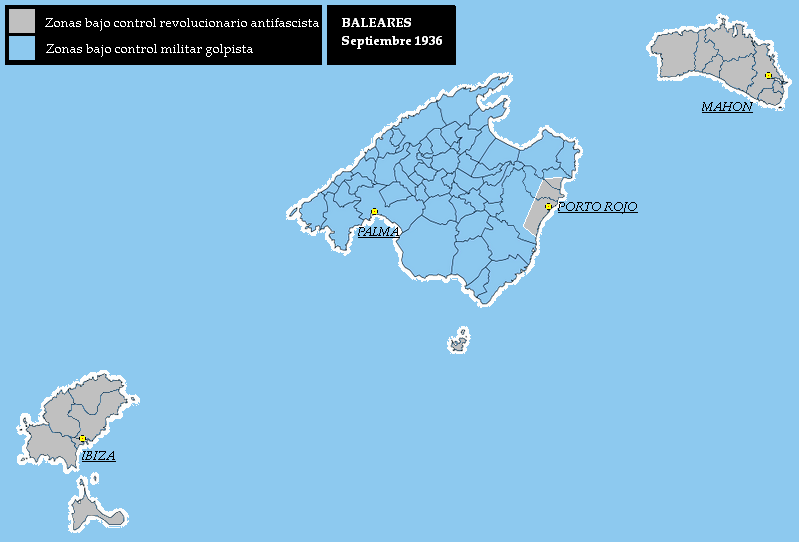
They called it la reconquista de Mallorca -- the reconquest of Majorca -- and the name revealed their confidence. In August 1936, barely a month into the Spanish Civil War, Republican forces launched an amphibious assault on the largest of the Balearic Islands, aiming to drive out the Nationalist garrison and reclaim Majorca for the Republic. Eight thousand militia landed on the eastern coast, pushed twelve kilometers inland, and for a few weeks it seemed possible that the name might prove prophetic. Then Italian aircraft arrived from across the Mediterranean, and everything fell apart. The reconquest became a rout, and the Balearic Islands remained in Nationalist hands for the rest of the war.
An Expedition Nobody Authorized
The plan to retake Majorca was born in the chaotic first weeks of the civil war, when Republican Spain was less a unified state than a patchwork of militias, regional governments, and competing political factions. Ibiza, Formentera, and Majorca had joined Franco's Nationalist rebellion in July 1936, and various militia groups in Barcelona and Valencia independently began planning seaborne counterattacks. The Madrid government never approved the Majorca operation. Captain Alberto Bayo, a Communist sympathizer, assembled his force on Menorca -- which had remained loyal to the Republic -- with logistical support from the Government of Catalonia and the Central Committee of Antifascist Militias. But the anarchist militias, distrustful of Bayo's politics, refused to coordinate with him. From the beginning, the expedition carried an air of improvisation and mutual suspicion.
Beachheads at Porto Cristo
On August 16, 1936, Bayo landed his force of 8,000 militia at Punta Amer and Porto Cristo on Majorca's eastern coast, supported by units of the Spanish Republican Navy. The defenders were outnumbered: 1,200 regular infantry, 300 Guardia Civil, and a contingent of Falangist volunteers. Despite difficulties unloading and deploying their artillery -- six 75mm and four 105mm guns -- the Republicans pushed inland, gaining twelve kilometers of territory against the smaller garrison. Separately, 400 Catalan militia had occupied the small island of Cabrera on August 13 in an operation apparently unrelated to Bayo's expedition. A Republican force from Menorca had already landed on Cabrera on August 1 and held it against all efforts to dislodge them. The pieces were there for a coordinated campaign across the Balearics, but coordination was precisely what the Republican side lacked.
Italy Tips the Balance
The turning point came on August 27, when supplies and air support arrived from Italy. Mussolini's intervention transformed the military equation overnight. Italian aircraft replaced the Republican bombers that had been operating overhead, seizing control of the skies and exposing the Republican ground forces to attacks they could neither counter nor endure. Without air cover, the militia's advance stalled. The Nationalist counterattack on the ground drove the Republicans back toward the beaches in confusion, and they abandoned their artillery and equipment as they retreated. The evacuation began on September 5, and the last Republican ship steamed away on September 12, leaving Majorca firmly in Nationalist hands.
The Balearics Lost
The Nationalist response to the Republican withdrawal was swift and methodical. Within a week of the retreat from Majorca, Cabrera had fallen back to the Nationalists. Ibiza was captured on September 19 by troops from the Majorca garrison, and Formentera surrendered the following day. Only Menorca remained under Republican control -- it would hold out until February 1939, one of the last Republican territories to fall in the entire war. The failure at Majorca had consequences beyond the Balearics. It demonstrated the fragility of Republican military coordination, the danger of launching operations without central government approval, and the decisive advantage that foreign air power gave the Nationalist side. Captain Bayo survived the debacle and later played a role in training Fidel Castro's guerrillas in Mexico, applying lessons from a defeat on a Mediterranean island to a revolution in the Caribbean.
From the Air
Located at approximately 39.62N, 2.98E off the eastern coast of Majorca near Porto Cristo. The landing beaches at Punta Amer and Porto Cristo are visible along the island's east coast. Nearest major airport is Palma de Mallorca (LEPA). The battle area is along the coastal plain east of the Serra de Llevant mountain range. From altitude, the channel between Majorca and Menorca -- across which Republican forces staged -- is clearly visible. Best viewed at 5,000-8,000 feet to see the relationship between the landing beaches, the inland advance, and the sea routes to Menorca and the mainland.