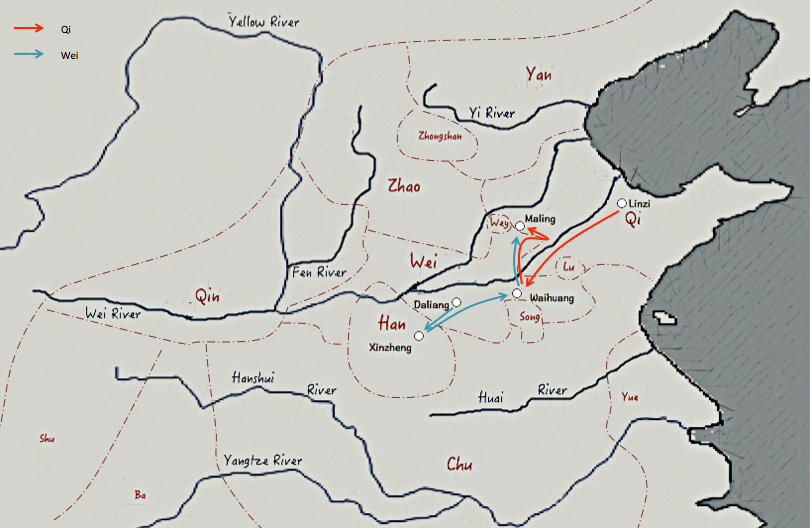
Battle of Maling
Sun Bin ordered his men to strip the bark from a tree in a narrow, heavily wooded pass and carve a message into the pale wood: "Pang Juan shall die in Malingdao, under this tree." It was a prophecy addressed to the man who had once been his classmate, the same man who had crippled him by removing his kneecaps to prevent him from ever commanding troops in person. When Pang Juan arrived at Maling that night in 342 BC, leading a small cavalry force in pursuit of what he believed was a collapsing army, 10,000 Qi crossbowmen were waiting in the darkness. The Battle of Maling destroyed the military power of the State of Wei and became one of the most studied ambushes in Chinese military history.
The Strategist's Patience
The conflict began when Wei attacked the State of Han in 342 BC. Han turned to its ally Qi for help, but Sun Bin, Qi's military strategist, advised King Wei of Qi to wait. Let Han fight without reserve, he counseled, believing it could rely on Qi reinforcements. Let Wei's army exhaust itself in prolonged combat. Only when both sides were depleted should Qi intervene, preserving its own strength while earning Han's gratitude. After a year of fighting, Han could no longer resist and begged for help a second time. Sun Bin's response was characteristically indirect: rather than marching to Han's relief, he proposed striking at Daliang, the capital of Wei, forcing Wei to withdraw its army from Han to defend its own heartland.
The Tactic of Missing Stoves
When King Hui of Wei learned of the threat to his capital, he ordered General Pang Juan to break off his campaign against Han and march against Qi with 100,000 troops. Pang Juan, who had learned from a previous ambush at the Battle of Guiling, ordered his forces to bypass the main roads and move at speed. Sun Bin did not try to intercept this high-morale army. Instead, he let the bulk of his forces rest and took a smaller unit forward to face Pang Juan, then immediately retreated into Qi territory. Each day, Sun Bin ordered his soldiers to light fewer cookfires. On the first day, enough stoves for 100,000 men. On the second, 50,000. On the third, 20,000. Pang Juan, counting the fires, concluded that Qi's soldiers were deserting in droves. He abandoned his main force and pursued with a small elite cavalry, exactly as Sun Bin had calculated.
Darkness at Malingdao
As the Qi forces fell back, Sun Bin ordered his troops to abandon heavy equipment along the route, reinforcing the impression of an army in disarray. When they reached Maling, Sun Bin recognized the terrain he needed: a narrow, wooded pass where cavalry would be trapped and crossbows would have the advantage. He estimated that Pang Juan's pursuing force would arrive at nightfall and positioned 10,000 crossbowmen in the surrounding woods. The carved tree waited at the pass. When Pang Juan's cavalry entered Malingdao and someone spotted the carved message, it was already too late. The Qi crossbowmen opened fire in the darkness, cutting down Wei soldiers before they could see their attackers. The rest of Sun Bin's army then charged in. According to some sources, Pang Juan committed suicide when he realized the trap was complete. Others say he was among the first struck down by the crossbow bolts.
A Teacher's Prophecy Fulfilled
The carved words on the tree were not merely a taunt. They referenced a prophecy spoken by the teacher who had trained both Sun Bin and Pang Juan. The two men had studied military strategy together, and Pang Juan, jealous of his classmate's superior talent, had later betrayed Sun Bin and arranged to have his kneecaps removed, ensuring he could never walk again, let alone lead troops in battle. Sun Bin escaped to Qi, where he served as strategist from a chariot rather than on horseback. After the battle, sources record that Sun Bin felt deep sorrow at his former classmate's death, despite everything Pang Juan had done to him. Prince Shen of Wei was captured, and the state of Wei, which had been among the most powerful in China, declined into irrelevance, never again able to compete for dominance among the warring states.
From the Air
Located at 35.886N, 115.398E near Dazhangjia Town in Shen County, on the border of Shandong and Henan provinces. The terrain is flat agricultural plain in the North China Plain. The ancient pass at Maling no longer exists as a distinct geographic feature. Nearest airports include Heze Mudan Airport to the south and Jining Da'an Airport (ZSJG) to the east. The Yellow River is visible to the north.