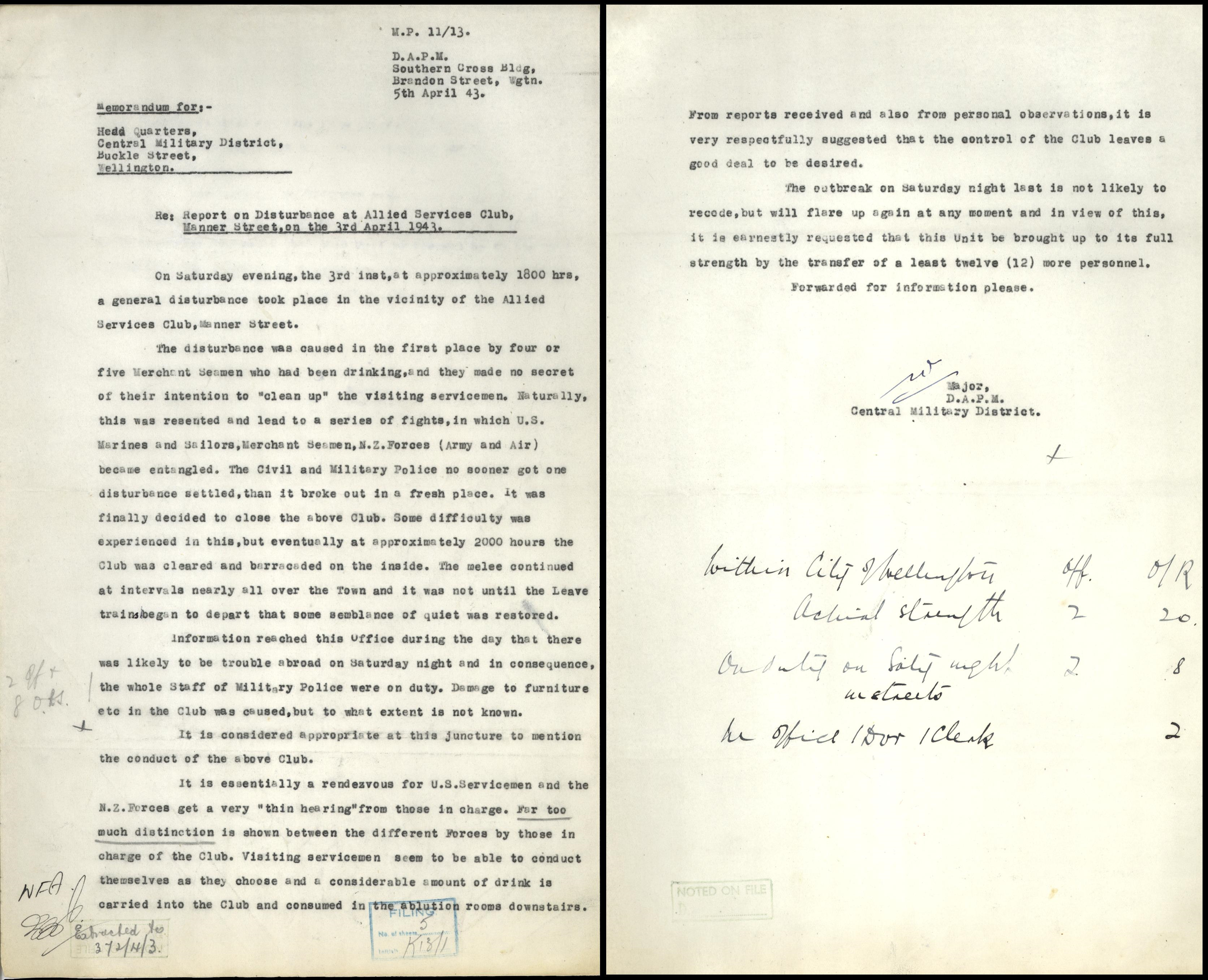
Battle of Manners Street
The bars closed at six. In wartime Wellington, this was known as the "six o'clock swill" -- hotel patrons had until 6 pm to drink, and then they were ejected into the streets. On the evening of 3 April 1943, the crowds that spilled out of the pubs collided with a confrontation already brewing outside the Allied Services Club on Manners Street, and what followed was the most notorious civil disturbance in New Zealand's wartime history. The "Battle of Manners Street" was not really a battle. It was a brawl that exposed the fault lines between two allied nations, and at its centre was a question of who was allowed to walk through the front door.
Forty-Five Thousand Guests
Between 1942 and 1944, as many as 45,000 American servicemen were stationed in New Zealand, mostly in camps near Auckland and Wellington. They were better paid than their New Zealand counterparts, more polished in their manners, and -- as local women quickly noticed -- considerably more attentive. Romantic liaisons between American troops and New Zealand women sparked resentment among Kiwi soldiers, who coined the phrase "American invasion" with only partial irony. But money and charm were not the deepest source of friction. Many white American soldiers, particularly those from the southern states, brought with them racial attitudes that clashed violently with New Zealand's social norms. The New Zealand government published a guidebook for the incoming troops, reminding them that "the Maori today occupy a position in society socially and politically equal to that of any pakeha or white New Zealander." The reminder was necessary because it was not being observed.
The Door That Closed
The Allied Services Club occupied the former Waldorf Restaurant on Manners Street, converted in July 1942 into a social centre where soldiers could eat, dance, and unwind. It was staffed by volunteers, open to all military personnel regardless of nationality. According to one account of the evening of 3 April, some American servicemen inside the club began preventing Maori soldiers from entering. New Zealand troops -- Pakeha and Maori together -- objected. The confrontation escalated when the Americans removed their belts and used them as weapons against those trying to reopen the door. Fighting spilled out onto Manners Street, spread to the ANA Club on Willis Street, then to Cuba Street. Civilian and military police struggled to contain the brawl, which raged for hours and only subsided when US soldiers boarded trains back to their camps.
The Official Silence
The Commissioner of Police told the Evening Post that there had been "certainly a bit of a skirmish" involving a "small crowd," and that nobody had been injured, hospitalised, or killed. One civilian was arrested. One New Zealand serviceman was dealt with by military authorities. No American was charged. An army major's internal memo offered a different framing entirely: a few drunken merchant seamen had decided to "clean up" the Americans, leading to damage at the club before it was barricaded shut around 8 pm. Neither version captured the full picture, but both served the same purpose -- minimising an incident that, if reported honestly, would have embarrassed two allied governments during a world war.
The Pattern That Persisted
Manners Street was not an isolated event. On 27 April 1943, a fight erupted at the Basin Reserve between New Zealand and American troops. In October 1943, American servicemen and Maori civilians clashed in Otaki. On 12 May 1945, over 150 Maori and American servicemen fought in Cuba Street in a confrontation that was explicitly racial. Military reports recorded Maori testimony that Americans had told them not to ride in tramcars, to walk via back streets, and had called them "black curs." The Maori soldiers, many of whom had volunteered to fight for the same cause the Americans had, found themselves treated as inferiors by their own allies. These later incidents never gained the notoriety of the Battle of Manners Street, but they revealed the same fracture: an imported racism colliding with a society that, for all its own imperfections, had made a different choice about who belonged.
From the Air
Located at 41.290S, 174.776E in Te Aro, central Wellington. Manners Street runs through the heart of the city's commercial district, intersecting with Willis Street and near Cuba Street -- all sites involved in the 1943 disturbances. From the air, the Te Aro area is identifiable by its dense urban grid south of Lambton Harbour. The Basin Reserve cricket ground, site of another wartime altercation, is visible to the southeast. Nearest airport is Wellington International (NZWN), approximately 5 km to the southeast. Best viewed at 2,000-4,000 ft altitude.