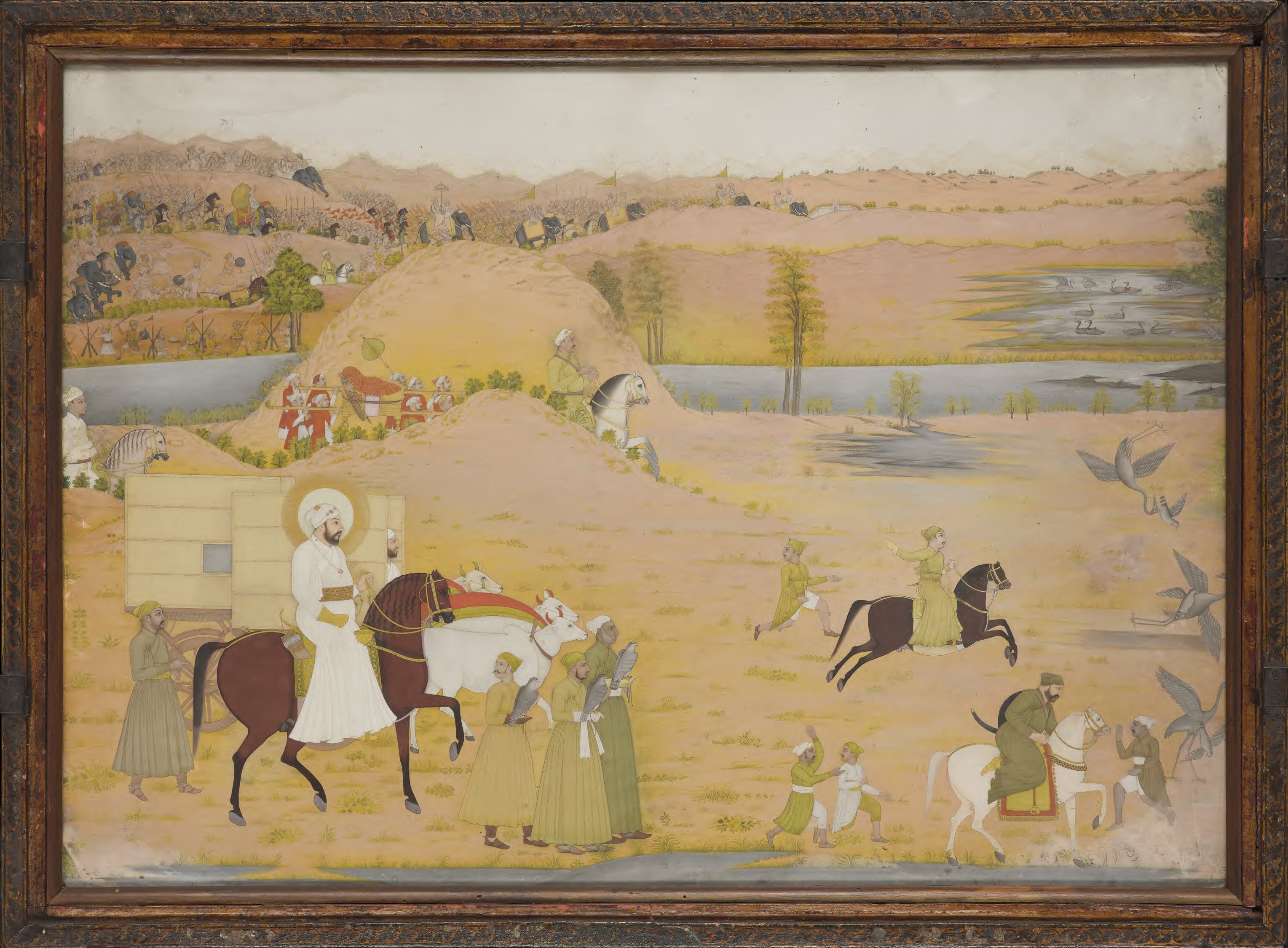
Battle of Manupur
On the morning of March 11, 1748, Mughal Vizier Qamar ud-Din knelt in prayer inside his command tent. A cannonball struck him in the waist. Afghan spies had measured the distance from a hilltop artillery piece to the vizier's position with lethal precision. His son, Moin ul-Mulk, concealed the death from the army and took command on the spot. What followed was one of the most chaotic and consequential battles in the twilight of Mughal India -- a day when an Afghan force of 12,000 nearly shattered an army five times its size, only to be undone by an accident no commander could have foreseen.
The Road Through Lahore
Ahmad Shah Durrani had founded his empire just a year earlier, in 1747, and he was already reaching for India. His commander-in-chief, Jahan Khan, swept through Jalalabad and Peshawar so quickly that the Mughal governor fled without a fight. Pashtun tribes -- the Yusufzai, Afridi, and Khattak -- rallied to the Afghan banner. The Punjab's governor, Shah Nawaz Khan, wavered between Afghan and Mughal allegiance, accepting offers from both sides before finally opposing Durrani. It did not matter. When the armies met outside Lahore on January 11, Afghan regiments within Shah Nawaz's own force defected. The Mughals collapsed, and the Afghans entered Lahore, plundering the city and conscripting thousands. By February, Ahmad Shah was marching toward Delhi with momentum and confidence, seizing the fortress city of Sirhind along the way. The Mughal court, desperate, assembled an army of over 200,000 -- including camp followers -- to block his path at a place called Manupur.
Twelve Thousand Against Sixty Thousand
The numbers were staggering. Ahmad Shah had roughly 12,000 fighting men. The Mughals fielded between 60,000 and 70,000 combatants, with heavy artillery concentrated in their center. Recognizing he could not win a war of attrition, Ahmad Shah designed his battle around speed and disruption. He would hammer the Mughal vanguard, shatter one of the overextended flanks, and send a raiding force to plunder the baggage train in the rear. The Mughal left flank, held by Rajput cavalry under Ishwari Singh, became the target. Afghan zamburak gunners -- swivel cannons mounted on camels -- organized into two rotating divisions. One would charge, deliver a barrage at close range, and withdraw while the second advanced to repeat the assault. The Rajputs, formidable in hand-to-hand fighting, had no answer to this mobile artillery. Thousands died. When Ishwari Singh learned the vizier was dead and saw his men being pulverized, he fled the field entirely.
The Rockets That Changed Everything
With the Rajput flank gone, the Afghans plundered the Mughal baggage train and flanked Moin ul-Mulk's position. Defeat seemed certain for the Mughals. Then Safdar Jang, commanding the Mughal right, made his move. When Ahmad Shah sent 700 camel-mounted swivel guns to a hilltop above Safdar Jang's position, the Nawab of Awadh dispatched 1,700 musketeers straight uphill. Their concentrated volley fire killed the Afghan gunners and captured the weapons. Safdar Jang then wheeled his entire force to relieve the crumbling Mughal center, bringing 700 swivel and heavy guns with him. The sheer weight of Mughal numbers began to tell. And then came the accident. Rockets that the Afghans had looted during the sack of Lahore ignited -- perhaps through carelessness, perhaps through the chaos of battle. Thousands of rockets screamed into the air, touching off the gunpowder stores of the Afghan artillery. A thousand Afghan and Persian soldiers burned to death in moments. Disorder consumed the Afghan ranks.
A Retreat Worth Studying
Ahmad Shah Durrani had lost the battle, but he refused to lose his army. Rather than flee, he withdrew in disciplined order, arraying his men for battle and trading volleys of musket fire with the pursuing Mughals. He occupied a mud fortress between Manupur and Sirhind, using it to halt the Mughal advance until nightfall. Then he slipped away in darkness. To buy more time, he sent Taqi Khan to negotiate a sham peace, demanding all the territories Nader Shah had once seized -- an outrageous proposal designed purely to stall. It worked. The Mughals, uncertain whether Ahmad Shah was dead or alive, chose caution. And then fortune intervened again: Mughal Emperor Muhammad Shah fell ill and died, forcing the imperial army to halt. Safdar Jang also fell sick. By April 9, all Mughal operations ceased, and Ahmad Shah completed his withdrawal to Lahore.
Nine Invasions and a New Order
The Mughal victory at Manupur proved hollow. Ahmad Shah returned to Afghanistan, crushed a revolt by his nephew in Kandahar, and launched his second invasion of India that November. Moin ul-Mulk was forced to cede all territories north of the Indus and pay nearly one and a half million rupees yearly. A third invasion brought Lahore, Multan, and Kashmir under Afghan control. Over his reign, Ahmad Shah led nine invasions of India, sacking Delhi itself in 1757 and extinguishing what remained of Mughal authority. Meanwhile, a new power was rising in the Punjab. Shortly after Manupur, the Sikhs organized the Dal Khalsa and began challenging both Afghan and Mughal control of the region. Ahmad Shah destroyed their holy sites and persecuted their communities, but by the end of his campaigns, the Sikhs had established themselves firmly across much of the Punjab -- the enduring consequence of a battle that neither empire truly won.
From the Air
Located at 30.635°N, 76.435°E on the plains of Punjab near Sirhind, India. The terrain is flat agricultural land stretching between modern-day Patiala and Fatehgarh Sahib. Best viewed at 5,000-8,000 ft AGL. Nearest major airport is Chandigarh International (VICG), approximately 50 nm northeast. The historic Sirhind fortress ruins may be visible to the northwest.