Battle of Marston Moor
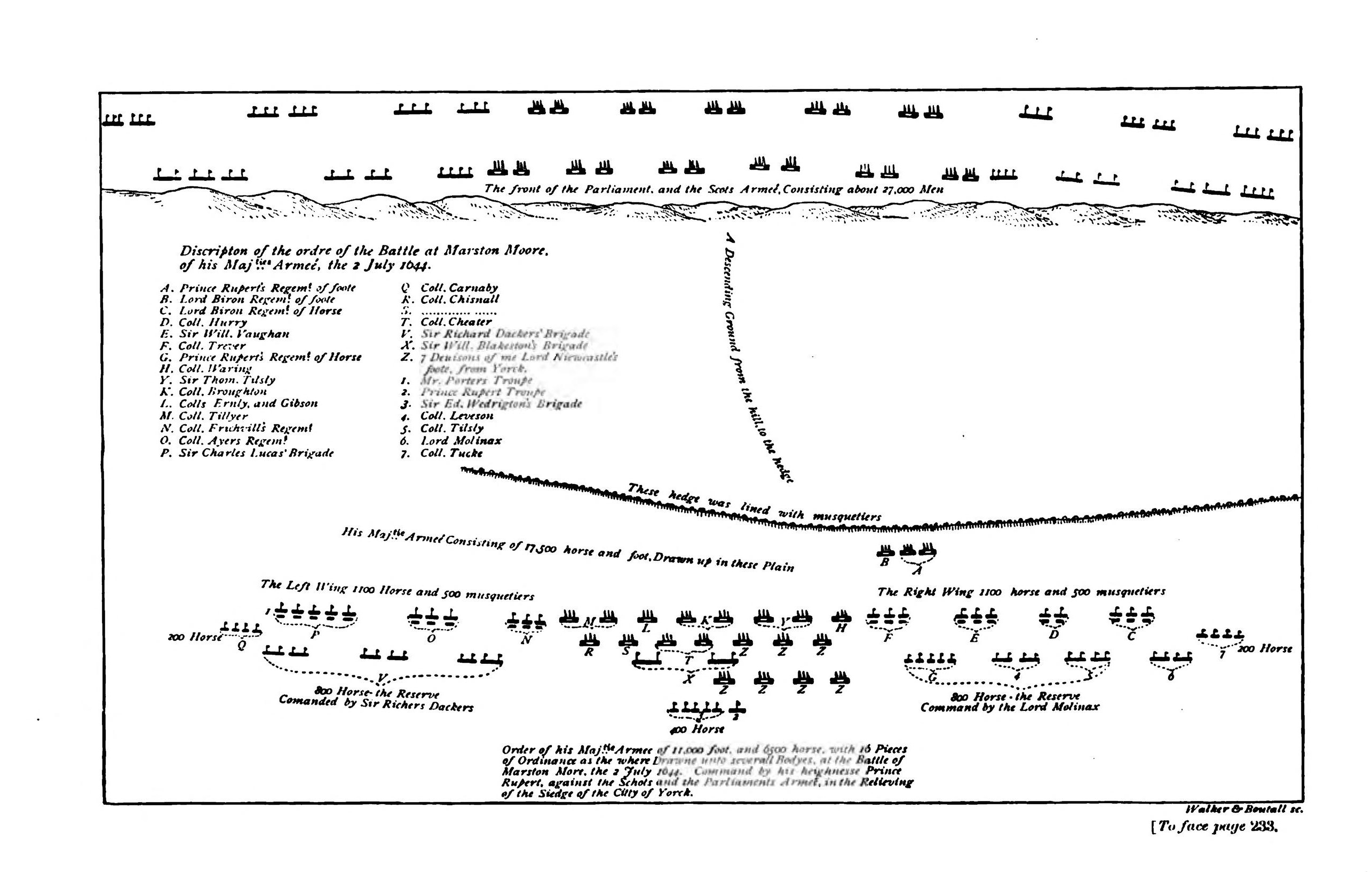
Prince Rupert thought the fighting was done for the day. By 5:00 p.m. on 2 July 1644, both armies had been facing each other across a drainage ditch on Marston Moor for hours, exchanging cannon fire but nothing more. The Royalist contingent from York had only just arrived. Their commander, Lord Eythin, criticized Rupert's dispositions but then declared it too late to do anything about them. The Royalists began to settle in for the night. Then, around 7:30 in the evening, 27,000 Parliamentarian and Scottish Covenanter troops attacked.
The Largest Battle
Marston Moor was the biggest engagement of the English Civil War, with roughly 46,000 soldiers crammed onto farmland between the villages of Long Marston and Tockwith in the flat Vale of York. The Parliamentarians and their Scottish Covenanter allies held Marston Hill, a low terminal moraine that gave them the higher ground, while the Royalists occupied the moor below, behind a drainage ditch that Prince Rupert had noted as an effective obstacle to cavalry. The allied army was a coalition of three forces: the Earl of Manchester's Eastern Association, Lord Fairfax's Yorkshire troops, and the Earl of Leven's Scottish Covenanters. Their combined infantry numbered over 14,000, supported by 30 to 40 pieces of artillery. On the left wing, Oliver Cromwell commanded more than 3,000 cavalry, including his formidable Ironsides, with Sir David Leslie's Scottish horse in reserve behind him.
Cromwell's Hour
When the surprise attack came in the summer evening, Cromwell's wing quickly defeated Lord Byron's Royalist cavalry on the right. Byron had been ordered to hold his ground behind the ditch, but instead launched a counter-charge that disordered his own troops and prevented his musketeers from firing for fear of hitting their own men. Cromwell was slightly wounded in the neck by a pistol ball and briefly left the field, but Leslie's Covenanter regiments swung the battle decisively. Rupert himself was nearly captured, reportedly hiding in a bean field to avoid being taken. On the opposite flank, Sir Thomas Fairfax's cavalry fared badly, bogged down in a lane only four abreast wide where Royalist musketeers cut them to pieces. When the lane's embankment was removed in the 1960s, several hundred musket balls were found in the earth.
The Last Stand of the Whitecoats
As darkness gathered under a rising full moon, the Royalist center held on longer than anyone expected. Lord Goring's victorious cavalry on the Royalist left had scattered in pursuit or stopped to loot the allied baggage train, leaving the infantry exposed. Six Covenanter regiments and all of Fairfax's foot broke and fled. But the Scottish infantry eventually reformed, and Cromwell's disciplined horsemen rallied behind the Royalist lines. Sir Thomas Fairfax, stranded among enemy troops, removed his identifying white handkerchief and made his way through to Cromwell's wing. Together, they turned on Goring's remaining men. The final act belonged to Newcastle's infantry, the "whitecoats," who gathered in a ditched enclosure for a desperate last stand. They refused quarter and fought until they were virtually annihilated. Approximately 4,000 Royalist soldiers died that night, many of them in that enclosure.
The North Is Lost
The aftermath was swift and decisive. The Marquess of Newcastle, ruined financially and militarily, resolved that he would not endure "the laughter of the court." He departed for exile in Hamburg the next day. Rupert, beaten decisively for the first time, kept the King's ambiguous dispatch close to him for the rest of his life. York surrendered on 16 July. With the city gone, the Royalists effectively abandoned northern England. Cromwell declared Marston Moor "an absolute victory obtained by God's blessing." His reputation as a military leader was cemented, and from this moment he exerted increasing influence in both Parliament and the field. The allied casualties were comparatively light: about 300 dead. The disparity tells the story of a battle that ended not in mutual exhaustion but in annihilation.
From the Air
Located at 53.96N, 1.25W between the villages of Long Marston and Tockwith in the Vale of York. The battlefield is flat agricultural land, difficult to distinguish from the air without local knowledge, though the low ridge of Marston Hill is visible. York lies approximately 7 miles east. Nearest airports: EGNM (Leeds Bradford) approximately 15 miles southwest; EGCN (Doncaster Sheffield) approximately 35 miles south. The flat Vale of York terrain provides excellent visibility.