Battle of Matasiete
By four in the afternoon on July 31, 1817, 559 Spanish soldiers lay dead or wounded on the slopes of Matasiete hill. The assault had begun at half past eight that morning, when General Pablo Morillo -- Spain's most feared commander in the Americas -- launched 2,000 infantry and 600 cavalry against the Republican positions above the town of La Asunción on Isla Margarita. What he did not expect was the kind of resistance he encountered. The Republicans fought from fortified positions on rugged terrain, rolling boulders down the slopes into the Spanish lines. When soldiers fell, unarmed men and women from the town picked up their weapons and joined the fight. General Francisco Esteban Gómez, the Republican commander, was shot multiple times and had his horse killed beneath him. He kept fighting. By sunset, Morillo was retreating.
Bolívar's Island Gambit
The battle's origins trace to May 1816, when Simón Bolívar arrived on Margarita Island and declared the Third Republic of Venezuela. An Assembly of Notables recognized him as Supreme Chief in the church of Santa Ana, giving the revolution an institutional foundation it had previously lacked. Bolívar then departed for the mainland, leaving the island as a critical Republican base. The strategy worked -- through 1816, the revolutionaries were generally successful. But the Spanish were not finished. General Pablo Morillo returned to Venezuela in December 1816 with a clear plan: retake Margarita first, then move on to Guayana Province. After months of gathering supplies and troops, he sailed for the island in late June 1817, beginning a hard-fought campaign to reclaim it.
The Hill Above the City
Morillo's forces advanced methodically. By July 24, they had occupied the San Carlos de Borromeo Fortress at Pampatar on the island's southeast tip, just a few miles from La Asunción. The Republicans had evacuated the castle and consolidated their forces at the city, where the terrain favored defense. Matasiete hill overlooked La Asunción from the east, and the Spanish occupied it with their full force. Below them, the Republicans had fortified the rugged approach with redoubts, moats, and parapets. The terrain was steep and broken -- the kind of ground that neutralizes cavalry and turns an infantry advance into a grinding, exposed climb. When Morillo gave the order to assault on July 31, his soldiers charged into a landscape designed to kill them.
When the Town Joined the Fight
The battle's most remarkable detail is what happened after the first hours of combat. As Republican soldiers fell, civilians from La Asunción -- men and women both, many of them unarmed -- came forward to take up the weapons of the dead and wounded. Morillo himself, in his post-battle report, acknowledged the "stubborn courage" of the defenders, a rare tribute from a commander not known for generosity toward his enemies. The Republican artillery batteries Carante and Libertad fired without pause, with Felipe Villalba commanding the Libertad battery. Meanwhile, defenders above the Spanish line rolled massive boulders down the hillside, crushing soldiers who had no cover on the exposed slope. Gómez, despite his wounds, remained in command throughout. The battle lasted nearly eight hours before the Spanish finally broke off, their 559 casualties representing a devastating loss from a force of 2,600.
Victory That Changed the War
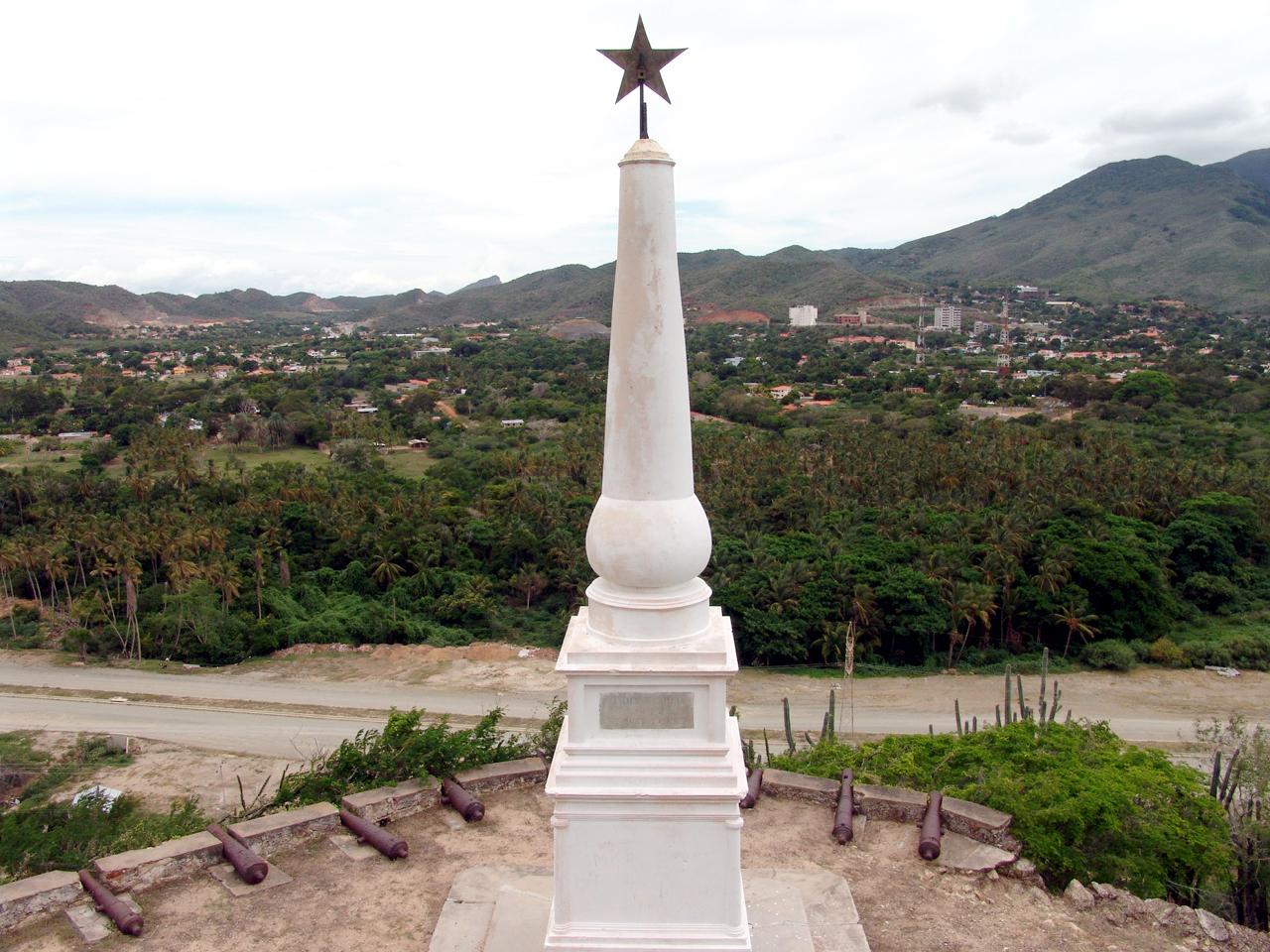
Morillo retired to Pampatar on August 1, pursued by Gómez with a harassing force of 200 infantry and 300 cavalry. The battle had saved La Asunción, though the Republicans continued to lose ground elsewhere on the island -- by mid-August they held only the city and the fortaleza del norte. What changed the strategic picture was news from the mainland. Revolutionaries had captured Ciudad Guayana on July 18 and occupied Baja Guayana on August 3, threatening Caracas itself. Morillo abandoned Margarita without completing his conquest, sailing to confront the mainland threat he could no longer ignore. He never recovered Guayana. La Asunción became the provisional capital of the independent Republic of Venezuela. Today, a column stands on the battle site, and in 1974 Matasiete hill was decreed a Natural Monument. The anniversary is celebrated as a holiday on Margarita, and in 2012, over 500 volunteers staged a reenactment on the original ground.
From the Air
Located at 11.04°N, 63.85°W near the city of La Asunción on Isla Margarita, Venezuela. Matasiete hill is east of the city and marked by a commemorative column. The San Carlos de Borromeo Fortress at Pampatar, where Morillo based his operations, is visible on the southeast coast a few miles away. The nearest airport is Santiago Mariño Caribbean International Airport (SVMG) near Porlamar, approximately 10 km to the south. From the air, La Asunción sits in a valley surrounded by hills, with Matasiete's distinctive profile to the east.