Battle of Matrand
Captain Dons and his thousand men heard the musket fire from Matrand and started running. They had marched through the night to position themselves behind the Swedish army, and now that army was trying to escape. The soldiers ran the final kilometers, many falling behind, desperate to reach the main road before the Swedes could slip through. When they arrived at Ilag, Swedish supply wagons were already passing. The Norwegians cut down the horses, blocking the road with dead animals and overturned carts. The trap was closing. What followed would be the bloodiest single day of the entire Swedish-Norwegian War of 1814.
The Church Hospital
The Swedish army that gathered at Matrand in early August 1814 was a force in retreat. After their defeat at Lier, they had fallen back first to Malmer, then to this village near the Swedish border where Major General Carl Pontus Gahn ordered a halt. The local church became a field hospital, its pews replaced with wounded men. Gahn needed time to rest his troops and resupply their ammunition before attempting another offensive against Kongsvinger Fortress in Hedmark. But on August 4, word arrived that Norwegian reinforcements were marching from Holand. Gahn made the prudent decision: withdraw to Sweden and fight another day.
Intelligence from Farmers
Norwegian farmers moved freely between the camps, and they talked. Lieutenant Colonel Andreas Samuel Krebs, commanding Norwegian forces in the area, soon knew exactly what Gahn intended. The Swedish general planned to march his 1,200 to 1,400 men back across the border. Krebs saw an opportunity that would not come again. He would hit the Swedes before they could escape, catching them between two forces in a classic pincer movement. On August 4, he set his plan in motion, sending Captain Dons with a thousand men on a wide flanking march to Pramhus while he led the main force toward Matrand.
The Closing Jaws
Krebs divided his force again at Malmer, sending 250 men to attack the Swedish flank at Skinpungrud. His remaining 700 to 800 soldiers advanced directly on Matrand. The vanguards clashed quickly, and the Swedes fell back to stronger positions east of the river. They held for an hour, buying time for Gahn to accelerate the withdrawal. But the Norwegians kept coming, reinforced by the Skinpungrud column. Krebs did not know if Dons had reached position, so he held back from a full assault. Then his men began encircling the Swedish defenders. Gahn saw the danger and pulled a battalion with two cannons back toward Skotterud to keep his escape route open.
Bayonets of the Vasterbotten
The Swedish situation grew desperate. Dons' men had reached Ilag just in time to block the retreat, killing horses and creating a barricade of dead animals and supply wagons. Swedish forces found themselves under attack from two directions, their ammunition running low. Gahn knew surrender meant losing his entire command. He ordered the third battalion of the Vasterbotten Regiment to break through with bayonets alone. They charged the Norwegian lines repeatedly, finally punching through after multiple attempts. The cost was staggering: 60 Swedes dead, 258 captured or wounded, with another 30 wounded men straggling back to Swedish lines later. The Norwegians lost 50 dead, 60 wounded, and 36 captured during the Swedish breakout.
The Hero of Matrand
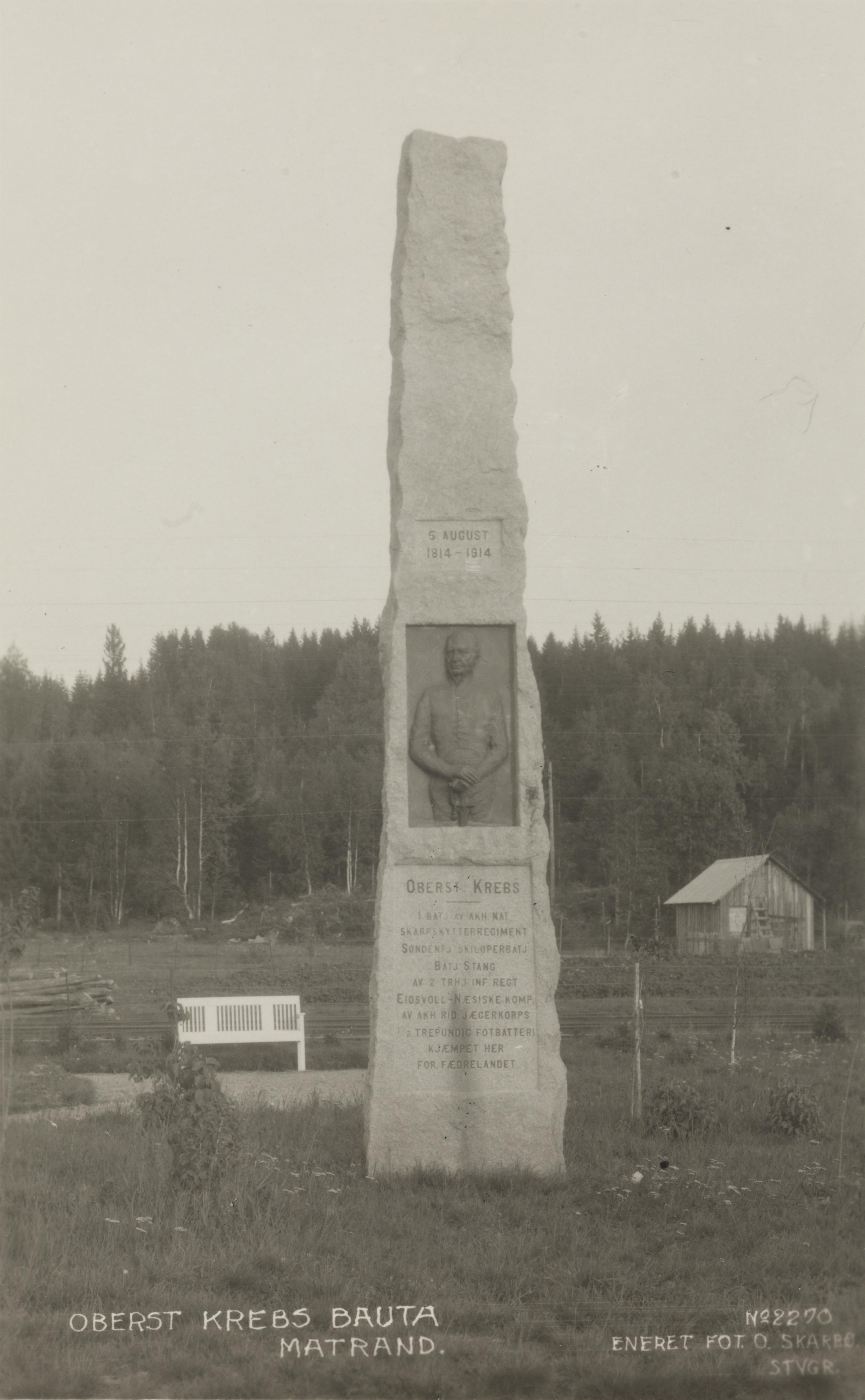
Lieutenant Colonel Krebs became a national hero. His victories at Lier and Matrand were the only Norwegian battlefield successes in an otherwise poorly led campaign. More importantly, they gave Norwegian negotiators leverage at the peace table. The Convention of Moss, signed soon after, required Norway to enter a personal union with Sweden, but it also forced Sweden to recognize the Norwegian constitution adopted at Eidsvoll on May 17, 1814. Norway would not be a conquered province but a partner kingdom with its own laws. For the men who bled at Matrand, for the Vasterbotten soldiers who charged with empty muskets, the battle had shaped a nation's future. A monument to Krebs still stands near the battlefield today.
From the Air
Located at 60.03N, 12.13E near the villages of Matrand and Skotterud in Eidskog municipality, Innlandet county, directly on the Norwegian-Swedish border. The battlefield sits in forested, rolling terrain along the historic invasion route toward Kongsvinger Fortress (visible 15nm northwest). Best viewed at 2,000-4,000 feet AGL. The road network through Matrand, Skotterud, and Ilag where the battle's key movements occurred remains identifiable. The Krebs monument marks the site. Nearest airports: ENGM (Oslo Gardermoen) 60nm southwest, ESOW (Vasteras) 100nm southeast in Sweden.