Battle of Medina Ridge
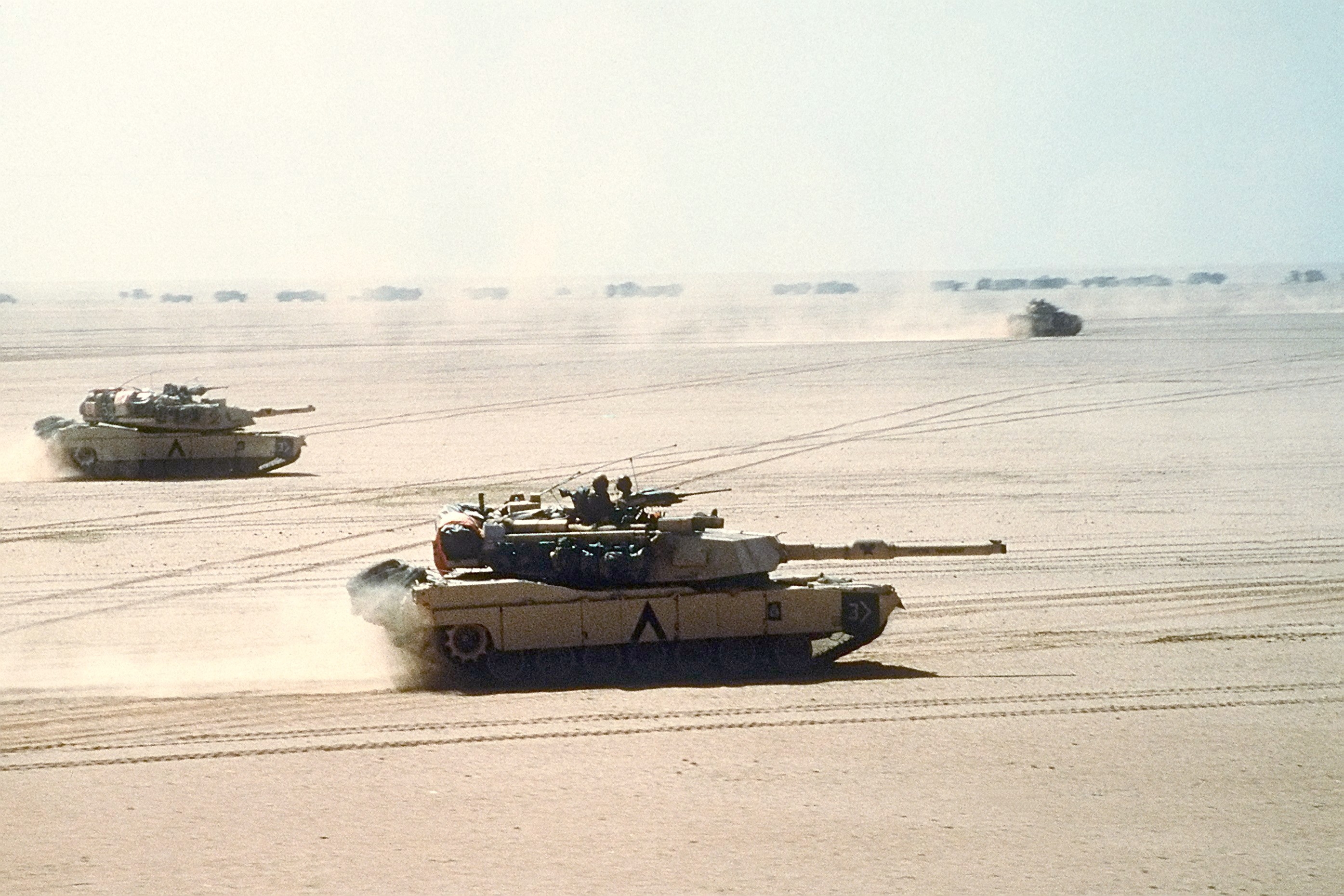
The Iraqis had done something clever. Along a low, seven-mile rise in the desert west of Basra -- a feature so modest that American troops simply named it "Medina Ridge" -- the Republican Guard's Medina Luminous Division had positioned its tanks on the reverse slope. Hidden from view until the Americans crested the ridgeline, these T-72s and Type 69s waited in prepared positions where, in theory, the long-range advantage of the M1A1 Abrams would be neutralized. It was one of the few moments in the Gulf War when Iraqi tactical planning genuinely threatened to shift the terms of engagement. On February 27, 1991, the plan met reality.
Three Thousand Vehicles Moving East
The U.S. 1st Armored Division, commanded by Major General Ron Griffith, was an immense formation: roughly 3,000 vehicles including 348 M1A1 Abrams tanks. For days it had been racing east through southern Iraq as part of VII Corps' sweeping flanking maneuver. On February 25, the 3rd Brigade of the 3rd Infantry Division, commanded by Colonel James Riley and attached to the 1st Armored for the campaign, conducted a 113-kilometer movement to destroy elements of Iraq's 26th Infantry Division, capturing 299 prisoners. The next day, the brigade covered 74 kilometers in twelve hours, fighting multiple engagements with elements of the 52nd Armored Division and the Tawakalna Division. During one clash, they destroyed 27 Soviet-export T-72 tanks that had established a hasty defense to cover Iraqi forces withdrawing from Kuwait. The division was closing fast on the Republican Guard's core.
The Reverse Slope
The Medina Luminous Division had chosen its ground carefully. A reverse slope defense -- positioning forces on the far side of a ridge from the approaching enemy -- is a classic tactic designed to deny the attacker his range advantage. American M1A1 Abrams tanks could kill at distances exceeding three kilometers, and the Chobham armor that protected them was nearly impervious at long range. By hiding behind the ridge, the Iraqis hoped to force the engagement into close quarters where their T-72s and older Type 69s might stand a better chance. The 1st Armored Division's cavalry squadron, 1-1 Cavalry, made first contact with the Medina Division and reported the enemy's location back to General Griffith. The 2nd Brigade, commanded by Colonel Montgomery Cunningham Meigs -- a descendant of the Civil War's General Montgomery C. Meigs -- prepared to lead the assault.
Two Hours on the Ridge
The battle lasted over two hours, making it the largest tank engagement of the entire Gulf War. As American tanks crested the ridgeline, they found the Iraqi armor laid out before them. The reverse slope position that was supposed to equalize the fight instead presented the Iraqi gunners with an unfamiliar targeting problem: firing uphill at silhouettes cresting above them. The Abrams crews, meanwhile, did what they did best. Their thermal sights picked up the heat signatures of Iraqi tanks, and their 120mm smoothbore guns reached out with devastating accuracy. American air support -- AH-64 Apache helicopters and A-10 Thunderbolt II ground-attack aircraft -- compounded the destruction from above. The 75th Field Artillery Brigade and the 25th Field Artillery's target acquisition battery conducted counter-artillery missions that destroyed two entire Medina field artillery battalions. When it was over, 186 Iraqi tanks and 127 other armored vehicles had been destroyed. Only four Abrams tanks took direct hits.
What the Iraqis Managed
The Battle of Medina Ridge was one of the few engagements where Iraqi forces mounted significant resistance. Despite being outmatched in technology and training, they did not simply collapse. Evidence and ballistics reports confirmed that some of the four Abrams hits came from Iraqi T-72 fire, with sabot holes providing physical proof. Iraqi gunners also shot down an A-10 Thunderbolt II and two AH-64 Apache helicopters -- no small feat given the speed and maneuverability of those aircraft. The 3rd Brigade's engagement with the augmented Medina Division ended in the destruction of 82 tanks, 31 armored personnel carriers, 11 artillery pieces, and 48 trucks, but it cost the Americans one soldier killed and 30 wounded, plus two Bradley cavalry vehicles. These were not hollow victories over a fleeing enemy. The soldiers of the Medina Division fought from their positions until they were overwhelmed.
The Ridge That Disappeared
Medina Ridge is not really a ridge at all -- just a gentle rise in the flat desert west of Basra, barely perceptible from the air. The name exists only because American soldiers needed to call it something. Today there is nothing to mark the site. No monument stands where 186 tanks burned. The desert has reclaimed the scars of the battle, and the ridge itself is as unremarkable as it was before February 27, 1991. Most units of the 1st Armored Division and the 3rd Brigade, 3rd Infantry Division received Valorous Unit Award citations for the engagement. The battle demonstrated what happens when well-trained crews in superior machines meet a force that, for once, chose to stand and fight. The Medina Division's tactical cleverness in choosing a reverse slope defense was sound in principle. But no amount of terrain advantage could overcome the disparity in sensors, armor, and training that defined the Gulf War's ground campaign.
From the Air
Located at approximately 30.17N, 46.94E in the desert west of Basra, Iraq. The battlefield is characterized by flat desert terrain with a barely perceptible low ridge -- the 'Medina Ridge' -- running roughly seven miles. The nearest major airport is Basra International (ORMM), approximately 50 km to the east. From altitude, the terrain is indistinguishable from the surrounding desert. The Shatt al-Arab waterway and the city of Basra are visible to the east-northeast.