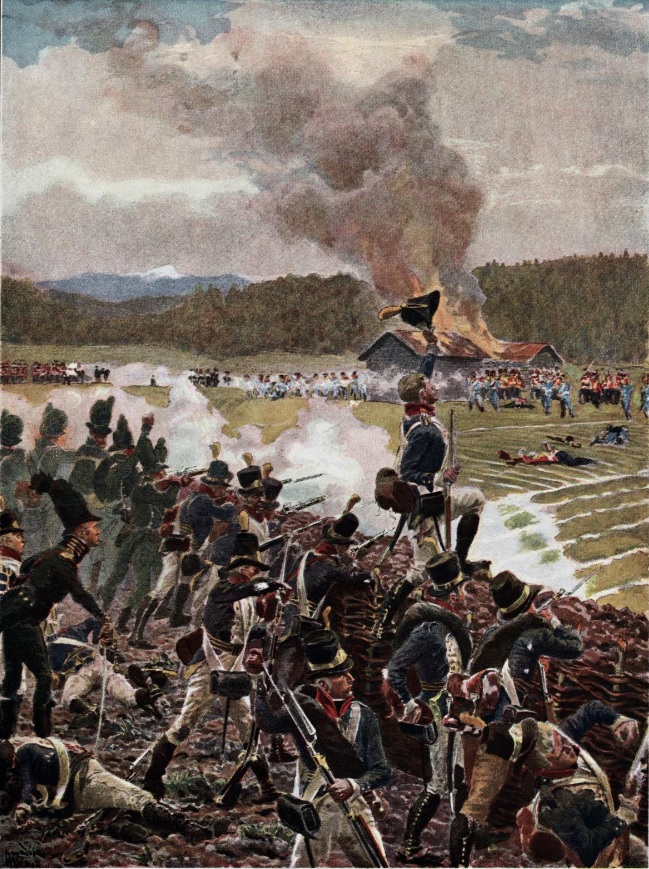
Battle of Mobekk
Sergeant Diricker climbed atop the earthen defenses each time the Norwegians attacked, swinging his hat and mocking the enemy. It was May 18, 1808, and 130 Swedish soldiers were holding a small redoubt at Mobekk against 450 Norwegians determined to break through. The sergeant's bravado captured something essential about this forgotten engagement along the Skinnarbøl River: raw courage on both sides, three desperate Norwegian assaults, and a Swedish victory that would be rendered meaningless within days when General Armfelt misread his orders and abandoned Norway entirely.
Aftermath of Lier
A month had passed since the Swedish victory at the Lier entrenchment, but General Gustaf Mauritz Armfelt had gone nowhere. His artillery was too weak to siege Kongsvinger Fortress, so he fortified his positions and waited for the spring thaw to break up the ice on the Glomma River. His first brigade remained around Lier while reinforcements trickled in from other Swedish brigades. Minor skirmishes flared around Masterud without decisive result. The Norwegians were not content to wait. In mid-May, Commander Christian August ordered General Bernhard Ditlef von Staffeldt to counterattack against the Swedish outposts along the Skinnarbøl River, which ran between the Vinger and Digeren lakes and protected Armfelt's vulnerable right flank. Staffeldt assigned the mission to Colonel Johan Georg Raeder with 800 men advancing in three columns against roughly 300 Swedish defenders.
Three Columns Attack
Raeder personally led the left column against Mobekk, the strongest Swedish position, at 11:30 AM. The redoubt was held by just 90 men from the Halsinge and Narke-Varmland regiments under Captain Strom. The center and right columns struck the Swedish positions at Skansgarden and Skinnarbøl, but those garrisons received orders to withdraw across the river. The Swedes burned the bridge behind them, leaving the Norwegians unable to ford the icy water. With the flanking positions evacuated, all Norwegian attention turned to Mobekk. Reinforcements poured toward the stubborn redoubt. At noon, 40 Varmland Jagers under Captain Lagerlof arrived to reinforce the defenders, with Lagerlof taking overall command. The odds now stood at roughly 130 Swedes against 450 Norwegians.
The Hat-Swinging Sergeant
Norwegian sharpshooters climbed onto the roofs of nearby farmhouses, pouring accurate fire down into the Swedish positions. The defenders crouched behind their earthworks, taking casualties but holding firm. Then came the first assault. Norwegian infantry charged the redoubt and were thrown back. They reformed and attacked again. Repulsed. A third assault followed, coinciding with another Norwegian contingent attempting to ford the river and strike the Swedish rear. Captain Lagerlof led a counterattack that hurled the flanking force back into the water. Through it all, Sergeant Diricker made himself a target, climbing the ramparts during each Norwegian charge to wave his hat in defiance. His display of contempt for enemy fire rallied his comrades and infuriated the attackers. By 4:45 PM, Colonel Raeder could no longer muster his exhausted troops for another assault. The Norwegians withdrew while Lagerlof's Jagers pursued them for more than a kilometer.
Disputed Casualties
The Norwegians reported 7 killed, 27 wounded, and 6 captured, a figure that multiple sources consider suspiciously low given three failed assaults against fortified positions. Swedish estimates ranged as high as 269 Norwegian casualties, including 16 prisoners. The truth likely lies somewhere between. The Swedes, fighting from within their redoubt, suffered 5 killed and 33 wounded. After the battle, Staffeldt wrote to Christian August explaining the defeat: his officers were inexperienced and his soldiers poorly trained. Still, he praised their courage. A week later, Staffeldt took revenge by attacking a Swedish outpost of 29 men at Jerpset in a night raid, capturing or killing the entire garrison.
A Campaign Ends in Confusion
Six days after Mobekk, on May 24, General Armfelt received orders from King Gustav IV Adolf. The king planned to land an Anglo-Swedish force in Denmark and wanted Armfelt to assume a defensive posture. Armfelt interpreted this as an order to retreat entirely. On May 29, he began withdrawing his forces from Norway. By mid-June, Swedish troops had abandoned the entire country except for small garrisons at Prestebakke and Overby. On June 10, an overwhelming Norwegian force surprised and captured these remnants at Prestebakke. The invasion was over. The battles at Lier, Toverud, Trangen, and Mobekk had cost hundreds of lives, yet nothing had changed. Sergeant Diricker's hat-waving bravado, the hard fighting at the Mobekk redoubt, the tactical victories and defeats, all of it amounted to nothing in the end.
From the Air
Located at 60.18°N, 12.09°E along the Skinnarbøl River in southeastern Norway, approximately 8 km northeast of the Lier battlefield. The terrain features forested hills between the Vinger and Digeren lakes. The Swedish-Norwegian border lies just 10 km east. Oslo Gardermoen (ENGM) is roughly 80 km southwest. Kongsvinger and its historic fortress are visible 6 km to the north. Best viewed at 2,500-4,000 feet AGL to see the river crossings and defensive terrain that shaped the engagement.