Battle of Mobile Bay
The words may never have been spoken. Most popular accounts claim that when the monitor Tecumseh struck a torpedo and sank in minutes on the morning of August 5, 1864, and the lead ship Brooklyn stopped dead in the channel, Rear Admiral David G. Farragut -- lashed to the rigging of his flagship Hartford to see above the gun smoke -- roared, "Damn the torpedoes, full speed ahead!" Men present at the battle doubted any voice could carry above the din of the guns. What likely happened was quieter: Farragut told Captain Percival Drayton to take Hartford around the stalled Brooklyn, then shouted to the commander of Metacomet, lashed alongside, "Go ahead, Jouett, full speed." Time polished the phrase into legend. But what Farragut actually did -- steering his wooden ship directly through a minefield that had just swallowed 93 of Tecumseh's 114 crew -- needed no embellishment.
The Last Open Door
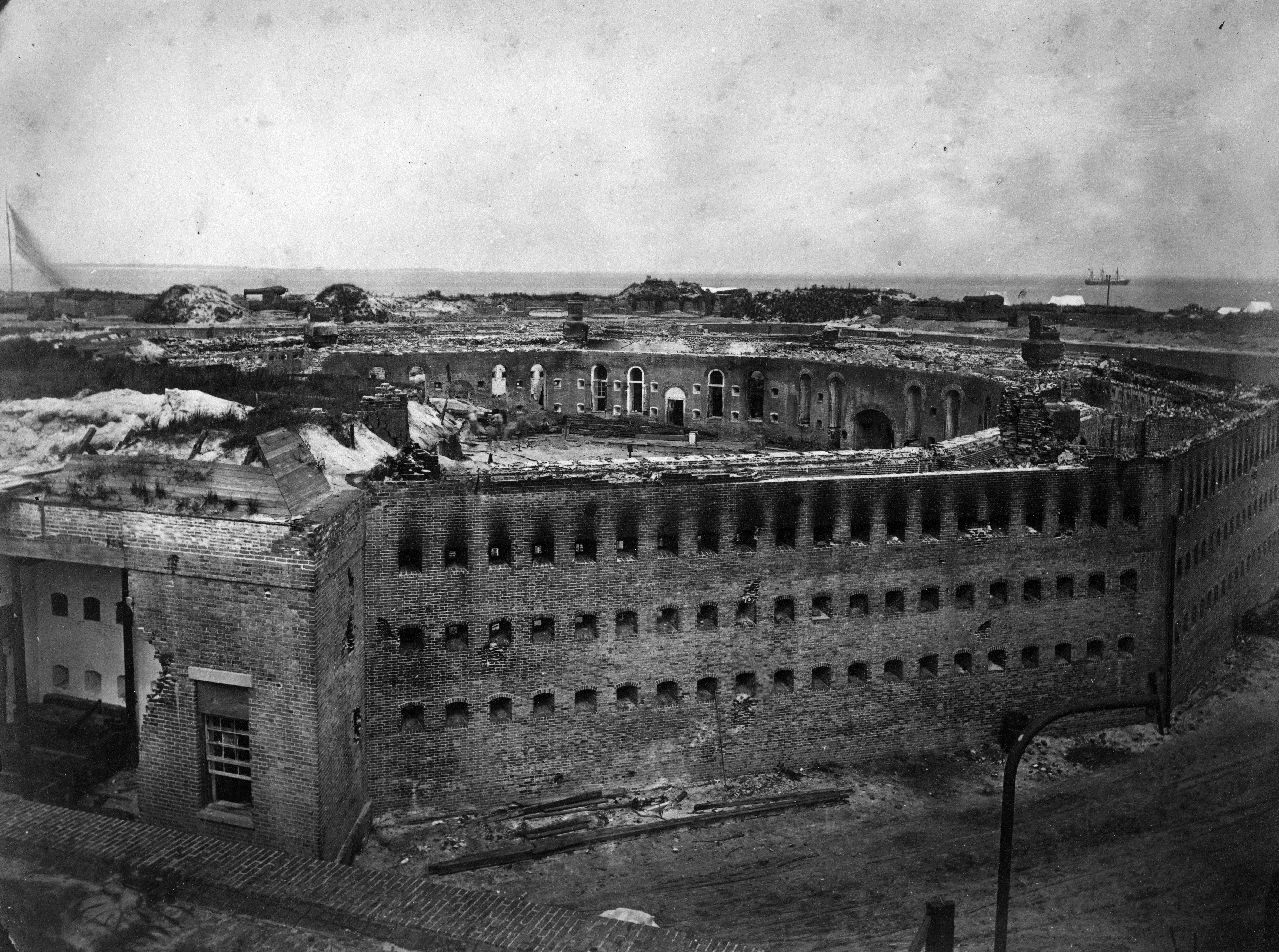
By the summer of 1864, Mobile was the last important Confederate port on the Gulf of Mexico east of the Mississippi River. After New Orleans fell in April 1862, the city had become the center of blockade running on the Gulf, funneling trade between the Confederacy, Havana, and the Caribbean. The entrance to Mobile Bay was guarded by three forts: Fort Morgan, a masonry structure dating from 1834 mounting 46 guns; Fort Gaines on Dauphin Island with 26 guns; and the smaller Fort Powell with 18 guns at Grant's Pass. The Confederate Torpedo Bureau had planted 67 naval mines across the channel, leaving a narrow gap on the eastern side for friendly vessels. And inside the bay waited the ironclad ram CSS Tennessee, carrying six guns behind armor plating, commanded by Admiral Franklin Buchanan -- the first admiral in Confederate history, who had captained the CSS Virginia at Hampton Roads.
Dawn Attack
Farragut's fleet numbered 18 vessels: four ironclad monitors, eight conventional wooden warships, and six smaller gunboats and double-enders. He lashed the 14 wooden ships together in pairs so a disabled vessel's partner could keep it moving. The monitors formed a column along the Fort Morgan side to shield the wooden ships from the fort's guns. At dawn on August 5, conditions favored the attackers: the incoming tide carried the fleet forward on reduced steam, and a southwest breeze blew gun smoke into the faces of Fort Morgan's artillerymen. At 6:47 AM, Tecumseh fired the first shot. The forts replied and the engagement became general. Minutes later, Tecumseh cut across the minefield toward Tennessee and detonated a torpedo. She sank in two to three minutes. Only 21 of her 114 crew survived. Commander Tunis Craven was among the dead.
Through the Minefield
Brooklyn's captain, James Alden, confused by conflicting orders, stopped his ship and signaled for instructions. The entire Union column was stalling under Fort Morgan's guns. Farragut, watching from Hartford's rigging where Captain Drayton had sent a sailor to tie him fast, refused to stop. He ordered Hartford around Brooklyn and directly into the minefield that had just claimed Tecumseh. His gamble rested on one calculation: the torpedoes had been submerged long enough that most were probably waterlogged and inert. He was right. Several Union sailors reported hearing the clicks of torpedo detonators as they passed through, but none exploded. All 14 wooden warships cleared the minefield and entered Mobile Bay.
Tennessee's Last Stand
Farragut expected Buchanan to shelter Tennessee under Fort Morgan's guns. Instead, the Confederate admiral drove his ironclad alone against the entire Union fleet. Federal sloops rammed Tennessee repeatedly -- Monongahela had been fitted with an iron bow shield for this purpose -- but in every collision the ramming vessel took more damage than the ironclad. Shots bounced off Tennessee's armor, while her own guns misfired due to inferior powder. The balance shifted when monitors Chickasaw and Manhattan closed in. Tennessee's smokestack was shot away, killing her boiler draft. Her rudder chains were severed. Gun port shutters jammed shut. Manhattan's heavy guns bent the iron plate and shattered the oak backing behind it. Fragments wounded Admiral Buchanan, breaking his leg badly. Commander James D. Johnston, Tennessee's captain, received permission from the injured admiral to surrender. The battle had lasted just over three hours.
A One-Two Punch
The three forts fell in sequence. Fort Powell's garrison spiked its guns and fled to the mainland. Fort Gaines surrendered on August 8 after its commander, Colonel Charles D. Anderson, ignored orders from Brigadier General Richard L. Page forbidding him to capitulate. Fort Morgan held out until August 23, enduring a day-long bombardment from 16 siege mortars, 18 guns, and the fleet -- including the captured Tennessee, now flying Union colors. The Federal fleet lost 150 killed and 170 wounded. Confederate naval losses were 12 dead and 19 wounded. One hundred fifteen men earned the Medal of Honor for their service at Mobile Bay, including four African American sailors: William H. Brown, Wilson Brown, John Henry Lawson, and James Mifflin. It remains the second-most decorated battle in U.S. history. Together with the fall of Atlanta, the victory boosted Northern morale and helped secure Abraham Lincoln's re-election in November 1864. Historian James M. McPherson wrote that Mobile Bay became "the first blow of a lethal one-two punch" that assured the war's end.
From the Air
The Battle of Mobile Bay took place at the entrance to Mobile Bay near 30.24N, 88.05W, between Fort Morgan on the eastern tip of Mobile Point and Dauphin Island to the west. From the air, the narrow channel between these two landforms is clearly visible, with Fort Morgan's pentagonal outline on the sand peninsula. The wreck of CSS Tennessee and other Civil War-era vessels remain on the bay floor. Nearest airports: Jack Edwards National Airport (KJKA) in Gulf Shores approximately 10nm east, Mobile Regional Airport (KMOB) roughly 35nm north. Dauphin Island is visible across the channel to the west. The bay stretches north toward Mobile where the Mobile and Tensaw rivers converge.