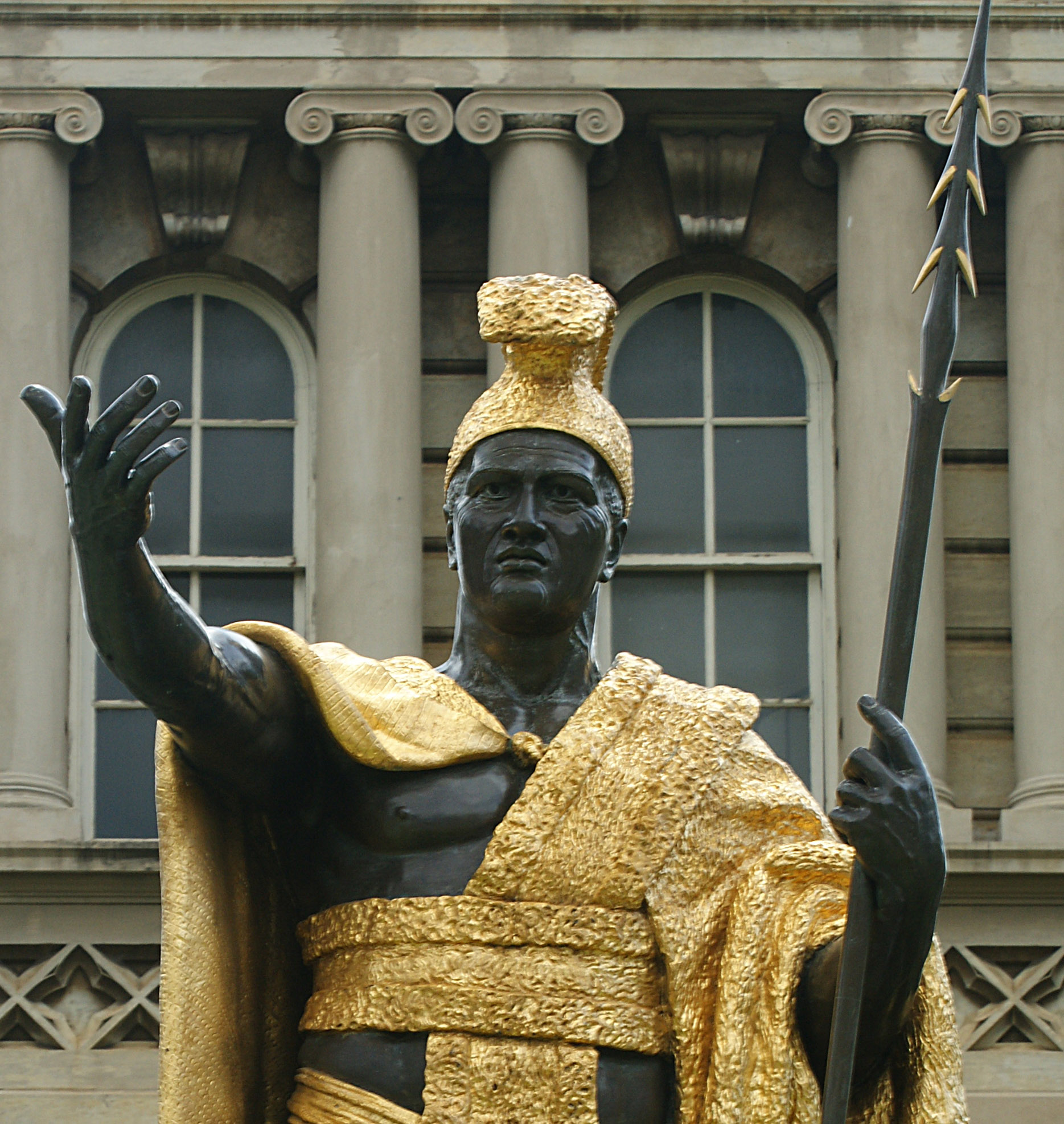
Battle of Mokuohai
The ohai trees are gone now. Sesbania tomentosa, the native shrub that gave this battlefield its name, is an endangered species that no longer grows near the Kona coast. No monument marks the spot south of Kealakekua Bay where, in 1782, the course of Hawaiian history pivoted. The Battle of Mokuohai -- "grove of ohai trees" -- was a fight over succession, honor, and who would unite the Hawaiian Islands. It was Kamehameha's first major victory, and it was won not with Western weapons but with traditional ones: sling stones and a shark-tooth dagger.
A Kingdom Divided at the Tomb
When Kalanioupu, the ruling chief of the island of Hawaii, died in the spring of 1782, his family carried his remains to the royal mausoleum at Puuhonua o Honaunau -- the great place of refuge on the Kona coast. His son Kiwalao inherited the kingdom, but his nephew Kamehameha received only a religious position and the district of Waipio Valley. The arrangement satisfied no one. A group of Kona chiefs -- Keaweaheulu, the twins Kamanawa and Kameiamoku, and Keeaumoku Papaiiahiahi -- offered to back Kamehameha instead. He accepted eagerly and traveled south from his residence in Kohala. Meanwhile, Kiwalao's half-brother Keoua Kuahula, left with no territory at all, went into a rage. He cut down sacred coconut trees belonging to Kamehameha, a profound insult, and killed some of his men. Their bodies were offered as a sacrifice to Kiwalao, who accepted them. Kamehameha had no choice but to respond.
Blood on the Lava Rock
The battle took place just south of Kealakekua Bay, near the present-day community of Keei, along the shore of what is now called Mokuakae Bay. As tensions escalated, women and children from both sides flooded into Puuhonua o Honaunau, the sacred place of refuge where even warriors in defeat could find sanctuary. The fighting was fierce and personal. Kameiamoku was the first leader wounded, but when Kiwalao himself advanced to finish him off, the twin Kamanawa intervened. A sling stone knocked Kiwalao to the ground. The injured Kameiamoku, despite his wounds, reached the fallen king and slit his throat with a lei o mano -- a weapon edged with shark teeth. The king's death broke his army's will. Kamehameha held the field.
The Long Road to Unification
Mokuohai was decisive but not final. Kamehameha now controlled much of the island's western coast, but Keoua Kuahula held the south and east, and years of warfare followed. In 1790, a volcanic eruption on Kilauea caught Keoua's army crossing the Ka'u Desert. Dozens of warriors died, their footprints preserved in the volcanic ash -- a ghostly record still visible today. Kamehameha interpreted the eruption as divine favor and built the massive temple of Puukohola Heiau at Kawaihae to honor the war god Kukailimoku. In 1791, he lured Keoua to the temple's dedication ceremony, where Keoua was killed upon arrival. With rivals eliminated, Kamehameha turned his ambition toward the other islands, eventually conquering Maui, Oahu, and Molokai to establish the Kingdom of Hawaii. It all began in a grove of ohai trees that no longer exist, on a shore where the only monument is the landscape itself.
From the Air
The battle site is located at approximately 19.46°N, 155.92°W, south of Kealakekua Bay on the Kona Coast of the Big Island. From the air, the bay is a prominent indentation in the coastline, with the white Captain Cook monument visible on the far shore. Puuhonua o Honaunau National Historical Park is visible just to the south. Nearest airport is Ellison Onizuka Kona International (PHKO). Best viewed at 2,000-4,000 ft AGL.