Battle of Mons Graupius
"They make a desert and call it peace." The words are attributed to Calgacus, the Caledonian war leader, in a speech almost certainly invented by the Roman historian Tacitus. But even as fiction, the sentiment has echoed for two thousand years, becoming the most famous denunciation of imperialism to emerge from the ancient world. The Battle of Mons Graupius, fought in AD 83 or possibly 84 somewhere in what is now northeast Scotland, was Rome's farthest military engagement in the British Isles. Everything we know about it comes from a single source -- Tacitus, whose father-in-law, Gnaeus Julius Agricola, commanded the Roman forces.
Marching North
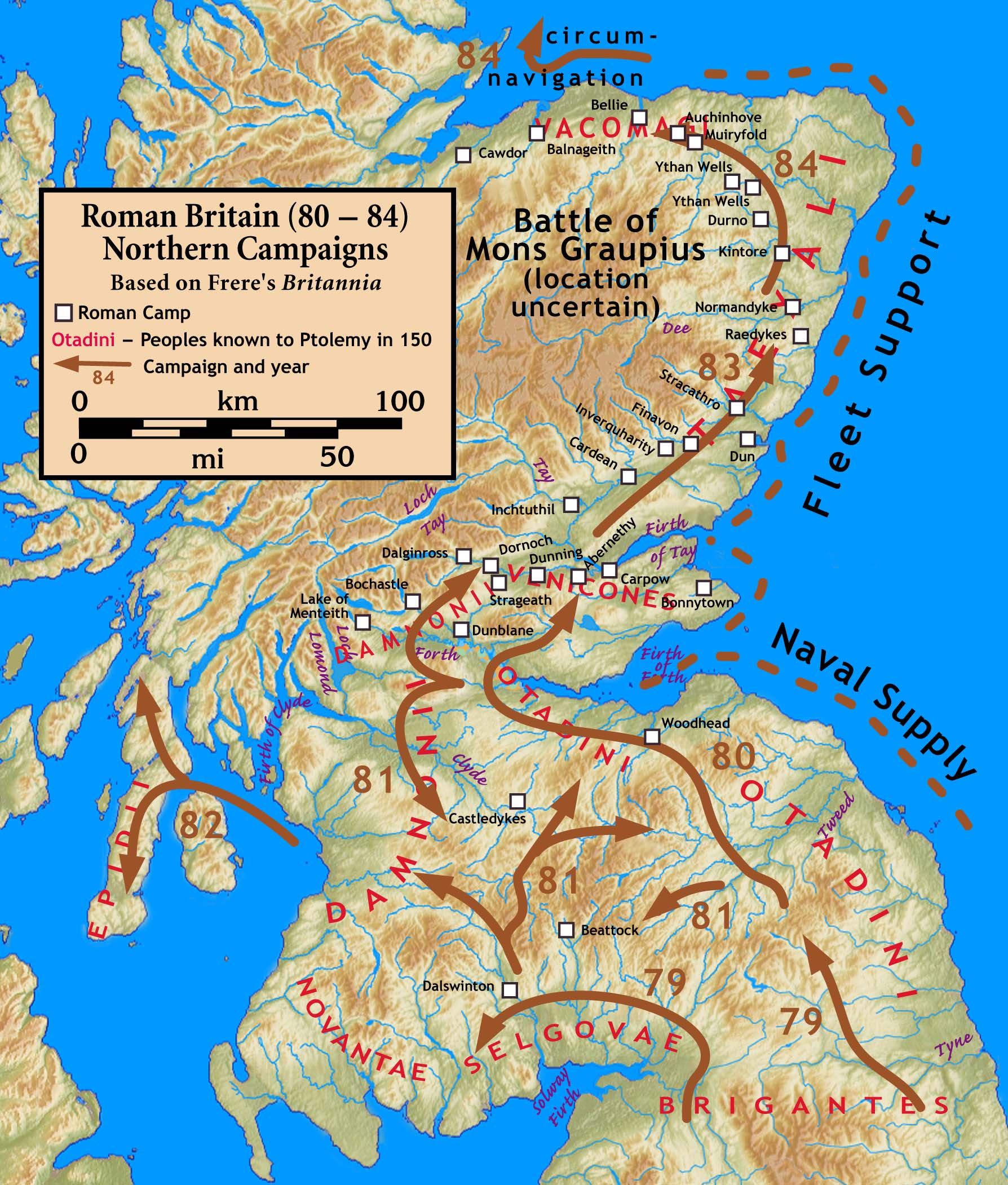
Agricola had been methodically extending Roman control northward through Britain during his governorship. The Caledonians -- the last unconquered major tribal group in the island -- had avoided pitched battle for years, a strategy that frustrated Roman commanders accustomed to decisive engagements. The turning point came when Agricola's forces marched on the Caledonian granaries just as they had been filled from the harvest. Face the Roman army in the field or starve through the winter: those were the options Agricola imposed. Tacitus reports that Agricola sent his fleet ahead to panic the coastal communities, then advanced with light infantry reinforced by British auxiliaries. The fleet's movement along the coast may have tracked the army's march overland, a coordinated campaign that the Caledonians, for all their knowledge of the terrain, could not avoid forever.
A Battle Without a Map
Where exactly the battle took place remains one of Scottish archaeology's most persistent questions. In the 19th century, scholars placed it at virtually every known Roman site in Perth and Kinross. Aerial photography in the 20th century shifted attention northeast, where a series of marching camps extend toward the Moray coast. The leading candidate today is Bennachie in Aberdeenshire, a distinctive hill south of a large marching camp at Logie Durno. Other scholars have argued for Kempstone Hill, Megray Hill, or other elevations near the Roman camp at Raedykes, sites along the ancient Elsick Mounth trackway. Historic Environment Scotland has noted the uncertainty as the reason for excluding the battle from Scotland's Inventory of Historic Battlefields.
The Clash on the Hill
According to Tacitus, the Caledonian force numbered over 30,000, arrayed on high ground in a horseshoe formation with chariots operating on the plain below. Agricola fielded 8,000 auxiliary infantry in the centre with 3,000 cavalry on the flanks, holding his Roman legionaries in reserve. After an exchange of missiles, four cohorts of Batavian and two cohorts of Tungrian swordsmen drove into the Caledonian centre. The fighting was brutal at close quarters, and the Caledonians on the lower slopes were cut down. When those on the hilltop attempted to outflank the Roman line, Agricola's cavalry wheeled and broke them. Tacitus claims 10,000 Caledonians died at a cost of only 360 Roman auxiliaries -- numbers that historians have long treated with scepticism. The 20,000 Caledonians who retreated into the woods fared considerably better against pursuing forces, and by the next morning, Roman scouts could find no trace of the remaining Caledonian army.
Victory Without Conquest
Agricola was awarded triumphal honours and recalled to Rome. He had, Tacitus proclaimed, subdued all the tribes of Britain. It was not true, and Tacitus knew it. Within a few years, Roman forces had withdrawn to the Forth-Clyde isthmus, abandoning most of Caledonia. Tacitus's own bitter summary of the wider situation -- "Perdomita Britannia et statim missa," Britain was completely conquered and immediately let go -- captures his frustration with Emperor Domitian's refusal to consolidate Agricola's gains. The Caledonians were never fully subdued. They remained beyond the frontier, a persistent threat that would eventually prompt the construction of Hadrian's Wall and the Antonine Wall. Mons Graupius, whatever its precise location, marks the high-water mark of Roman expansion in Britain -- the point where the empire chose to stop rather than the point where it was stopped.
From the Air
The approximate location is 56.92N, 3.00W in northeast Scotland. Bennachie, the most commonly proposed site, is a distinctive hill rising to 528m in Aberdeenshire, visible from a wide area. The terrain is a mix of farmland and moorland. Nearest airports: Aberdeen (EGPD) 25nm east, Inverness (EGPE) 50nm northwest.