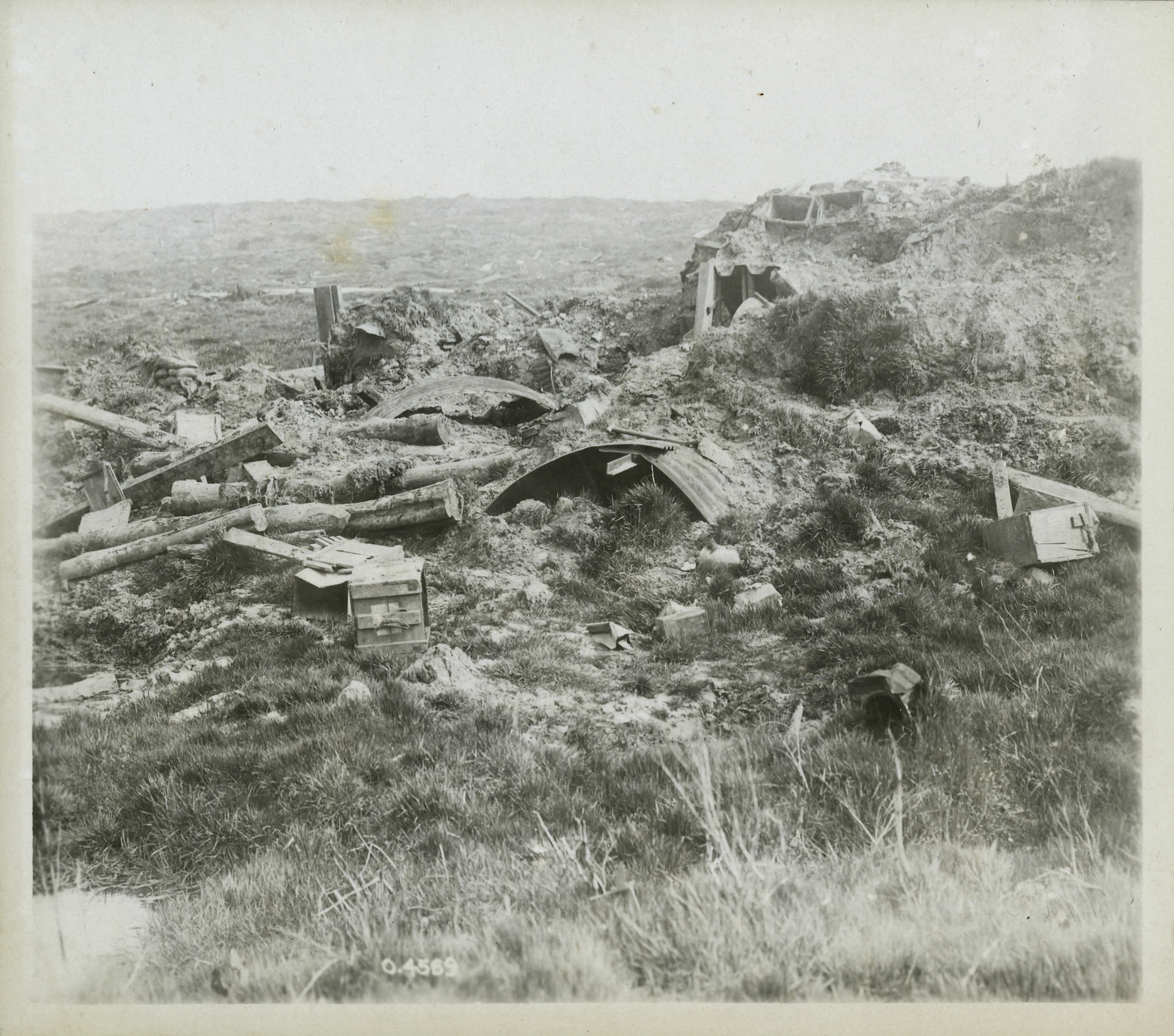
Battle of Mont Sorrel
Major-General Malcolm Mercer was inspecting the front line on the morning of 2 June 1916 when the shells started arriving. He had walked up to Observatory Ridge with Brigadier-General Victor Williams to look at the German positions across the way. The Wurttemberg artillery opened up a few minutes after they reached the forward trench, and they could not get back. Mercer was wounded three times before he died in the dawn of 3 June; Williams was hit in the face and head and dragged into German captivity. Their division, the 3rd Canadian, lost its commander and its forward brigade commander in the first hour of its first real battle. The men in the trenches with them, mostly Toronto and Montreal volunteers in their twenties, did not have very long after that.
A Low Ridge, Three Heights
Mont Sorrel is not a mountain. It is a slow Belgian rise, a few hundred yards across, on a ridge that runs through Hooge and Zwarteleen east of Ypres. With its neighbours Tor Top (Hill 62) and Hill 61, it stood about thirty metres above the swampy ground at Zillebeke. By spring 1916 it was the last fragment of the high ground around Ypres that the Allies still held. From its crest, a soldier could see the cathedral spires of Ypres four kilometres away, and the German army could see, in the other direction, every road and railway that fed the British rear. Both sides knew it mattered. The Canadians, newly arrived in the salient and still finding their feet, were the ones holding it.
The Wurttemberg Plan
The Germans needed a diversion. The British and French were assembling on the Somme for what would become the great summer offensive, and the German Supreme Command, exhausted by Verdun, could spare nothing for a major counter-stroke. The XIII (Royal Wurttemberg) Corps, commanded by General von Watter, was told to take Mont Sorrel and the heights beside it to draw British attention north. They spent six weeks preparing in secret, telling their troops they were being transferred away, slowly extending forward saps and stockpiling guns and trench mortars. On 1 June the men were finally told what was coming. They were also told, by way of encouragement, that the Imperial Navy had just won a great victory at Jutland. They climbed into the assault trenches that night. The two battalions of Infantry Regiment 121 facing the 8th Canadian Brigade had been raised in Ulm and the Swabian Alps; they were carpenters and Lutheran farmers' sons, mostly, doing what they had been ordered to do.
Three Hours of Artillery
On the morning of 2 June, the Wurttemberg corps opened the heaviest bombardment the Canadian Corps had yet faced. Nine-tenths of the Canadian forward reconnaissance battalion became casualties before the German infantry even moved. At one o'clock in the afternoon, German pioneers detonated four mines under the Canadian trenches, and six battalions stormed forward through the smoke. Resistance at the front line was, in the official history's bleak word, minimal. The 4th Canadian Mounted Rifles, dismounted infantry from Manitoba and the West, were almost annihilated in their trenches. The Princess Patricia's Canadian Light Infantry, on the left, lost more than four hundred men holding Sanctuary Wood while their flank gave way. The Germans took Mont Sorrel, Tor Top and Hill 61 within a few hours. The road to Ypres lay open, but no German officer pushed past the limits in his orders, and the moment closed.
Currie's Methodical Reply
Julian Byng, the new Canadian Corps commander, threw together a counter-attack in the early hours of 3 June. It was hurried, badly coordinated, and largely failed in broad daylight, with four battalions advancing into machine-gun fire across open ground. So Byng stopped, and waited, and gave the job of the deliberate counter-attack to Arthur Currie, commander of the 1st Canadian Division. Currie was a former real-estate agent from Victoria, British Columbia, and he was about to become one of the war's most respected divisional and corps commanders. He spent six days preparing. From 9 to 12 June he ran four short, deceptive thirty-minute bombardments to make the Germans expect immediate attacks that never came. On 12 June he kept all the German positions between Hill 60 and Sanctuary Wood under fire for ten hours. At dawn on 13 June, after another forty-five minutes of intense shelling, the Canadian battalions went forward behind a smoke screen. Two hundred German prisoners were taken. In just over an hour, the original Canadian line was back in Canadian hands.
Eight Thousand Names
From 2 to 14 June, the Canadian Corps lost 8,430 men killed, wounded and missing. The German Wurttemberg divisions and the 117th Division together suffered 5,765. The dead lie in the small cemeteries that ring the ridge today: Sanctuary Wood, Hooge Crater, Maple Copse, Lijssenthoek. Those whose bodies were never found are listed on the Menin Gate in Ieper, eleven kilometres west. After the battle, Byng refused to let the politician Sam Hughes appoint his own son to the vacant divisional command, and promoted Louis Lipsett instead, infuriating Ottawa and saving lives. Quietly, in the same weeks, the unreliable Canadian Ross rifle began to be replaced with the British Lee-Enfield. Mont Sorrel was the Canadian Corps' first major action, a victory of sorts in the end, paid for by men in their twenties from Calgary and Winnipeg and Trois-Rivieres. A small stone on Observatory Ridge marks where the 15th Battalion fought. The ridge itself is hardly thirty metres high. From the top, in the long Belgian dusk, you can still see Ypres.
From the Air
Located at 50.83N, 2.94E, on a low ridge 4 km east-southeast of Ieper (Ypres), Belgium. Mont Sorrel, Tor Top (Hill 62) and Hill 61 form a roughly north-south crest at about 60 m elevation between Zillebeke and Zandvoorde. The Hill 62 (Sanctuary Wood) Canadian Memorial and Sanctuary Wood Museum sit near the high point. Nearest airport is Wevelgem (EBKT, 22 km NE); Lille-Lesquin (LFQQ, 33 km SW) for larger traffic. Open mixed farmland, Ieper cathedral visible to the west. Best low-altitude visibility is winter mornings when the woods are bare.