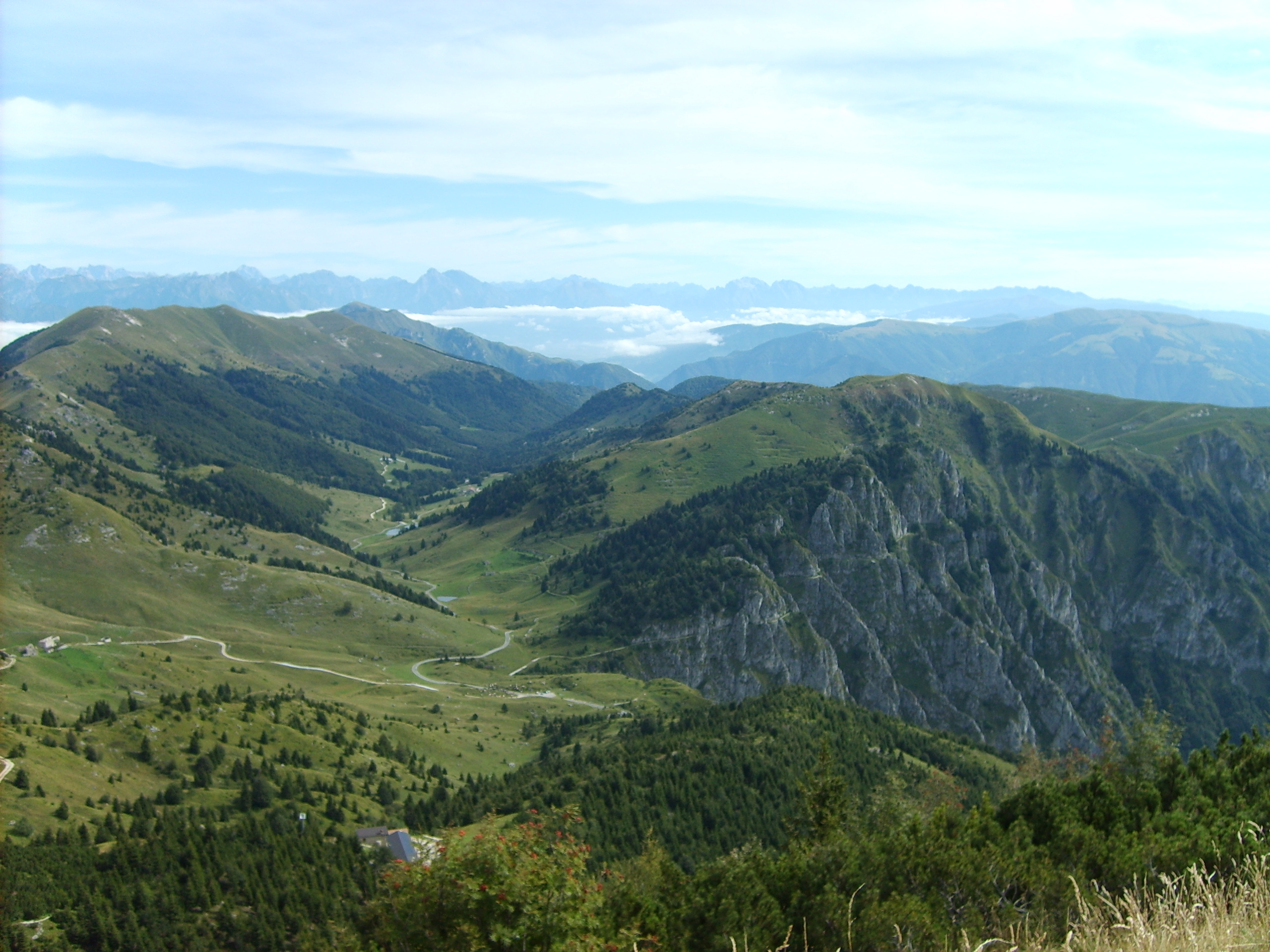
Battle of Monte Grappa
From their positions high on Monte Grappa in late 1917, Austro-Hungarian soldiers could see Venice. The city glimmered on the Adriatic horizon, tantalizingly close, a prize that would justify the catastrophic losses of three years of alpine warfare. They would never reach it. This limestone massif rising above the Venetian plain became the hinge on which the entire Italian front turned -- the place where the great Austro-Hungarian advance finally stopped, where the empire's last offensive failed, and where its army began the retreat that ended in dissolution. Three battles were fought here between November 1917 and October 1918, and together they tell the story of an empire's collapse.
The Mountain Becomes a Fortress
After the disastrous Battle of Caporetto in autumn 1917 routed Italian forces, General Luigi Cadorna ordered Monte Grappa fortified as an impregnable strongpoint. The mountain's strategic value was absolute: it anchored the left flank of the Italian defensive line along the Piave River. If Monte Grappa fell, the Piave line would be turned, and the road to Venice and the Po Valley would lie open. The Austrians understood this as well as the Italians did. Reinforced by the German Army's elite Alpenkorps, they threw themselves at the summit from November 11 to December 23, 1917. The fighting was brutal, conducted in freezing temperatures on exposed rock faces and in hastily dug positions. When it was over, the Austrians had failed to take the peak. Italian casualties totaled 12,000; Austrian losses reached 21,000. The line held.
An Empire's Last Gamble
The second battle came in June 1918, as part of the Austro-Hungarian Empire's final major offensive of the war. It was complementary to a broader attack along the Piave River, the last throw of the dice for an army and a state running out of men, materiel, and political cohesion. On Monte Grappa, the Austrians again failed to break through. The mountain had become a symbol as much as a strategic position -- proof that Italian forces, after the humiliation of Caporetto, could hold ground and fight. The Piave offensive collapsed, dealing a blow from which the Austro-Hungarian military never recovered. Erich Ludendorff, Germany's de facto military leader, later said that hearing the news gave him the sensation of defeat for the first time.
The Final Reckoning
The third battle began on October 24, 1918, exactly one year after Caporetto, when nine Italian divisions attacked the Austrian positions on Monte Grappa as part of the final Allied offensive. The mountain was no longer a defensive stronghold for Italy but an objective to be retaken from forces that had dug in along its slopes. The Austrians responded by increasing their garrison from 9 to 15 divisions, committing every remaining reserve they had. It was not enough. On October 28, as Czechoslovakia declared independence from Austria-Hungary, the exhausted Austrian army began a general retreat. The empire was disintegrating beneath its soldiers' feet. Within days, the Battle of Vittorio Veneto would complete the collapse, and the Armistice of Villa Giusti would end the war on the Italian front.
Stone and Memory
Monte Grappa stands 1,775 meters above sea level, its summit commanding views that stretch from the Dolomites to the Adriatic. Today the mountain is crowned by a monumental ossuary containing the remains of over 22,000 Italian and Austro-Hungarian soldiers. The terraced galleries of the dead, arranged in concentric rings around the peak, make the mountain itself a memorial. Walking among them, the scale of the sacrifice is inescapable: these were men from dozens of nations and language groups, conscripts of empires they may or may not have believed in, who died fighting for a hilltop that most of the world has forgotten. The mountain has not forgotten them. Trenches, tunnels, and gun emplacements are still visible across its slopes, and the landscape bears the scars of shelling a century later.
From the Air
Monte Grappa rises to 1,775 meters (5,823 feet) at 45.85N, 11.73E in the Venetian Prealps, roughly 65 km northwest of Venice. The massif is unmistakable from the air -- a broad-shouldered mountain dominating the transition from the Alpine foothills to the flat Venetian plain. The ossuary monument is visible on the summit. Nearest airports include Treviso (LIPH) to the southeast and Venice Marco Polo (LIPZ) to the south. The Piave River valley runs along the mountain's eastern flank, and the Brenta River valley lies to the west. Best viewed from 3,000-5,000 feet AGL on approach from the south.