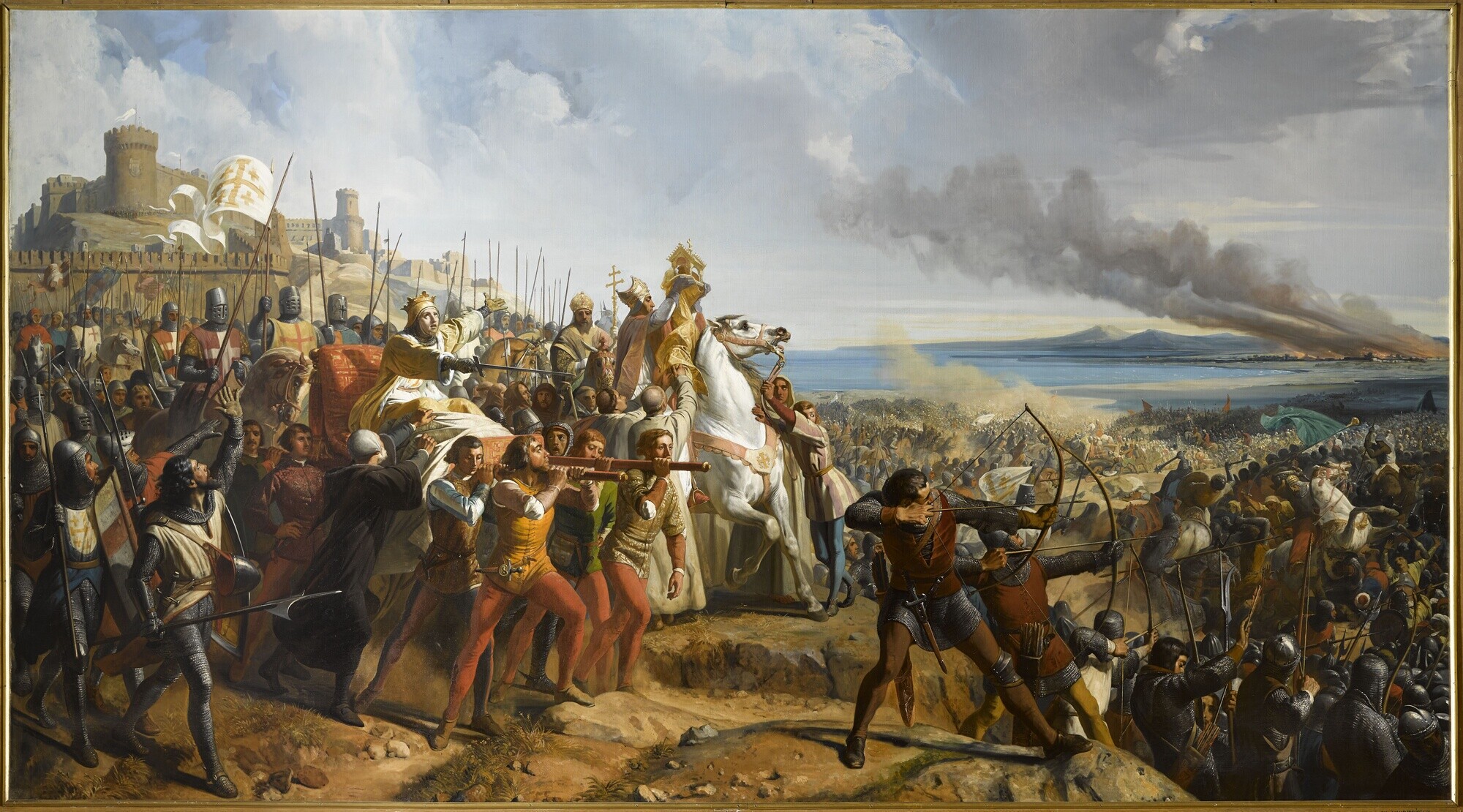
Battle of Montgisard
The teenage king could barely ride his horse. Leprosy was already consuming Baldwin IV of Jerusalem -- his hands had to be bandaged to cover the sores, and he needed help mounting and dismounting. He was sixteen years old, recovering from malaria, and he commanded fewer than 500 armored knights against a force that contemporary chroniclers numbered in the tens of thousands. On November 25, 1177, at a place called Montgisard near Ramla, Baldwin ordered the relic of the True Cross raised before his army, then dropped to his knees in the dust and prayed. When he rose, his men cheered. Then they charged. By nightfall, Saladin was fleeing toward Egypt on the back of a camel, having lost roughly ninety percent of his army. Muslim historians considered the defeat so catastrophic that only Saladin's victory at Hattin a decade later could redeem it.
A Kingdom Left Bare
The disaster began as a diplomatic failure. In 1177, Baldwin and Philip of Alsace, a Flemish nobleman on pilgrimage, had planned a joint naval attack on Egypt with Byzantine support. The alliance collapsed. Philip instead joined Raymond III of Tripoli on an expedition against the fortress of Harim in northern Syria, and the bulk of the Crusader army -- the Knights Hospitaller and much of the Knights Templar -- followed him north. The Kingdom of Jerusalem was left nearly defenseless. Saladin, watching from Egypt, recognized the opportunity and launched an invasion on November 18. Baldwin, still weakened by malaria, rode to meet the sultan alongside the nobleman Raynald of Chatillon with what William of Tyre recorded as only 375 knights. The Templars rushed to defend Gaza while Baldwin attempted to hold Ascalon. In desperation, the young king issued an arriere-ban, summoning every able-bodied man in the kingdom to arms.
The Sultan's Miscalculation
When Saladin reached Ascalon on November 22, Baldwin led his troops out to confront him -- then, seeing the size of the opposing army, retreated behind the city walls. Saladin made his critical error: he dismissed the leper king as irrelevant and marched on toward Jerusalem, leaving no scouts to watch Ascalon. He had intentionally left his baggage train at al-Arish to move faster through Crusader territory, and his army was spread across the countryside, foraging for food. Baldwin seized the opening. He contacted the Templars, ordering them to abandon Gaza and join him, then broke out of Ascalon with Raynald and eighty Templar knights, pursuing the Muslim army up the coast. Saladin had no idea they were coming. His supply train had become mired at a river crossing near Tell es-Safi -- a white limestone hill topped with the hastily built Crusader castle of Blanchegarde -- and his forces were strung out and unprepared.
Prayer and Slaughter
The Crusaders caught Saladin's army at Montgisard, near Ramla. The precise location remains debated -- Malcolm Barber identifies it with the mound of Al-Safiya, and Saladin's own chronicler Imad ad-Din al-Isfahani confirms the battle took place near that landmark. Baldwin ordered the True Cross raised and fell to his knees before his men. Contemporary sources describe the soldiers as visibly moved by the sight of their young, ravaged king praying for deliverance. Then the attack came. The Crusaders struck while Saladin's nephew Taqi ad-Din was engaging prematurely, before the sultan had finished marshaling his Mamluk guard. Taqi ad-Din's son Ahmad was among the first to fall. Baldwin himself fought in the thick of it, his bandaged hands gripping his weapons. The Egyptian force collapsed. According to Ralph de Diceto, Saladin narrowly escaped capture by fleeing on a racing camel. By nightfall his remnants had reached Tell el-Hesi, twenty-five miles from the battlefield.
Victory's Price
Baldwin returned to Ascalon in triumph. Only a tenth of Saladin's army limped back to Cairo, arriving on December 8. The young king commemorated the victory by erecting a Benedictine monastery on the battlefield, dedicated to Saint Catherine of Alexandria, whose feast day fell on the date of the battle. But the cost was real: Roger de Moulins, Grand Master of the Knights Hospitaller, reported that 750 Crusaders returned home wounded. The strategic consequences rippled outward. Saladin's defeat at Montgisard prevented him from relieving his Syrian vassals, who were besieged at Harim by the very forces whose departure had left Jerusalem exposed. For a decade, the battle stood as the defining humiliation of Saladin's career. He defeated Baldwin at the Battle of Marj Ayyun two years later, but the full redemption came only in 1187, when his victories at Cresson and Hattin and his siege of Jerusalem finally erased the memory of the day a dying teenager routed him in the Levantine dust.
From the Air
Located at 31.86N, 34.92E in the Shephelah lowlands between the coastal plain and the Judean Hills, near modern-day Ramla in central Israel. The battlefield is believed to be near Tell es-Safi (ancient Blanchegarde), a prominent white limestone mound visible from the air. The Valley of Ayalon stretches to the north. Nearest airports: Ben Gurion International (ICAO: LLBG) approximately 20 km to the northwest. The terrain is gently rolling agricultural land at low elevation. Fly at 2,000-3,000 ft AGL for good visibility of the landscape where the battle took place.