Battle of Mulleriyawa
According to Sinhalese chronicles, the marshlands of Mulleriyawa turned red with blood. Even allowing for poetic embellishment, the scale of the Portuguese defeat in 1559 was staggering -- one of the most decisive battles in Sri Lankan history, and the moment when the Kingdom of Sitawaka proved it could not merely resist Portuguese expansion but shatter it. What brought a veteran Portuguese commander to this marshy ground east of Colombo, and how a prince with war elephants sent him reeling back, is a story of colonial ambition colliding with fierce local resistance.
A Kingdom Divided Against Itself
The roots of Mulleriyawa reach back to 1521, when three sons of King Vijayabahu VI overthrew and assassinated their father in the event known as the Vijayaba Kollaya -- the Spoiling of Vijayabahu. They carved the Kingdom of Kotte into three pieces. The eldest, Buvanekabahu VII, kept the capital and the coast. The youngest, Mayadunne, took the inland Kingdom of Sitawaka, and proved to be the most dangerous of the three. When the middle brother died in 1538, Mayadunne absorbed his principality of Raigama and turned his attention to Kotte itself. The Portuguese, who had arrived in 1505 and built a fortress in Colombo, found themselves entangled in this fratricidal politics -- backing Kotte's kings against Sitawaka, installing the Catholic puppet king Dharmapala after Buvanekabahu's death in 1551, and eyeing a full offensive against Mayadunne.
The Commander Called Baroche
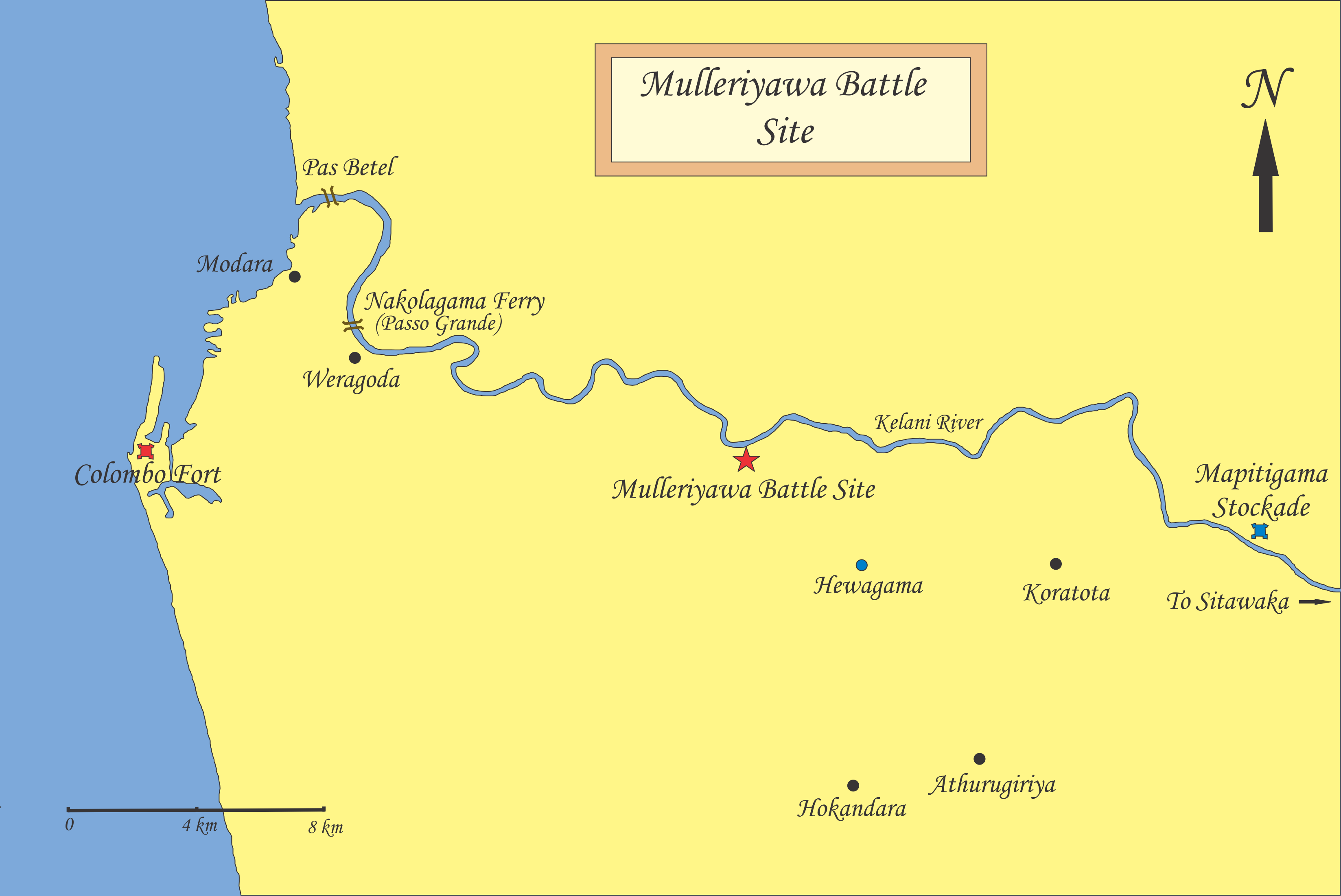
After Mayadunne's unsuccessful year-long siege of Kotte from 1557 to 1558, the Portuguese decided to strike back. But their captain-major, Afonso Pereira de Lacerda, was crippled by chronic malaria, barely coherent with fever. Goa dispatched a replacement: Jorge de Menezes, a veteran nicknamed Baroche for his exploits at the Indian city of Broach. De Menezes arrived in May 1559 with a reputation and a boast -- he intended to finish the enemy that had brought him to the island. His target was the stockade at Mapitigama on the northern bank of the Kelani River, a strategic position controlling the river crossing and the overland route to Sitawaka. Capturing it would give the Portuguese a launching pad for invasion. De Menezes marched out, confident in European arms and tactics. He did not know what waited in the meadows of Hewagama.
Elephants and Muskets in the Marshes
King Mayadunne sent his son, Tikiri Bandara -- later known as Rajasinha I -- to intercept the Portuguese. On arrival at Hewagama, Tikiri Bandara summoned fighters from across the surrounding korales, and in a remarkable turn, even the sons of General Maggona Arachchi, once fierce enemies of Sitawaka, joined his cause. They had lost faith in the puppet kingdom Kotte had become. De Menezes scored an early success, surprising a border garrison at dawn and killing 300 defenders at a smaller stockade on the southern bank. But when he marched through the night toward the main Sitawakan force, his troops were already spent. At the village of Mulleriyawa, Tikiri Bandara unleashed his full army: targe bearers, cavalry, Sinhalese musketeers, and war elephants. Two elephants entered the chronicles by name -- Viridudassaya, who captured an enemy standard, and Airavana, who seized a shield and chain. The exhausted, ammunition-depleted Portuguese were overwhelmed.
A Cannon Shot and a Retreat
At the battle's most desperate moment, a single Portuguese soldier named Antonio Dias de Lomba fired an abandoned berco cannon -- a breech-loading swivel gun -- into a line of Sitawakan troops. The unexpected blast temporarily halted the attack, giving the surviving Portuguese enough time to stagger back to the smaller stockade they had captured earlier. They arrived wounded, depleted, and humiliated. Tikiri Bandara, meanwhile, is said to have returned to King Mayadunne carried on the shoulders of a captured Portuguese soldier. Whether literally true or not, the image captured the completeness of the victory.
The Road to Colombo
Mulleriyawa broke Portuguese power in the interior. The threat to Sitawaka from the east ceased entirely, and emboldened by his son's victory, Mayadunne launched frequent raids against both the Portuguese and what remained of the Kotte Kingdom. By 1565 the Portuguese could no longer hold Sri Jayawardenapura Kotte, the once-proud capital. They abandoned it and retreated to Colombo, sheltering behind the fort walls and the guns of their navy, taking their puppet King Dharmapala with them. The marshlands where de Menezes had expected a quick colonial triumph became instead the place where Sinhalese sovereignty reasserted itself -- at enormous cost to both sides, but with consequences that reshaped the island's political map for decades to come.
From the Air
Located at 6.94N, 79.95E, east of Colombo in Sri Lanka's western lowlands near the Kelani River. The battle site lies in the Mulleriyawa area between Ambatale and the Kelani River, now part of greater Colombo's suburban sprawl. Nearest airports: Bandaranaike International (VCBI) 28 km north, Colombo Ratmalana (VCCC) 12 km southwest. Best viewed at 3,000-5,000 ft AGL. The Kelani River is a strong visual reference, winding westward toward Colombo.