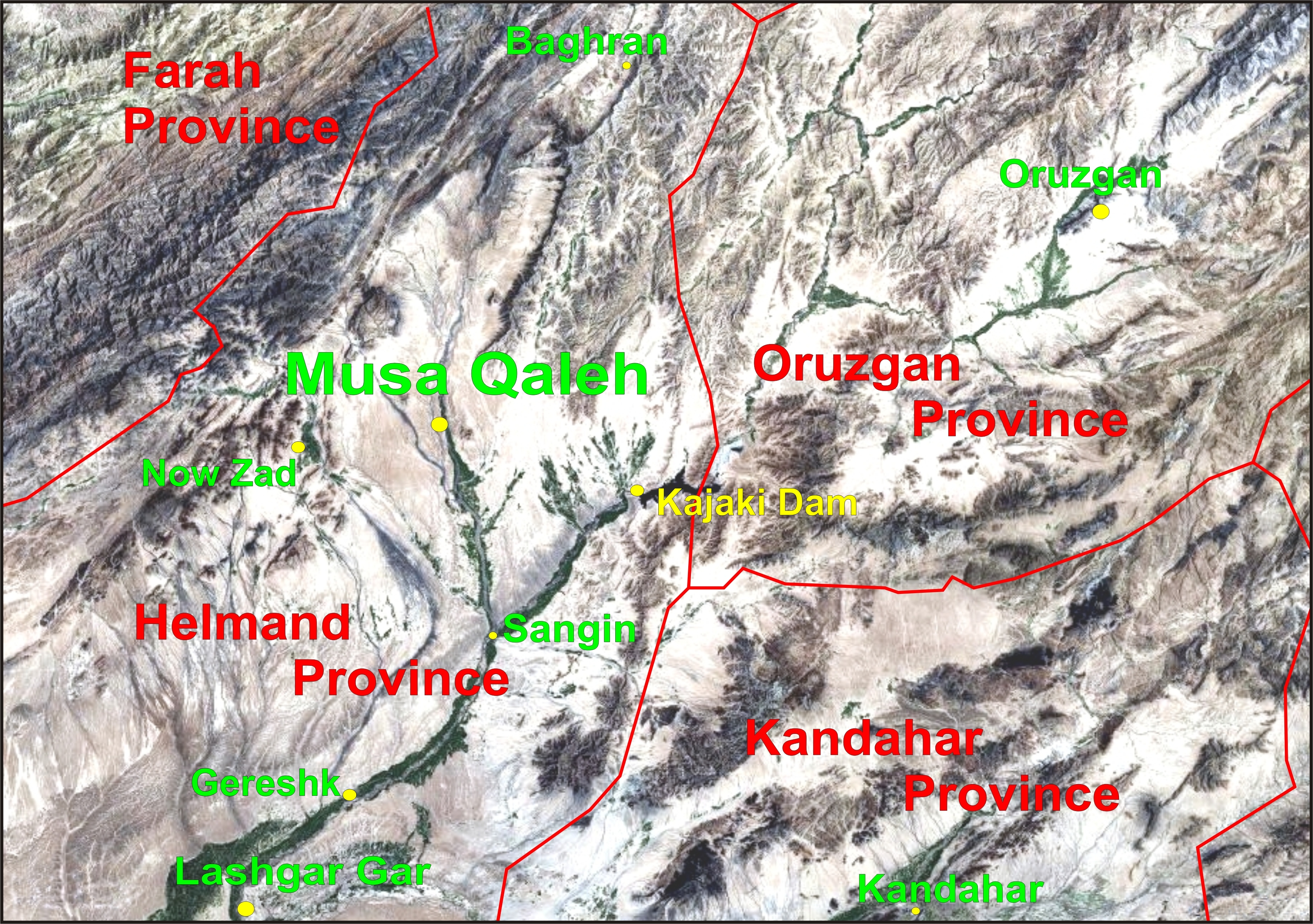
Battle of Musa Qala
A British officer's warning proved prophetic: "There is an obvious danger that the Taliban could make the deal and then renege on it." They did exactly that. In February 2007, roughly 200 to 300 Taliban fighters swarmed back into Musa Qala, the dusty market town in Helmand Province that coalition forces had handed over to local elders just months earlier. By December, a multinational force would fight to retake it in what became a pivotal test of whether Afghanistan's own army could lead a major battle.
A Deal That Couldn't Hold
Musa Qala sits in southern Helmand Province, surrounded by the opium fields and tribal loyalties that made the region one of the most contested in Afghanistan. In 2006, a British garrison held the town but found itself under constant siege, its replacements unable to arrive until a full battle group operation, codenamed Snakebite, broke through Taliban lines. By October 2006, commanders brokered a controversial deal: neither British nor Taliban forces would occupy the town, with control instead passing to local tribal elders. The arrangement collapsed within months. A US airstrike killed a Taliban commander's brother and twenty of his followers, and the militants poured back in. Music was banned, recordings smashed. Men were attacked for not wearing beards. Women who went without the burqa were punished. A confluence of tribal politics, religion, and opium money ensured the truce was never going to last.
Operation Snakepit
Weeks of preparation preceded the December 2007 assault. British reconnaissance patrols from the Brigade Reconnaissance Force, 40 Commando Royal Marines, and the Scots Guards probed Taliban positions, pushing to within a mile and a half of the town center. Coalition aircraft dropped leaflets warning civilians to flee, and hundreds of families did. Meanwhile, Afghan President Hamid Karzai personally courted a critical defection: Mullah Abdul Salaam, a key Alizai tribal leader, brought as many as a third of Musa Qala's Taliban defenders to the coalition side. Whether they actually fought or simply stayed out of the way remains unclear, but the defection shrank the opposition significantly. ISAF officers estimated the remaining Taliban strength at two to three hundred fighters.
Three Days of Fighting
The main assault launched at four in the afternoon on 7 December. That evening, some 600 American soldiers from the 82nd Airborne Division air-assaulted into positions around the town. An Apache helicopter took ground fire that knocked out one engine; its pilot, CW2 Thomas O. Malone, landed safely despite being wounded. More than 2,000 British troops -- Scots Guards, Household Cavalry, Royal Marines from 40 Commando -- set up a cordon and began advancing with Afghan forces from three directions. Fighting ground on through the 8th and 9th, with US air power hammering Taliban anti-aircraft positions while insurgent reinforcements streamed in from neighboring areas. On 9 December, Corporal Tanner J. O'Leary of the 508th Parachute Infantry Regiment was killed by an improvised explosive device, a reminder that the most lethal threat in Helmand was often buried underfoot.
The Taliban Melt Away
By 10 December the insurgents had withdrawn north into the mountains. NATO officially confirmed the capture on the 12th, and Afghan troops were called forward for the final push into the town center -- a deliberate symbolic gesture meant to demonstrate that Afghanistan's own soldiers could defeat the Taliban. What coalition forces found told its own story: bomb factories, weapons caches, and returning civilians who described Taliban punishments and the presence of Pakistani and Arab jihadists. The feared house-to-house combat never materialized. The Taliban had chosen to retreat rather than be destroyed, a pattern that repeated across Helmand. In the same week, British forces battled near the Kajaki Dam, Estonian and American troops fought near Nawzad, and Danish forces under British command were attacked in Gereshk. The insurgency was not concentrated in one town; it was everywhere.
Victory Without Resolution
Controlling Musa Qala was meant to squeeze Taliban operations across southwestern Afghanistan and serve as proof that the Afghan National Army and ISAF could hold ground. In January 2008, the defected Mullah Abdul Salaam was appointed district governor, a gesture aimed at encouraging other Taliban commanders to switch sides. But British officials acknowledged the broader reality: troop shortages made it difficult for NATO to hold territory seized from the Taliban, and the insurgents continued to enjoy significant civilian support. Helmand's governor promised 5,000 tons of aid for returning civilians, yet the deeper problem -- a war tangled in tribal loyalties, opium economics, and shifting allegiances -- could not be resolved by military force alone. The battle was a tactical success. The campaign it belonged to would continue for another fourteen years.
From the Air
Coordinates: 32.44°N, 64.74°E. Musa Qala sits in a valley in northern Helmand Province, visible as a cluster of compounds amid irrigated green zones flanked by arid desert. Recommended viewing altitude: 8,000-12,000 feet AGL for terrain context. Nearest airports: Kandahar Airfield (OAKN) approximately 150 km southeast, Camp Bastion/Shorabak (OAZI) approximately 80 km south. Terrain is rugged with mountains to the north where Taliban fighters retreated. Visibility can be reduced by dust, especially in summer months.