Battle of Na San
"We have not been breached! All positions hold! It is an indescribable deluge of fire." Colonel Jean Gilles radioed those words on the night of December 1, 1952, as wave after wave of Viet Minh soldiers threw themselves against his fortified camp in the mountains of Son La Province. The Battle of Na San was a French victory by any tactical measure. It was also, in hindsight, the most dangerous kind of success: one that convinced the losers to try harder next time and the winners to repeat a strategy on a scale where it would fail catastrophically.
The Hedgehog in the Mountains
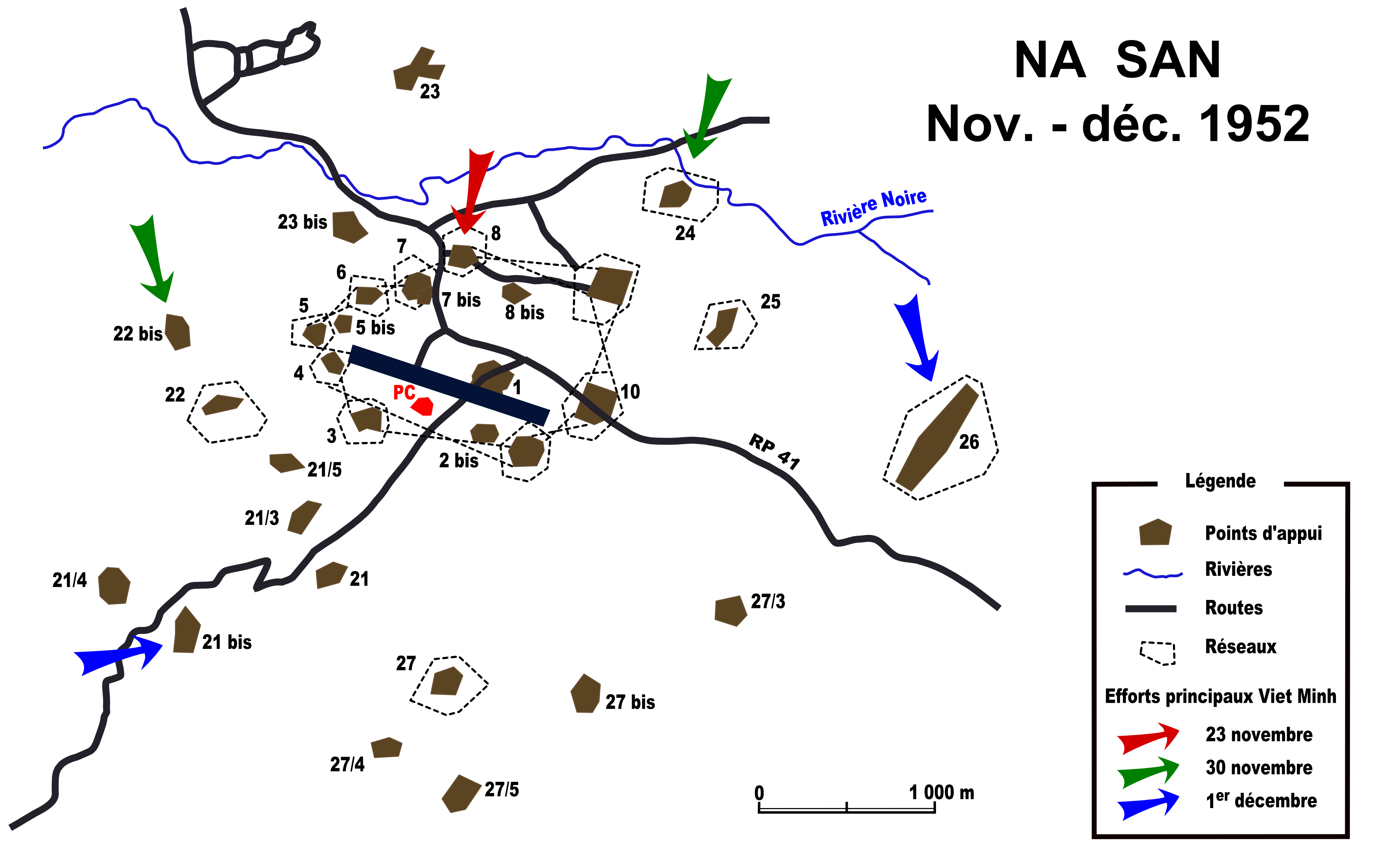
Na San sits along Route Provinciale 41 in northwestern Vietnam, a narrow valley roughly two kilometers by one, ringed by 24 hills. In the autumn of 1952, General Vo Nguyen Giap had seized the initiative in the T'ai region, overrunning Nghia Lo and parts of Son La and Lai Chau with four regular divisions. French commander General Raoul Salan needed to stop the bleeding. He tasked Colonel Gilles with building a fortified air-land base at Na San, supplied entirely by Dakota transports from Hanoi. The concept, called the hedgehog or le herisson, was designed not to hold territory but to provoke. Thirty armed positions, connected by trench systems and wrapped in barbed wire, surrounded a central airstrip. Eleven battalions and six artillery batteries, some 15,000 men drawn from Foreign Legion, Algerian, Moroccan, Thai, and Vietnamese units, manned the perimeter. The objective: dare Giap to attack where French firepower could destroy his troops in the open.
Night Assaults and Napalm
Giap took the dare. On November 23, Viet Minh forces from the 308th Division launched the first probe against 110 legionnaires at Position 8. They were thrown back twice, leaving 64 dead. For a week, nightly probes tested the perimeter while French patrols ventured out by day. The main assault came on November 30, when nine battalions struck positions 22 bis and 24, dangerously close to headquarters. The 2nd Thai Battalion at 22 bis held for nine grinding hours before being overrun; of 225 defenders, only one squad escaped to the airfield. Moroccan tirailleurs at Position 24 resisted three hours before being overwhelmed. At dawn on December 1, Gilles counterattacked. Foreign Legion paratroopers stormed 22 bis while colonial paratroopers fought seven hours to retake Position 24. That night Giap launched his all-out offensive, attackers outnumbering defenders fifteen to one at some positions. Dakotas circled overhead dropping flares while B-26 bombers, Hellcats, and Privateers dropped napalm onto the assault waves. By mid-morning on December 2, the attacks stopped abruptly, leaving eerie silence across the valley.
A Victory and Its Ghosts
Giap withdrew on December 4 after nearly two weeks of trying to breach the hedgehog. French estimates placed Viet Minh losses at 1,544 dead and 1,932 wounded or captured. The defending force lost close to two full battalions. It was, by the numbers, a clear French win. Salan himself acknowledged that without air support, Na San would have been impossible and he would have lost the entire northwest. Even Emperor Bao Dai celebrated, reportedly saying, "Let us wish that Giap makes the mistake of coming!" Giap's own assessment was more measured and more revealing. He concluded that the hedgehog represented a new class of defense his forces had not previously encountered, and that they had not yet learned how to destroy it. He recognized that the French could exploit the Viet Minh's inability to sustain large forces in remote mountain terrain for extended periods. It was not a confession of permanent defeat. It was a promise to study the problem.
The Vanishing Camp
Despite the victory, France was already searching for a political exit from Indochina, and Na San was abandoned in August 1953. Gilles, the tactician who had built and defended the hedgehog, orchestrated an evacuation so skillful that the Viet Minh surrounding the camp did not realize it was happening until nearly everyone was gone. A Viet Minh officer later admitted that the enemy withdrew without their knowledge until only one battalion remained, and that poor intelligence allowed the entire force to escape. The camp's defenses, the trenches and wire and artillery positions that had held through weeks of assault, were left to the jungle. But the idea behind them traveled onward, carried by officers who believed they had found a formula for defeating Giap in set-piece battle.
The Lesson Misread
Na San's most consequential legacy was the confidence it inspired. The hedgehog had worked: fortified positions, concentrated firepower, and air resupply had broken Giap's assault divisions. French planners, including the newly appointed General Henri Navarre, concluded that repeating the strategy on a larger scale could lure Giap into committing his entire army to destruction. They chose a valley called Dien Bien Phu, 150 kilometers to the northwest. What they failed to grasp was everything that had made Na San survivable and Dien Bien Phu was not. At Na San, the French held most of the high ground. At Dien Bien Phu, the hills belonged to the Viet Minh. At Na San, air resupply lines held. At Dien Bien Phu, anti-aircraft fire made them suicidal. And Giap, true to his word, had studied the hedgehog. He spent months positioning artillery in camouflaged mountain casemates before attacking. The battle that followed, in the spring of 1954, ended French Indochina. Na San had been a tactical victory that became a strategic catastrophe, not because the tactic failed, but because its success was mistaken for a universal solution.
From the Air
Located at 21.22°N, 104.04°E in Son La Province, northwestern Vietnam. The valley is a small basin roughly 2 km by 1 km surrounded by hills along Route Provinciale 41. Best viewed from 4,000-6,000 ft AGL. The former airstrip that was central to the battle may still be partially visible. Nearest significant airport is Na San Airport (VVNS), though it sees limited traffic. Hanoi Noi Bai International Airport (VVNB) is approximately 250 km to the southeast. Mountainous terrain throughout the area with peaks up to 1,500 m. Weather can be poor with low cloud ceilings, particularly during the monsoon season.