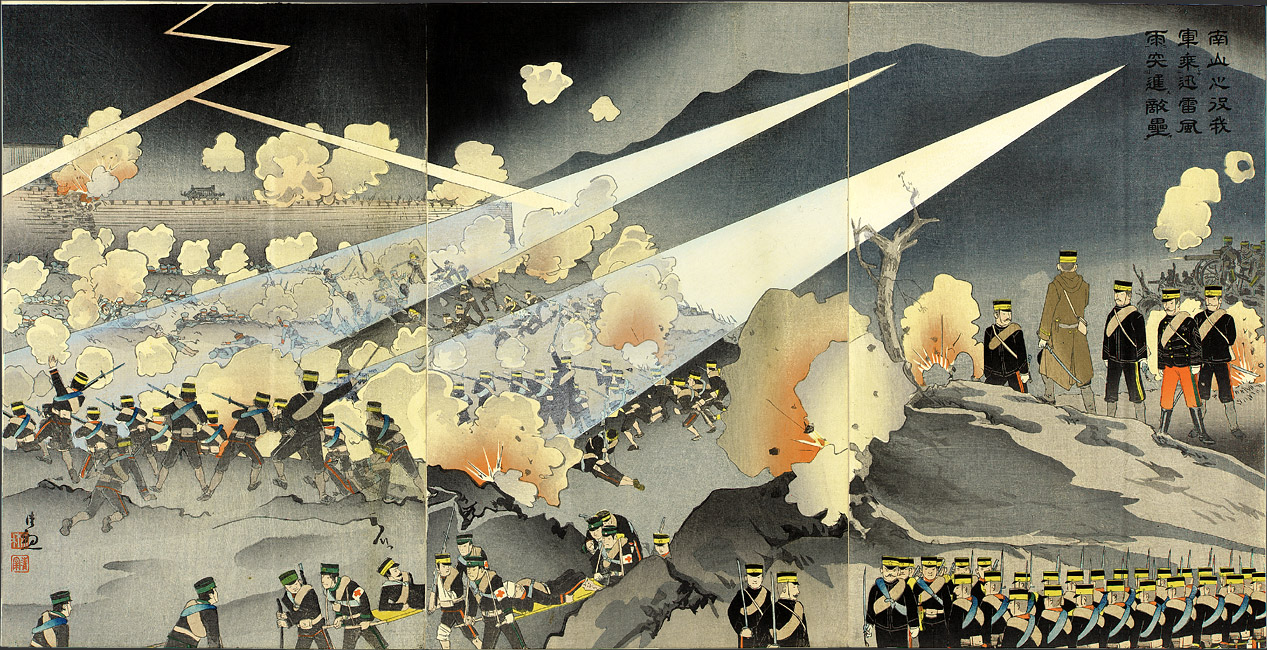
Battle of Nanshan
A Japanese intelligence colonel named Doi had watched the fortifications go up. Posing as one of the thousands of Chinese laborers hired by the Russians to build the defenses, he had mapped every trench, every gun position, every coil of barbed wire on Nanshan Hill. The Japanese knew exactly what awaited them. They attacked anyway, and the hill nearly broke them. The Battle of Nanshan, fought on 24-26 May 1904, was one of the bloodiest land engagements of the Russo-Japanese War, a preview of the industrial killing that would define the Western Front a decade later.
The Narrowest Point
Nanshan Hill rises 116 meters above the narrowest part of the Liaodong Peninsula, where only two miles of land separate the eastern and western coasts. The Russians had turned this natural chokepoint into a fortress. Colonel Nikolai Tretyakov and roughly 3,000 men of the 5th East Siberian Rifles dug into positions on the hill, backed by 114 pieces of field artillery and machine guns, with networks of trenches and barbed wire stretching across the entire width of the peninsula. They knew they would be outnumbered. The Japanese Second Army under General Yasukata Oku, 38,500 strong with three divisions drawn from Tokyo, Nagoya, and Osaka, had landed at Pitzewo some 70 miles northeast and was pushing south toward Port Arthur. To reach that Russian stronghold, they had to get through Nanshan.
Three Days of Storm and Steel
The battle opened on 24 May 1904 during a thunderstorm, when the Japanese Fourth Division attacked the walled town of Chinchou just north of the hill. Despite being defended by only 400 men with antiquated artillery, the town held through two full assaults. It fell only on the morning of 25 May, when two battalions from the First Division independently breached the defenses. With his flank secured, General Oku could turn to the main objective. On 26 May, following a prolonged artillery barrage supported by gunboats offshore, all three Japanese divisions hurled themselves at the entrenched Russian positions. Mines, Maxim machine guns, and barbed wire tore the attackers apart. By 6:00 pm, after nine separate assaults, the Japanese had failed to overrun the hill. Oku had committed every reserve he had, and both sides had exhausted most of their artillery ammunition.
The Retreat That Wasn't Necessary
What happened next baffled the Japanese. The Russian reserve commander, Lieutenant-General Alexander Fok, a former police officer who had risen through political patronage rather than military competence, failed to reinforce the position or organize a counterattack. When the Japanese finally consolidated their hold on the hill, they were too depleted to advance for four days. When they finally moved south on 30 May, they discovered that the Russians had abandoned Dalny entirely, retreating all the way back to Port Arthur without making any effort to hold the strategically valuable port. The harbor equipment, warehouses, and railway yards were left intact, a gift the Japanese could scarcely believe.
Monuments and Memory
After Japan occupied Dalny, a memorial tower was erected on top of Nanshan Hill, inscribed with a poem by General Nogi Maresuke, the officer who would go on to lead the devastating Siege of Port Arthur. The tower was demolished after the Pacific War, and only its foundation remains. A portion of the stone tablet bearing Nogi's poem is now stored in the Lushun Prison museum. The Russian military cemetery at the foot of the hill in what is now the Jinzhou District of Dalian still stands, its graves a reminder that the 3,000 defenders who held the hill against nine assaults were fighting a battle that their own commanders had made unwinnable through incompetence and indecision.
From the Air
Located at 39.08N, 121.72E in what is now the Jinzhou District of Dalian, Liaoning Province. Nanshan Hill is visible from altitude as an elevated feature at the narrowest point of the Liaodong Peninsula, where the land constricts between the Yellow Sea and Dalian Bay. Nearest airport is Dalian Zhoushuizi International (ZYTL), approximately 20 km south. The Russian military cemetery and remnants of the memorial foundation are on the hilltop.