Battle of Nashville
Confederate soldiers dug sleeping pits in the frozen earth south of Nashville in early December 1864 -- shallow holes just large enough for two or three men to huddle beside a small fire. An Alabama soldier named Edgar Jones wrote that while the warmth was welcome, the shelters gave him "a sort of graveyard feeling," since they looked remarkably like graves. He was more right than he knew. Within two weeks, the Army of Tennessee would effectively cease to exist, broken by a Union force that attacked with devastating precision on December 15 and 16. The Battle of Nashville was one of the most decisive victories of the entire Civil War, and today the battlefield lies beneath the neighborhoods, shopping centers, and highway interchanges of south and west Nashville -- a place where people live their daily lives on top of one of the war's most consequential killing fields.
The Road Through Franklin
The road to Nashville ran through a series of Confederate miscalculations. General John Bell Hood, having lost the Atlanta campaign, marched his Army of Tennessee northwest into middle Tennessee, hoping to draw Sherman into a favorable fight. Sherman declined the invitation entirely, cutting his army loose for his March to the Sea and leaving Hood's problem to Major General George H. Thomas. Hood pursued Union General John Schofield from Pulaski to Columbia, tried to intercept him at Spring Hill, and failed. Furious, Hood ordered nearly 31,000 men to assault Schofield's fortifications at Franklin on November 30. The result was catastrophic: over 6,000 Confederate casualties, including a devastating number of generals. Schofield withdrew overnight into Nashville's formidable defenses, where Thomas had assembled approximately 55,000 veterans from five different armies. Hood followed with roughly 30,000 battered survivors and entrenched south of the city, hoping Thomas would smash himself against Confederate fortifications. It was a gamble born of desperation.
Ice, Impatience, and a General's Nerve
Thomas refused to be rushed. His cavalry, commanded by the young Brigadier General James Wilson, was poorly armed and badly mounted, and Thomas would not attack without adequate protection on his flanks -- especially knowing Wilson would face the formidable Nathan Bedford Forrest. Washington seethed at the delay. Ulysses Grant, worried Hood might march all the way to Ohio, pressured Thomas relentlessly. Lincoln complained it resembled "the McClellan and Rosecrans strategy of do nothing and let the rebels raid the country." Then a bitter ice storm struck Nashville on December 8, making any offensive movement impossible. Sub-freezing weather continued through December 12. Grant lost patience entirely and ordered Major General John Logan to Nashville to replace Thomas if he had not attacked by the time Logan arrived. Grant himself left Petersburg to take personal command. Logan made it to Louisville by December 15 -- but that morning, the Battle of Nashville had finally begun. Grant got no farther than Washington.
The Sledgehammer Falls
Thomas's plan was elegant. On December 15, a diversionary attack hit the Confederate right, where two brigades including United States Colored Troops advanced and overran the skirmish lines before being halted by heavy fire from a concealed Confederate lunette. But the real blow fell on Hood's left. Wilson's cavalry and Smith's XVI Corps executed a massive wheeling movement, sweeping south and rolling up five Confederate redoubts one after another. The IV Corps advanced frontally and found the main Confederate line had shifted. By day's end, Stewart's corps was wrecked and the entire Confederate army fell back to a new defensive line anchored on Shy's Hill and Peach Orchard Hill. On December 16, Thomas repeated his tactics with greater force. Attacks on Peach Orchard Hill drew Confederate reinforcements from the already thin left flank. At 3:30 p.m., Brigadier General John McArthur sent word that his division would attack Shy's Hill in five minutes unless ordered otherwise. His three brigades surged up the hill, discovering that the Confederate trenches had been dug on the geographic crest rather than the military crest -- troops could advance almost to the top before coming under fire. The Confederate left disintegrated.
A Broken Army's Retreat
Hood's army fled south through the December darkness on Franklin Pike and Granny White Pike, Wilson's cavalry blocking one road while Lee's Confederate rearguard fought desperately on the other. The pursuit continued for nearly two weeks, with Wilson's horsemen and Forrest's rearguard clashing at Richland Creek, Anthony's Hill, and Sugar Creek. Hood finally crossed the Tennessee River on a pontoon bridge near Bainbridge, Alabama, on December 28. Federal casualties totaled 387 killed, 2,562 wounded, and 112 missing. Confederate losses are harder to pin down -- Thomas captured 4,561 prisoners in the battle alone, with thousands more taken during the retreat. The Army of Tennessee had entered the campaign with approximately 38,000 men. By January 20, Hood reported just 18,742 effective troops. His nominal superior, General Beauregard, estimated the number at fewer than 15,000. Hood resigned his command on January 13, 1865, and never received another field assignment.
Buried Beneath the Living City
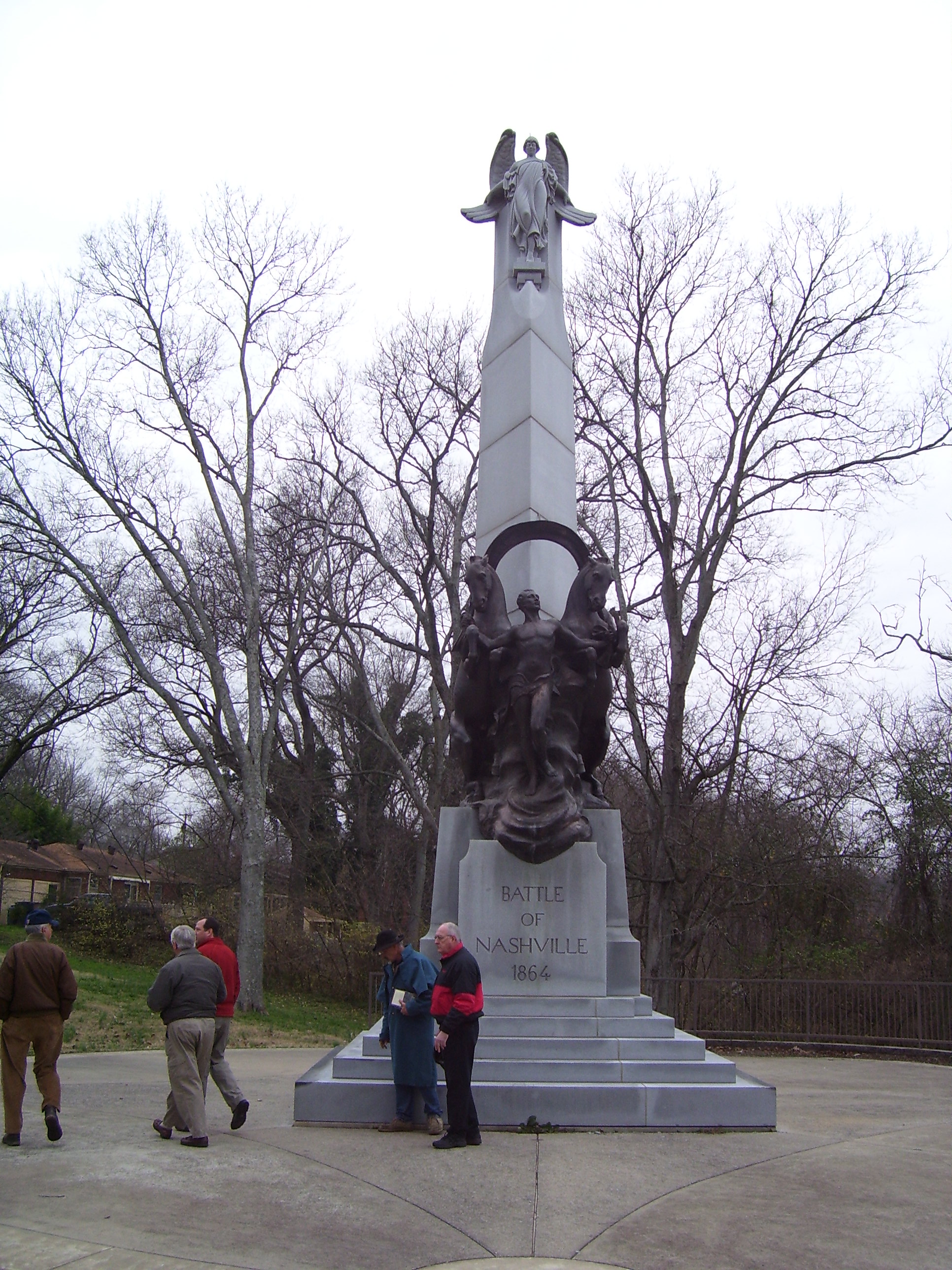
The Nashville battlefield is enormous by Civil War standards, sprawling across what is now south and west Nashville. Residents of Green Hills, Forest Hills, Oak Hill, and Brentwood live and shop on ground where tens of thousands of soldiers fought. Early twentieth-century efforts to create a National Battlefield Park failed because Nashville's civic leaders -- Southerners who had little interest in commemorating such a thorough Confederate defeat -- withheld their support. Most of the battlefield has been lost to development. But traces remain. Shy's Hill, owned by the Battle of Nashville Preservation Society, still shows Confederate trench lines on its east and south slopes. Redoubt No. 1 on Benham Avenue in Green Hills preserves clearly visible earthworks. Fort Negley, built in 1862-1863 by African Americans forcibly impressed by the Union military government, has been stabilized and interpreted as a historic site. At Belle Meade Plantation, bullet scars on the front porch columns testify to the cavalry skirmish fought on its lawn. A monument created by sculptor Giuseppe Moretti in 1927, relocated in 1999 to the intersection of Granny White Pike and Clifton Lane, honors soldiers of both sides.
From the Air
Located at 36.09°N, 86.81°W. The battlefield encompasses most of south and west Nashville, centered roughly on the area between modern-day I-65, I-440, and Granny White Pike. The Cumberland River, which formed the Union defensive barrier on the north and east, is clearly visible curving around downtown Nashville. Key landmarks: Fort Negley is visible as a hilltop park south of downtown; Shy's Hill is near Battery Lane in the Green Hills area; the Belle Meade Plantation grounds lie along Harding Pike to the west. Nashville International Airport (KBNA) lies 8nm southeast of downtown. John C. Tune Airport (KJWN) is on the west side. Recommended viewing altitude 3,000-5,000 ft AGL to see the full extent of the battlefield across the urban landscape. The 7-mile semicircular Union defensive line roughly traces the arc of modern south Nashville development.