Battle of Nasiriyah
It started with a missed turn. On the morning of March 23, 2003, the 507th Maintenance Company -- a supply unit led by Captain Troy King, a logistics officer with little combat training -- drove past Highway 8 and continued straight into Nasiriyah along Highway 7. Iraqi vehicles began shadowing the convoy. By the time King realized his mistake and tried to turn the column around, the streets had become a kill zone. Eleven soldiers died in the ambush. Six were captured. The battle that erupted around them would rage for ten days, cost 32 American lives, and produce one of the most contested propaganda narratives of the entire war.
A City on the Euphrates
Nasiriyah sits along the Euphrates River in Dhi Qar Province, about 225 miles southeast of Baghdad. Its population is almost entirely Shia Muslim. In March 2003, the city served as headquarters for the Iraqi Army's 3rd Corps, though its component divisions were at roughly half strength. The 51st Mechanized Infantry Division had deployed south to guard oil fields. The 6th Armored Division had moved north toward Al Amarah. That left three brigade-sized elements of the 11th Infantry Division to hold the city. The coalition's plan was straightforward: Task Force Tarawa -- the 2nd Marine Expeditionary Brigade -- would seize two bridges inside Nasiriyah and hold them open so Regimental Combat Team 1 could pass through heading north toward Baghdad. The plan assumed a quick transit. It did not account for what happened to the 507th.
Ambush Alley
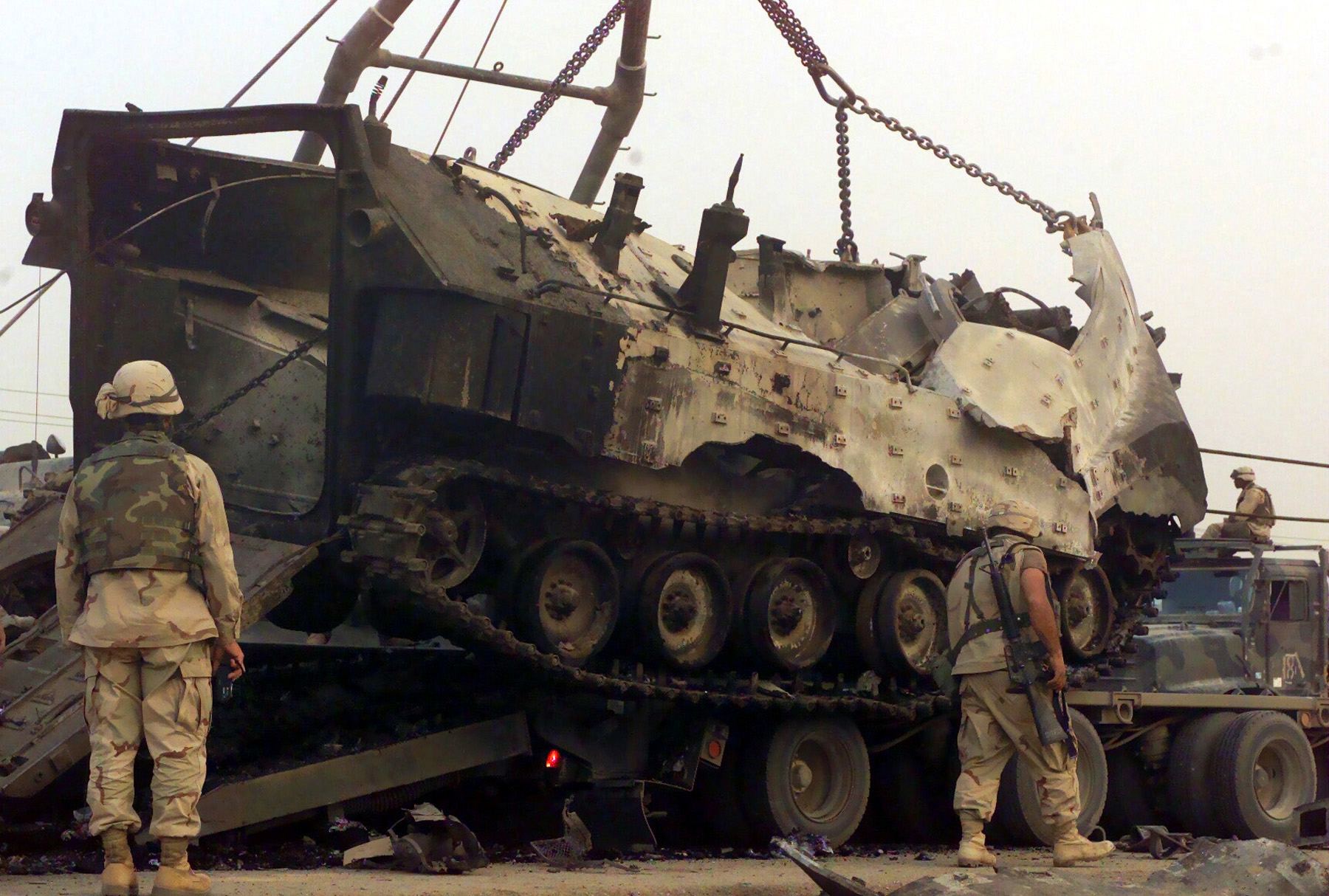
March 23 became the bloodiest day. After the 507th's ambush triggered chaos in the southern approaches, Marines of 1st Battalion, 2nd Marines attacked into the city with Assault Amphibious Vehicles and Cobra gunships, fighting to capture the bridges over the Euphrates. Fedayeen Saddam paramilitaries and Ba'ath Party fighters defended them fiercely. Then the worst came at the Saddam Canal. Eighteen Marines from Charlie Company's 60mm Mortar Section were killed, and eight AAVs were disabled by RPGs, mortars, artillery, and four Iraqi tanks hidden behind a building. A friendly-fire incident compounded the carnage: two A-10 Thunderbolts from the Pennsylvania Air National Guard, cleared by a forward air controller who had no contact with Charlie Company, strafed the Marine vehicles in multiple passes. At least one Marine died from the A-10 fire; the actual toll may have been as high as seventeen. Videotapes from the aircraft went missing. The investigation confirmed friendly fire but, as one account put it, was conducted "with no enthusiasm for determining what really happened."
Pushing Through
The fighting delayed Regimental Combat Team 1's advance by a full day. On the evening of March 24, LAV-25s of the 2nd Light Armored Reconnaissance Battalion pushed north of the Saddam Canal, leading RCT-1 through the gauntlet that Marines had named Ambush Alley. The 3rd Battalion, 1st Marines -- the "Thundering Third" -- held the corridor open as the rest of the combat team passed through overnight. Two Marines from the 6th Engineer Support Battalion, Corporal Evans James and Sergeant Bradley Korthaus, drowned trying to cross the canal under fire the following day. Sergeant Michael Bitz died from hostile fire while treating wounded Marines. In the murky darkness of March 25, an M1A1 Abrams tank drove through a gap in an unfinished sidewalk and plunged into the river. The entire four-man crew perished. Navy Seabee divers spent two days recovering the tank and the bodies inside.
The Jessica Lynch Story
Among the six soldiers captured from the 507th was Private First Class Jessica Lynch, a 19-year-old supply clerk from West Virginia. On April 3, The Washington Post reported that Lynch had fought heroically, firing her weapon even after sustaining multiple gunshot wounds. The story, sourced to unnamed officials, spread worldwide. It began unraveling the next day, when the Associated Press reported that Lynch's doctors said she had not been shot or stabbed. By April 15, the Post itself questioned its own account. Author Jon Krakauer later concluded that most details of Lynch's ordeal had been "extravagantly embellished, and much of the rest was invented from whole cloth" by anonymous military sources. Lynch herself testified before Congress that she had never fired her weapon. Also captured was Private First Class Lori Piestewa, a Hopi woman from Arizona who became the first Native American woman killed in combat while serving in the U.S. military. Piestewa died of her wounds shortly after capture. Specialist Shoshana Johnson, captured alongside Lynch, became the first Black female prisoner of war in U.S. military history.
What the Battle Left Behind
By March 27, organized Iraqi resistance had collapsed into sporadic Fedayeen attacks -- uncoordinated RPG and small arms fire against Marine patrols. Resistance formally ceased on April 1. The final toll: 32 Americans dead, 60 wounded, and six captured. Iraqi casualties were estimated at 359 to 431 killed, with over 300 wounded and 1,000 captured. The battle's significance extended beyond its body count. The fierce resistance from the 11th Infantry Division's 45th Brigade reportedly boosted morale across Iraqi Republican Guard units. The friendly-fire cover-up and the fabricated Lynch narrative became case studies in wartime information management. Colonel Joe Dowdy was relieved of command of RCT-1, partly due to the delays at Nasiriyah. For the Marines who fought through Ambush Alley, the battle left wounds that no press release could narrate or obscure. The Battle of Nasiriyah was cited as a major factor in a Marine's PTSD in episode 2 of the 2010 PBS series This Emotional Life.
From the Air
Located at approximately 31.05°N, 46.27°E along the Euphrates River in Dhi Qar Province, southern Iraq. The city straddles the river with two main bridges visible from altitude -- these were the tactical objectives of the battle. The Saddam Canal runs east-west through the northern part of the city. Highway 7 runs north-south through the urban area. Nasiriyah is roughly 225 miles southeast of Baghdad. Nearest major airport: Basra International (ORMM), approximately 180 km to the southeast. Tallil Air Base (ORTL), a military airfield, lies immediately adjacent to the city to the southeast near the ancient ruins of Ur. Flat desert terrain surrounds the city, with the green Euphrates corridor clearly visible. Best observed at 8,000-12,000 feet for urban layout and bridge positions.