Battle of Natural Bridge
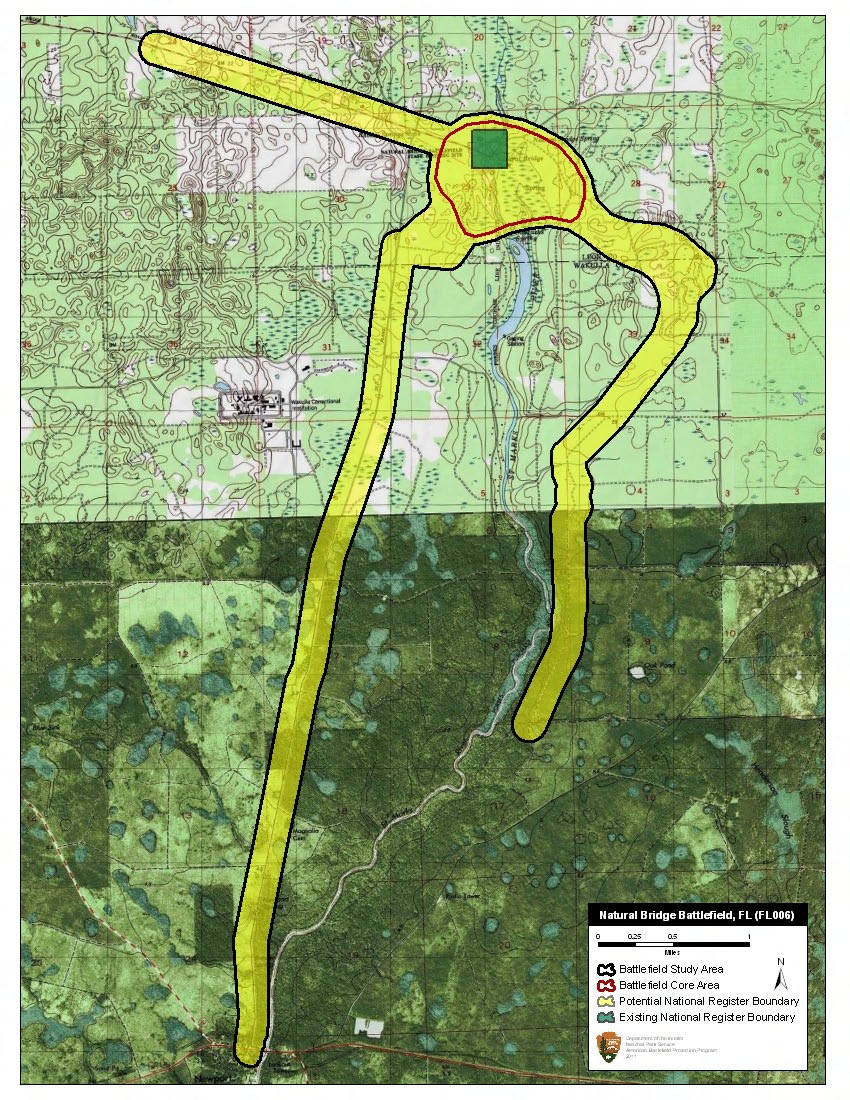
The boys were as young as fourteen. On the morning of March 6, 1865, roughly twenty-five cadets from the West Florida Seminary -- a school that would one day become Florida State University -- marched south from Tallahassee to join a thin Confederate defense line at a place called Natural Bridge. Here, the St. Marks River drops into a sinkhole and runs underground before resurfacing downstream, creating a natural land bridge across an otherwise impassable waterway. Union troops were already approaching in force. The cadets took their positions near the center of the line, helped man artillery pieces, and delivered ammunition under fire. By the end of the day, they had helped preserve Tallahassee as the only Confederate state capital east of the Mississippi River that Union forces never captured.
A River That Disappears
The Natural Bridge itself is a geological oddity. The St. Marks River, flowing through the limestone karst terrain of north Florida, drops into a sinkhole and vanishes underground, running beneath the surface before re-emerging downstream. The stretch of dry ground above the subterranean river creates a natural crossing point, one of the few places where an army could move across the St. Marks without boats or pontoons. Both sides understood its strategic importance. If Union forces could cross here, the road to Tallahassee lay open. If the Confederates could hold the bridge, the capital would remain in Southern hands. The geology of Florida's karst landscape, shaped over millions of years by dissolving limestone, had created the battlefield's most decisive feature.
Newton's Gamble
Union Brigadier General John Newton launched a joint army-navy expedition with the stated aim of engaging Confederate troops that had raided Cedar Keys and Fort Myers. The Union Navy attempted to push ships up the St. Marks River but found the waterway too shallow. The army force pressed on by land, advancing through the night. When they found one bridge already destroyed, they turned toward Natural Bridge, arriving before dawn on March 6. The first Union assault pushed the Confederate defenders back but could not drive them from the crossing. Two more charges followed, each repulsed by defenders shielded behind earthen breastworks. Sailors from the Union fleet also participated in the fighting, and two -- Seaman John Mack and Coxswain George Schutt -- were later awarded the Medal of Honor for their actions that day.
Old Men and Schoolboys
The Confederate force that held Natural Bridge was roughly 600 strong, a patchwork of regular soldiers, home guard militia, and the West Florida Seminary cadets. Brigade General William Miller commanded the defense, positioning his troops behind breastworks that guarded every approach to the bridge. The cadets, ages fourteen to seventeen, were stationed near the center of the line. Accounts from the battle note that their composure under fire impressed even hardened veterans. They helped serve the artillery and kept ammunition moving to the guns throughout the day-long engagement. The battle resulted in 148 Union casualties and 26 Confederate losses. Unable to break through after three separate assaults, the Union troops retreated south to the protection of their fleet.
The Capital That Never Fell
Although the Union expedition had not specifically targeted Tallahassee, the defeat at Natural Bridge effectively ended any threat to Florida's capital for the remainder of the war. The Confederacy would surrender just over a month later, in April 1865, making Natural Bridge one of the last Confederate victories of the entire conflict and the second-largest battle fought in Florida. Tallahassee's distinction as the only Confederate state capital east of the Mississippi never captured by Union forces remains a point of local pride. Florida State University's ROTC program -- the institutional descendant of the West Florida Seminary -- is one of only four Army ROTC programs in the country authorized to display a Civil War battle streamer, a direct legacy of those teenage cadets who held the line.
Holding the Ground
The battlefield is preserved today as Natural Bridge Battlefield State Historic Site, a quiet park set among the live oaks and palmettos south of Woodville, Florida. Each year on the first weekend of March, a ceremony and battle reenactment brings Union, Confederate, and civilian reenactors to the site to honor the combatants on both sides. The event is free and open to the public. The natural bridge itself remains, the river still disappearing underground and resurfacing just as it did in 1865. The breastworks are gone, the smoke has long since cleared, but the landscape holds its shape. The geological feature that determined the battle's outcome continues to define this place -- a stretch of solid ground over a hidden river, where schoolboys once stood against a professional army and held.
From the Air
The Battle of Natural Bridge site is located at 30.284N, 84.152W near Woodville, Florida, approximately 10nm south of Tallahassee. From the air, look for the St. Marks River corridor running through dense forest, with the Natural Bridge Battlefield State Historic Site visible as a cleared area along the river. The geological feature -- where the river disappears underground -- is subtle from altitude but the park's open grounds and access road are identifiable. Nearest airport: Tallahassee International (KTLH), approximately 12nm north. Best viewed at 1,500-2,500 feet AGL.