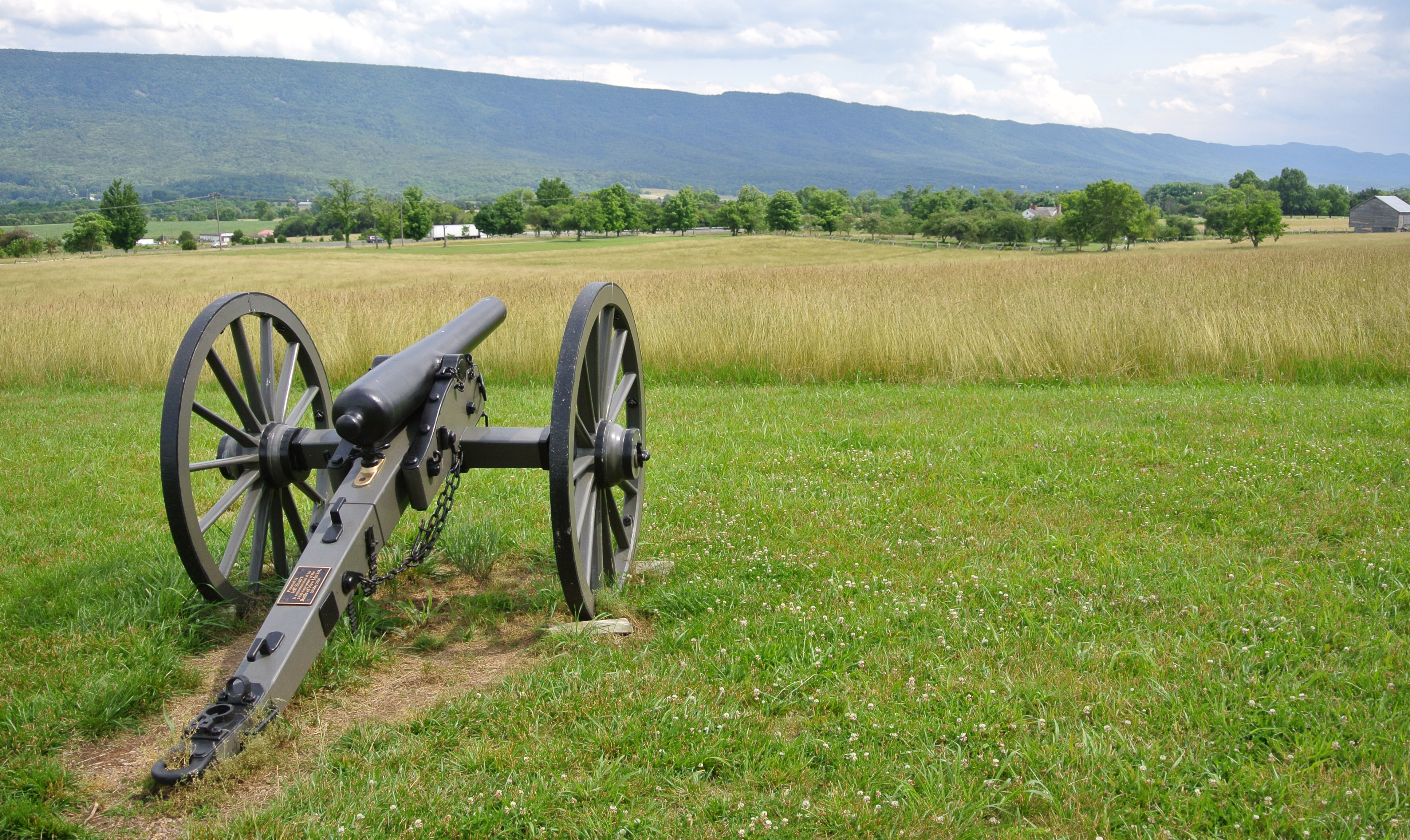
Battle of New Market
Every year at the Virginia Military Institute, a roll call echoes across the parade ground. An officer reads the name of a cadet who died at New Market. A representative from the same company in the modern Corps answers: "Died on the Field of Honor, Sir." A three-volley salute follows, then Taps. The ceremony has been held since 1887, but the battle it commemorates happened on a single rain-soaked afternoon in May 1864, when 247 cadets averaging eighteen years of age, some as young as fifteen, marched into Union fire in the Shenandoah Valley and helped turn the tide of the only engagement in American history where a school's student body fought as an organized military unit.
Grant's Grand Design Unravels
In the spring of 1864, Ulysses S. Grant set a multi-front strategy in motion to crush the Confederacy. Control of the Shenandoah Valley, the breadbasket that fed Robert E. Lee's Army of Northern Virginia, was critical. Grant ordered Major General Franz Sigel to advance with roughly 9,000 troops and 28 cannons up the valley toward Staunton, Virginia, where he would link with George Crook's column advancing from West Virginia to destroy the Virginia & Tennessee Railroad. Detachments along the way whittled Sigel's effective force to about 6,300. Confederate Major General John C. Breckinridge, a former U.S. Vice President, scrambled to assemble every available soldier. His makeshift army of 4,100 included two infantry brigades, a cavalry brigade under John D. Imboden, and the VMI cadet corps, a battalion of 247 young men commanded by Lieutenant Colonel Scott Shipp with a two-gun artillery section. Rather than wait for Sigel to reach Staunton, Breckinridge marched north to meet him. By the evening of May 14, the two forces were eight miles apart.
Into the Orchard
Contact came south of New Market on the morning of May 15. Breckinridge deployed his brigades along the Valley Turnpike, keeping the cadets in reserve. He launched his infantry attack near noon, slowly pushing the Union line off Manor's Hill and northward toward Bushong's Hill. But when massed Union rifle and artillery fire shattered the Confederate center around 2:00 p.m., the 51st Virginia Infantry and the 30th Virginia Infantry Battalion retreated in confusion, opening a dangerous gap. Breckinridge had no choice. He reluctantly ordered the cadet battalion forward to fill the hole. As the young soldiers advanced toward the Bushong orchard, their commander Shipp was wounded and replaced by Captain Henry A. Wise. Sigel launched counterattacks on both flanks but failed. His cavalry charge was routed by Confederate artillery, and three infantry regiments were repulsed on the right, hampered by confusion in the Union command. Sigel himself was reported shouting orders in German.
The Field of Lost Shoes
Shortly after 3:00 p.m., Breckinridge ordered the full advance. As the Confederate line crossed a muddy field near Bushong's orchard, the saturated ground sucked the shoes off several VMI cadets, who pressed forward in stocking feet. The field would be known forever after as the Field of Lost Shoes. The advancing Confederates forced Sigel's batteries to retreat, and Union infantry began breaking for the rear. Five cannons were abandoned, one captured by the cadet battalion itself. Fresh Union reinforcements and Battery B of the 5th U.S. Artillery slowed the pursuit, but with his men exhausted and ammunition running low, Sigel ordered a retreat across the Shenandoah River to Mount Jackson, burning the bridge behind him. The Union army had suffered 841 casualties: 96 killed, 520 wounded, and 225 captured or missing. Confederate losses stood at 43 killed, 474 wounded, and 3 missing. Of the 247 VMI cadets, 60 became casualties, a rate of 24 percent. Five were killed in action, and five more died later of their wounds.
Harvest and Aftermath
The Confederate victory had immediate strategic consequences. The Shenandoah Valley's crops were saved for Lee's army, and his supply lines to western Virginia remained intact. Virginia newspapers compared Breckinridge to Stonewall Jackson. An enraged Grant replaced Sigel with General David Hunter, who resumed the march southwest and defeated the Confederates at the Battle of Piedmont on June 5, occupying Staunton the following day. Breckinridge's forces were transferred east to reinforce Lee at the Battle of Cold Harbor. New Market delayed Grant's valley strategy by weeks, but it did not stop it.
Memory Cast in Bronze
Today, 300 acres of the battlefield are preserved as the New Market Battlefield State Historical Park. At VMI, the monument Virginia Mourning Her Dead stands at the center of the New Market Day ceremony. It was sculpted by Moses Ezekiel, VMI Class of 1866, who fought at New Market as a cadet himself. The names of all cadets in the Corps of 1864 are inscribed on the monument, and six of the ten who died are buried at its base. The wounded from the battle were cared for in Bushong's barn and at the Smith Creek Baptist Church. The dead were buried in the graveyard of St. Matthew's Lutheran Church. In 1923, Marine Corps Brigadier General Smedley Butler staged a massive reenactment on the original ground with Quantico marines, drawing an estimated 150,000 spectators. The 2014 film Field of Lost Shoes brought the cadets' story to a wider audience. But it is that annual roll call, the naming of the dead and the response from the living, that keeps New Market vivid in a way no monument or movie can match.
From the Air
The New Market battlefield sits at 38.66N, 78.67W in the Shenandoah Valley of Virginia, along the historic Valley Turnpike (now US Route 11). The 300-acre state historical park and the town of New Market are visible between the North Fork of the Shenandoah River to the west and Smith's Creek to the east. Massanutten Mountain rises to the east, and the main Blue Ridge runs to the west. Nearest airports include Shenandoah Valley Regional (KSHD) about 20 nm south and Luray Caverns Airport (W45) about 15 nm northeast. Best viewed at 2,000-3,000 feet AGL to see the full sweep of the valley floor where the battle unfolded.