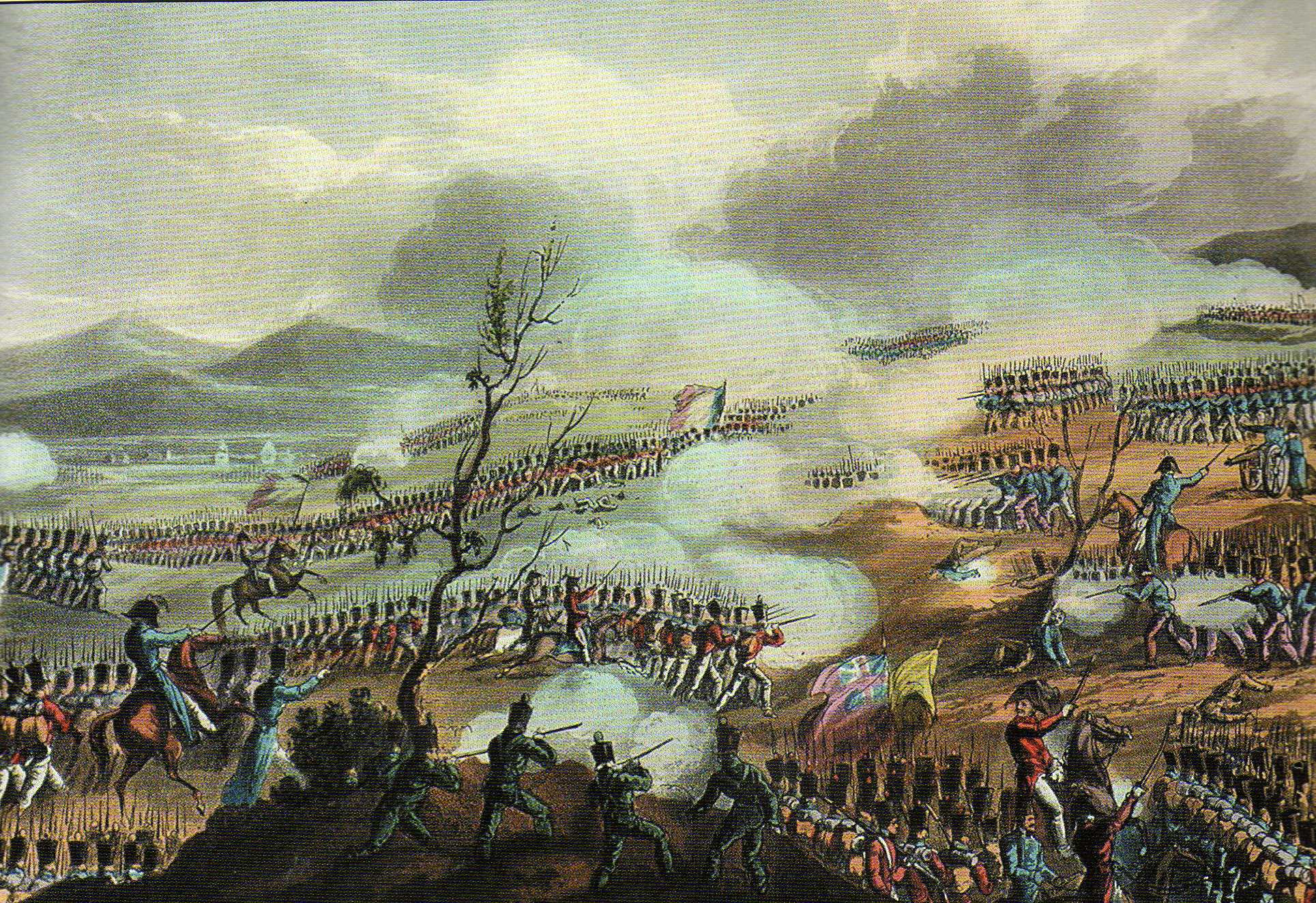
Battle of Nivelle
Colborne's men took the star-shaped fort without suffering a single fatality. On 10 November 1813, the 52nd Light Infantry materialized from the treeline below the Mouiz plateau so suddenly that the French garrison, believing soldiers had appeared from the earth itself, broke and fled before a shot was fired. It was the kind of tactical surprise that defined the Battle of Nivelle - a day when Wellington's carefully orchestrated assault along a twenty-mile front shattered Marshal Soult's defensive line in the foothills of the western Pyrenees and drove the French army streaming back across the River Nivelle by two o'clock in the afternoon.
Stretched to Breaking
Soult's position looked formidable on paper. His army occupied a chain of hilltop redoubts stretching from the Atlantic coast to the snow-covered pass of Roncesvalles, with the craggy, gorse-covered mass of La Rhune dominating the center of the line at nearly 3,000 feet. But the marshal had only 50,000 men to hold a twenty-mile perimeter, leaving no reserves to plug gaps or counterattack breakthroughs. Wellington recognized the vulnerability immediately. His plan was elegant in its simplicity: demonstrate along the entire French line to pin defenders in place, then drive the main assault through the center with Beresford's four divisions. Any breach in the center would sever communication between Soult's flanks, making each half of his army vulnerable to encirclement.
Ghosts on the Greater Rhune
The attack began before dawn. The Light Division advanced toward the plateau atop the Greater Rhune, which French troops had already abandoned after the skirmish at the Bidassoa weeks earlier, fearing they would be cut off from their own army. The division's objective was to sweep three defensive forts the French had built along the crest of the Lesser Rhune. Moving down into the ravine below the ridge, the men of the 43rd, 52nd, and 95th Rifles were ordered to lie flat and wait. When a battery of cannon fired the signal, they surged upward. Exhausted from the climb, they stormed the redoubts on the crest with such surprise and boldness that the French defenders fled toward positions on neighboring hills rather than stand and fight.
Appearing from the Earth
While the 43rd and 95th cleared the Rhune positions, a powerful star-shaped fort remained on the Mouiz plateau below, reaching toward the coast. Colborne led his 52nd Light Infantry against it, supported by riflemen of the 95th. The approach used dead ground so effectively that the French garrison saw nothing until British soldiers emerged from the trees at close range. In the defenders' stunned perception, the attackers had materialized from the ground. The French soldiers, suddenly aware they could be cut off, abandoned the fort and its connecting trenches without a prolonged fight. Colborne took possession without losing a single man killed - a remarkable outcome against a fortified position designed to withstand exactly this kind of assault.
The Bridge at Amotz
With the mountain positions falling, the main British assault swept forward across a five-mile front. Nine divisions fanned out against Soult's disintegrating line. The decisive moment came when the 3rd Division seized the bridge at Amotz, severing all communication between the two halves of the French army. Once that link broke, organized resistance collapsed. French soldiers who had held their posts through the morning assault now found themselves isolated, unable to receive orders or reinforcements. By two o'clock, Soult's troops were streaming across the Nivelle in full retreat, abandoning positions they had spent weeks fortifying. The French lost 4,500 men; Wellington's casualties were around 2,500, reflecting the scale of the allied victory over a well-fortified position, and the strategic result was decisive.
Double Triumph
News of the victory at the Nivelle reached London at the same time as reports of the liberation of Hanover by allied forces in northern Europe, giving the British public a rare double celebration. For Wellington, the battle confirmed what San Marcial and the Bidassoa crossing had already suggested: Soult's army was a spent force. The marshal had been pushed steadily back from the Spanish frontier, losing defensive line after defensive line. His troops, demoralized by months of retreat, no longer fought with the tenacity that had once made French infantry the terror of Europe. The road to Bayonne and ultimately to the French interior now lay open, and the Peninsular War was entering its final act.
From the Air
The Battle of Nivelle took place along the River Nivelle at approximately 43.33N, 1.54W in the foothills of the western Pyrenees near the Franco-Spanish border. La Rhune (905 meters) dominates the terrain and is visible from considerable distances. Best viewed at 3,000-5,000 feet AGL to appreciate the chain of hilltop positions along the French defensive line. The nearest airports are San Sebastian (LESO) about 15 nautical miles southwest and Biarritz-Anglet-Bayonne (LFBZ) approximately 10 nautical miles north. Mountain weather can change rapidly; expect turbulence near ridgelines.