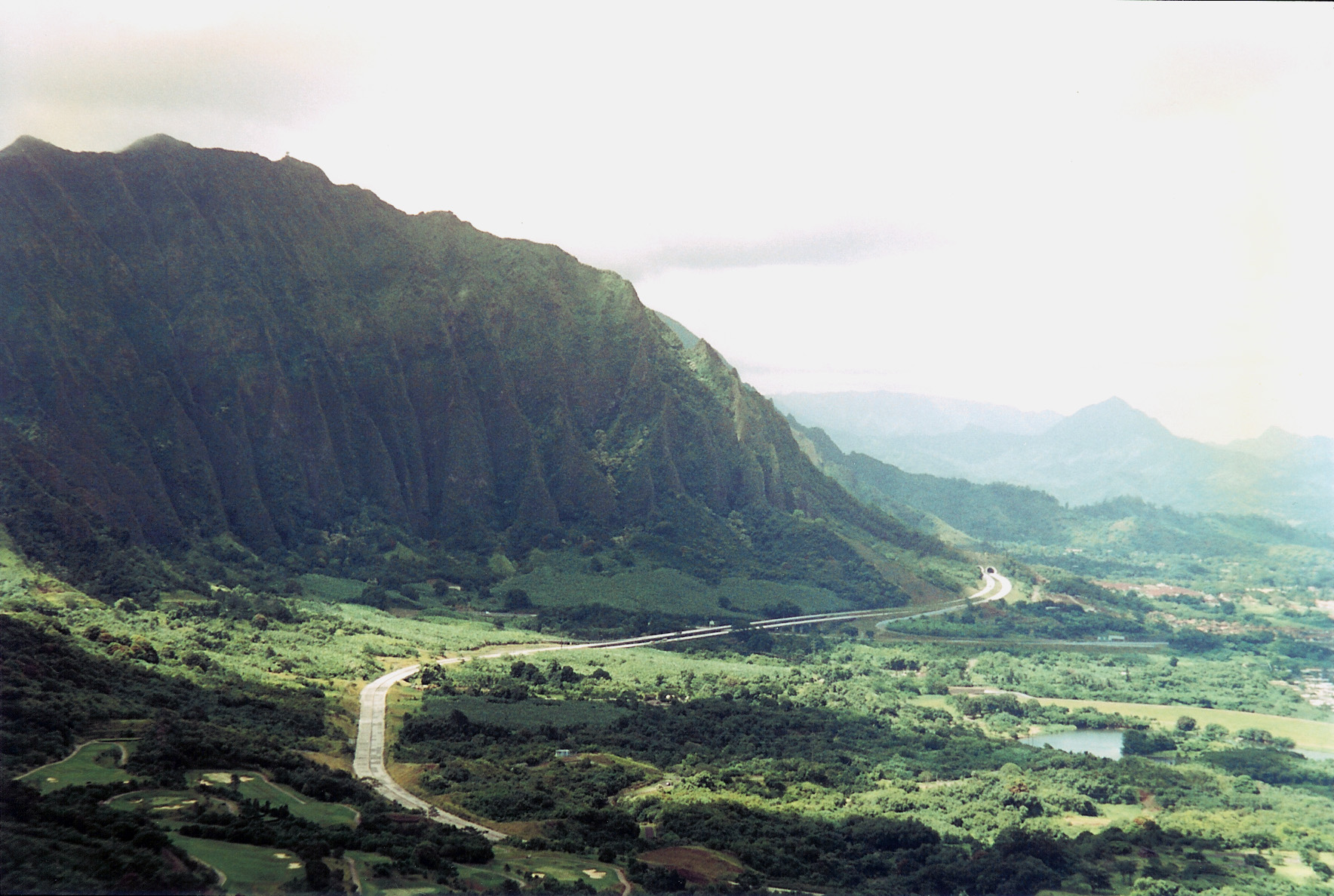
Battle of Nu'uanu
The Hawaiians called it Kalelekaanae: the leaping mullet. The name referred not to fish but to warriors, over 700 of them, who went over a 1,000-foot cliff at the head of Nu'uanu Valley in May 1795. They were the defenders of Oahu, driven there by the army of Kamehameha I, and their fall marked the moment the Hawaiian Islands ceased to be a collection of rival chiefdoms and became, for the first time, something close to a unified kingdom. A century later, construction workers building a road along the Pali discovered 800 skulls at the base of the cliff, the physical remains of a political transformation.
A Kingdom in Pieces
Before the battle, the Hawaiian Islands were divided among competing chiefs who formed and broke alliances with the same fluidity as the ocean currents between their islands. Kamehameha I controlled the Big Island of Hawaii. Kahekili II held Oahu, while his half-brother Kaeokulani controlled Kauai, Maui, Lanai, and Molokai. European traders and adventurers complicated everything. Around 1792, the English merchant Captain William Brown sailed into Honolulu Harbor and offered military support to Kahekili in exchange for port access. Kamehameha, not to be outdone, sought artillery from Captain George Vancouver and in February 1794 formally ceded the Big Island to Great Britain in exchange for weapons. These were the terms of Hawaiian politics in the 1790s: sovereignty traded for gunpowder.
Civil War on Oahu
Kahekili II died in mid-1794, and the alliance holding his territory together died with him. His son Kalanikupule inherited Oahu. His half-brother Kaeokulani wanted to pass through Oahu to reach Kauai. What began as a passage became a war called Kukiiahu, lasting from November 16 to December 12, 1794. Kalanikupule won, thanks in part to the cannons aboard Captain Brown's ships. But victory brought new problems. A dispute over payment ended with Brown and several of his men killed. Kalanikupule seized the ships and their weapons, intending to sail against Kamehameha. The ships' crews recaptured the vessels, sailed to the Big Island, and handed Kalanikupule's entire arsenal to Kamehameha. It was a catastrophic strategic error for Oahu.
Twelve Thousand Men and 1,200 Canoes
Kamehameha had been preparing for years. Under the direction of British sailor John Young, his warriors trained with muskets and cannons. By February 1795, he had assembled the largest military force the Hawaiian Islands had ever seen: approximately 12,000 men and 1,200 war canoes. He conquered Maui and Molokai in the early spring, then turned to Oahu. Kalanikupule had warning. The chiefs of Maui and Molokai sent word of the coming invasion, and Kalanikupule built fortification lines across the southern approaches to Honolulu. He was aided by Kaiana, one of Kamehameha's own chiefs, who had defected before the battle and cut gunports into the Nu'uanu mountain ridge for Oahu's cannons. But Kalanikupule had far fewer weapons than Kamehameha, and fewer men to use them.
Up the Valley, Over the Edge
Kamehameha's forces landed on Oahu's southeastern shore near Waialae and Waikiki. After days of scouting, the army advanced westward and hit Kalanikupule's first defensive line near Punchbowl Crater. Kamehameha split his forces, sending one half in a flanking maneuver around the crater while the other attacked directly. Pressed from both sides, the Oahu army fell back to a second line at Laimi. Kamehameha brought up his own cannons and secretly detached troops to clear the ridgeline heights above the valley. During the fighting at Laimi, both Kalanikupule and the defector Kaiana were wounded. Kaiana died. With its leadership shattered, the Oahu army retreated north through the narrowing valley until there was nowhere left to go but over the cliff at Nu'uanu Pali.
The Kingdom That Followed
Kalanikupule escaped the battle but was eventually captured. Kamehameha's victory at Nu'uanu was the decisive moment of his campaign, and afterward his domain was called the Kingdom of Hawaii for the first time. Still, the islands were not yet fully unified. Kauai and Niihau remained independent under King Kaumualii, and Kamehameha had to suppress an uprising on the Big Island before he could address them. In the end, Kaumualii submitted to Kamehameha without a battle, giving the conqueror effective control over every inhabited island in the chain. The Pali lookout where the warriors fell is today a scenic overlook on the windward side of Oahu. The trade winds whip through the gap in the Koolau Range so fiercely that visitors sometimes struggle to stand upright, a reminder that the landscape itself still commands respect.
From the Air
The battle site extends from Waikiki (21.28N, 157.83W) northwest through Nu'uanu Valley to Nu'uanu Pali lookout at 21.37N, 157.79W, where the Koolau Range drops precipitously to the windward coast. The Pali cliffs are dramatic from both sides. The valley narrows visibly from the air as it climbs from Honolulu to the ridge. Nearest airport: PHNL (Daniel K. Inouye International Airport), approximately 5 nm west.