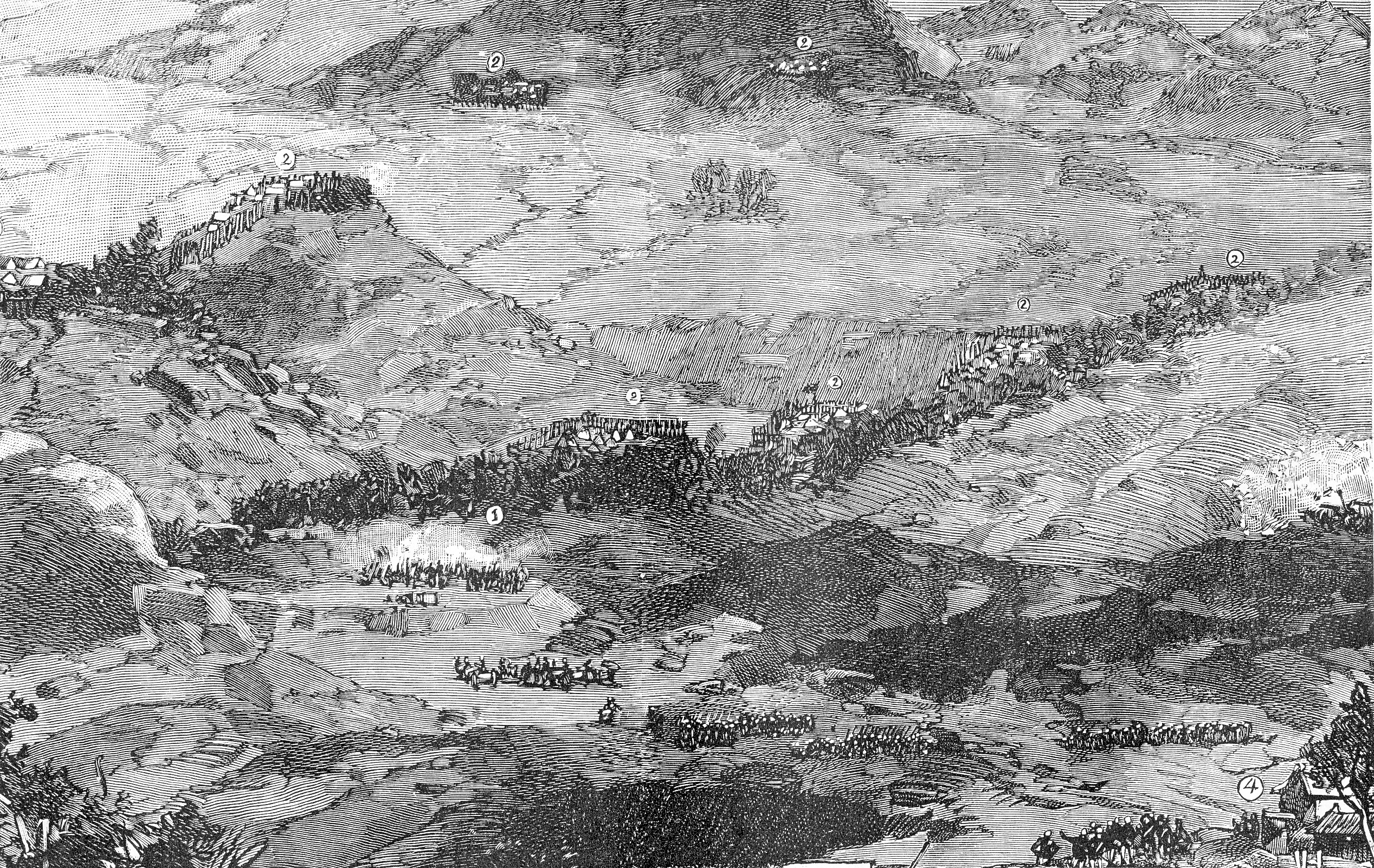
Battle of Nui Bop
On the morning of 23 December 1884, Tonkinese farmers walked into the French headquarters at Chu with urgent news: a Chinese army had occupied the conical hill of Nui Bop, eighteen kilometers to the east, and its soldiers were plundering every village they could reach for food. The farmers' resentment delivered intelligence that reconnaissance had not. Within days, General Francois de Negrier would lead fewer than 3,000 men against a fortified camp held by 12,000 Chinese regulars, in what his fellow officers later called the most spectacular professional triumph of his career.
A Hungry Army on a Hill
The Guangxi Army had reason to be desperate. Driven south in the October battles of the Kep campaign, its detachments had been defeated in quick succession at Lam, Kep, and Chu. But the Chinese commanders had not abandoned their ambition to break into the Red River Delta. Hunger sharpened their urgency. In late December, some 12,000 troops under General Wang Debang, who had humiliated a French column months earlier at the Bac Le ambush, occupied Nui Bop and began digging in. They built eight forts across the massif's lower slopes, positioned Krupp artillery batteries, and laid out a fortified camp that bristled with defenses facing south toward the French base at Chu. The hill's proximity to Chu made it intolerable. The French could not launch their planned campaign against Lang Son with 12,000 enemy soldiers threatening their right flank. Something had to give.
The Flanking March
De Negrier chose cunning over brute force. Rather than marching east from Chu into the teeth of the Chinese defenses, he crossed to the southern bank of the Luc Nam River on the morning of 3 January 1885 and swung wide to strike the Chinese left. A Foreign Legion battalion at Chu would demonstrate against their front to hold their attention. The plan was elegant; the execution stumbled almost immediately. At the ford of Dao Be, the column discovered that the riverbank rose more than nine feet sheer above the water. What should have been a quick crossing consumed three hours. By the time the main body resumed its march at four in the afternoon, Chinese scouts had spotted the column. Surprise was lost. When the advance guard under Commandant Mahias reached the Phong Cot valley, a long line of Chinese infantry stood waiting across the valley floor, with skirmishers already pushed forward into a wood barely 800 meters from the river.
Midnight at Phong Cot
What followed was a grinding afternoon of close combat on unfamiliar terrain. Mahias's marines drove the Chinese skirmishers from the wood with relative ease, but Captain Salles pushed too far beyond his own lines and found himself taking fire from heights on both sides of the valley. The artillery had to shift targets to extricate him. The 143rd Line Battalion struggled to establish a foothold on the high ground to the right, and when its advance opened a gap in the center, Chinese troops counterattacked through it. Lieutenant Desloge's reserve company plugged the hole and pushed on. By nightfall, the French held the surrounding heights but not the village itself. De Negrier, sensing the Chinese were shaken, ordered Lieutenant-Colonel Herbinger to take Phong Cot. The Chinese had already slipped away in the darkness. Herbinger occupied it without firing a shot and placed Captain Verdier's company in an exposed forward position beyond the village perimeter.
A Private Named Meffret
Just before dawn on 4 January, the Chinese counterattacked in force, with artillery from the Western Fort hammering the French positions. Within minutes, Verdier's isolated company was surrounded. As his men fought at close range, Verdier sent a young private named Meffret crawling through the Chinese lines in the predawn gloom to reach Phong Cot and beg for reinforcements. Meffret made it. Herbinger's response was bafflingly inadequate: ten men. But Captain Tailland, watching from a hill to the west, could see the company being overwhelmed. Without waiting for orders, he led his marines to the rescue. Verdier, wounded, ordered his men to charge. The gamble worked. The Chinese recoiled, Tailland's men arrived on the left flank, and the two companies drove the attackers off together. Both officers were later mentioned in dispatches. By midmorning, de Negrier directed a series of attacks that rolled up the Chinese positions one by one. The 111th Battalion charged the main trench with bayonets, and the 143rd Battalion and Algerian Rifles turned the enemy's left. By 11:15 a.m., the entire fortified camp was in French hands.
What Victory Cost
French casualties were 19 dead and 65 wounded, modest losses for an assault against nearly ten-to-one odds. The Chinese left 600 dead on the field, along with two Krupp batteries, battle flags, rifles, tents, and provisions. What happened next darkens the triumph: French soldiers methodically killed wounded Chinese soldiers they found on the battlefield with pistol shots to the head. Unwounded prisoners were interrogated and later released with small payments. The victory's strategic effect was immediate. With Nui Bop secured, the French had a staging ground for the supplies and ammunition needed for the Lang Son expedition. In Paris, the battle tipped a fierce political debate. The day after de Negrier's victory, the hawkish new army minister General Jules Lewal ordered the capture of Lang Son as soon as possible. A month later, Briere de l'Isle launched the campaign that took it in ten days. The conical hill that hungry Chinese soldiers had fortified against all comers had become the hinge on which France's Tonkin strategy turned.
From the Air
Located at 21.848N, 106.758E in the Luc Nam valley of northern Vietnam, near the Chinese border in present-day Bac Giang / Lang Son province area. The distinctive conical hill of Nui Bop is visible from moderate altitude. Nearest significant airports include Noi Bai International (VVNB) approximately 130 km southwest. The terrain is hilly with river valleys running through limestone karst landscape. Best viewed from 5,000-8,000 feet for terrain context.