Battle of Nykarleby
The Swedish army won the battle and lost the war -- and the celebrations in between may have been the reason. On Midsummer's Eve 1808, Swedish forces under Carl Johan Adlercreutz descended on the town of Nykarleby in Ostrobothnia, expecting to encircle and destroy the Russian main army. They found the town empty, the enemy already gone, and the bridge in flames. What followed was part skirmish, part farce, and part cautionary tale about what happens when soldiers pause to drink on the longest night of the year.
The Trap That Wasn't
Adlercreutz had identified Nykarleby as the perfect place to spring an encirclement. The Russian forces occupying the Ostrobothnian coast were concentrated in the town, and a coordinated Swedish advance could pin them against the sea. Another Swedish force under Johan Bergenstrahle was simultaneously landing at Vaasa to the south, creating what looked like an airtight pincer. But the Russians, commanded by Jankovitch, had already evacuated. By the time the Swedes arrived, the town's garrison had withdrawn toward Vaasa, burning the bridge across the river behind them. Adlercreutz's surprise attack met nothing but smoke and an empty town.
Dobeln in the River
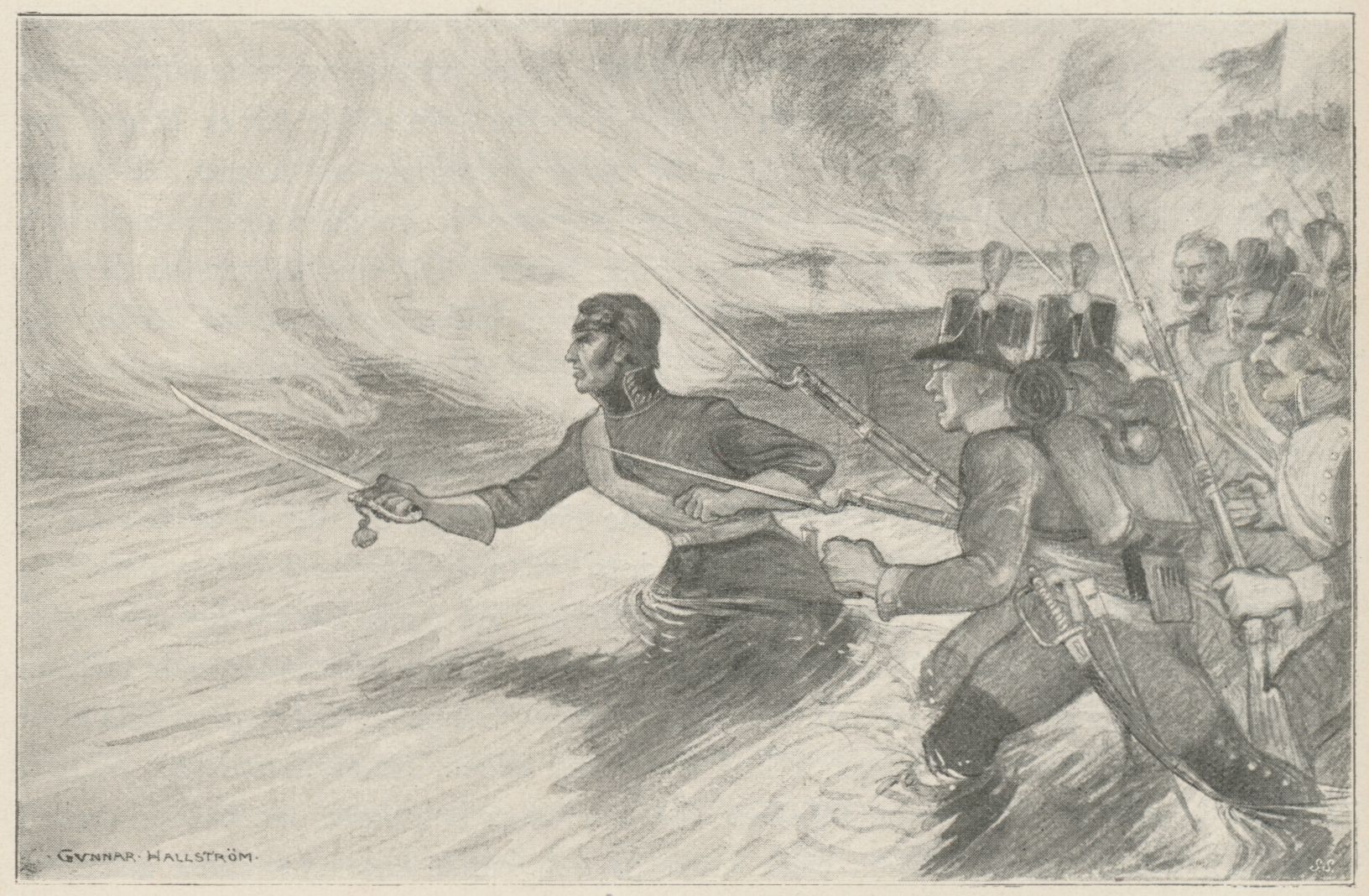
Georg Carl von Dobeln -- the same officer who would distinguish himself at the Battle of Jutas later that September -- was marching at the head of the Pori Regiment when he saw the Russians retreating across the burning bridge. According to legend, his fury at the failed surprise was so complete that he charged straight into the river, fully armed, with his regiment loyally splashing in behind him. The current nearly swept him away, and his men had to haul their commander to safety before he drowned. Whether the story is precisely true or has been polished by two centuries of retelling, it captures the frustration of a plan gone wrong -- the enemy visible, retreating, and unreachable.
Midsummer's Feast, Tomorrow's Defeat
What the Swedes did have was a liberated town, a Midsummer's Eve, and grateful inhabitants. The people of Nykarleby opened their doors, offering food and drink to the arriving soldiers. The Swedes accepted. The fighting that did occur -- a brief clash with Russian rearguard units and an encounter with a small Swedish patrol under Major Carl von Otter -- amounted to little more than skirmishing. Casualties were minimal on both sides, and the Battle of Nykarleby earned its reputation as a relatively bloodless affair. But the celebration exacted a cost that no one tallied that evening. The hours spent feasting in Nykarleby were hours not spent marching south to support Bergenstrahle's landing force at Vaasa.
The Price of a Party
The delay proved strategic. Without Adlercreutz's main force arriving in time, the Swedish operation at Vaasa faltered. The coordinated pincer that might have crushed the Russian army in Ostrobothnia never materialized. The broader summer offensive stalled, and within weeks the Swedish position in Finland deteriorated further -- culminating in the tactical success but strategic failure at Jutas, and the devastating defeat at Oravais, in September. Finland, which had been part of Sweden for over six hundred years, would be ceded to Russia by the Treaty of Fredrikshamn in September 1809. The Battle of Nykarleby remains one of those episodes where a tactical success -- however modest -- contributed to a strategic failure. The Swedes won the town but lost the night, and with it, perhaps, the momentum that might have changed the course of the Finnish War.
From the Air
Located at 63.52N, 22.53E on the coast of the Gulf of Bothnia in western Finland. Nykarleby is a small town at the mouth of a river, with the historic town center and bridge crossing visible at low altitude. Nearest airport: Kokkola-Pietarsaari (EFKK) approximately 15 km to the north. Vaasa (EFVA) lies about 60 km to the south along the coast. Coastal terrain with the Gulf of Bothnia to the west; flat agricultural land inland.