The Thunderstorm That Changed Japan
"Man has but fifty years, and life is but a dream." Oda Nobunaga chanted these words from the song "Atsumori" as he dressed for battle on the morning of June 12, 1560. He wolfed down a bowl of rice porridge while still standing, strapped on his armor, and rode out of Kiyosu Castle toward almost certain death. The warlord Imagawa Yoshimoto had crossed into Owari Province with 25,000 troops, already overrunning Nobunaga's border fortresses. Nobunaga could muster roughly 3,000. His advisors urged retreat. He chose attack. By nightfall, Yoshimoto would be dead and the trajectory of Japanese history permanently altered.
A Province in the Path of an Army
Imagawa Yoshimoto controlled three provinces -- Suruga, Totomi, and Mikawa -- and in the spring of 1560 he assembled an army of 25,000 to march along the Tokaido highway toward Kyoto. His aim was to challenge the weakening Ashikaga shogunate for dominance over Japan. The route took him directly through Owari Province, recently unified under Nobunaga, a young lord not yet taken seriously by the established powers. The Imagawa forces swept through Nobunaga's border defenses with ease. Matsudaira Motoyasu, a vassal of Yoshimoto who would later become Tokugawa Ieyasu, captured Marune fortress. Washizu fell as well. Yoshimoto made camp at a place called Dengakuhazama, in the village of Okehazama, just outside what is now the city of Nagoya. His generals were celebrating. The conquest of Owari appeared to be already settled.
A Gambler's Arithmetic
Inside Kiyosu Castle, Nobunaga's generals debated whether to fortify the castle and withstand a siege. Nobunaga dismissed the idea -- Kiyosu could not hold against 25,000. "Only a strong offensive policy could make up for the superior numbers of the enemy," he declared. His scouts knew the terrain around Okehazama intimately; Nobunaga had conducted war games there for years, disguised as falconry hunts. That night, he told his men that waiting meant death and sent them home to rest. Before dawn, he prayed at Atsuta Shrine, then led his small force to a fortified temple called Zensho-ji, positioning them within striking distance of the Imagawa camp. To deceive enemy scouts, he ordered banners and flags planted around the temple to suggest a much larger army.
Rain, Thunder, and Three Thousand Men
The afternoon of June 12 was brutally hot. Inside the Imagawa camp, soldiers celebrated their easy victories. Many had stripped off their armor. Then the sky darkened. A violent thunderstorm rolled across the narrow valley where Yoshimoto had pitched camp, sheets of rain hammering the tents and drowning out all other sound. Under cover of the downpour, Nobunaga's men struck. They hit the heart of the camp, not the flanks -- a frontal assault that exploited surprise, terrain, and weather. Panic erupted. The Imagawa soldiers, many unarmed and disoriented, broke ranks and fled. Yoshimoto himself fought. When the Oda samurai Mori Shinsuke attacked with a spear, Yoshimoto sliced through the weapon's shaft and cut into Shinsuke's knee. But a second warrior, Hattori Koheita, tackled the general and took his head. With Yoshimoto and nearly all his senior officers dead, the massive army collapsed.
Three Unifiers Born from One Battle
The Battle of Okehazama is counted among the most consequential events in Japanese history. The Imagawa clan, stripped of its leader and its prestige, disintegrated within years. Matsudaira Motoyasu, freed from his obligations as an Imagawa vassal, allied with Nobunaga and eventually became Tokugawa Ieyasu, founder of the Tokugawa shogunate that would rule Japan for over 250 years. Among Nobunaga's own retainers, the battle marked the first time he noticed a lowly sandal-bearer named Kinoshita Tokichiro, who would rise to become Toyotomi Hideyoshi, the second of Japan's three great unifiers. One afternoon's gamble in a thunderstorm set all three men on the path that would end the Sengoku period and reunify the nation.
Seven Pillars in a Quiet Park
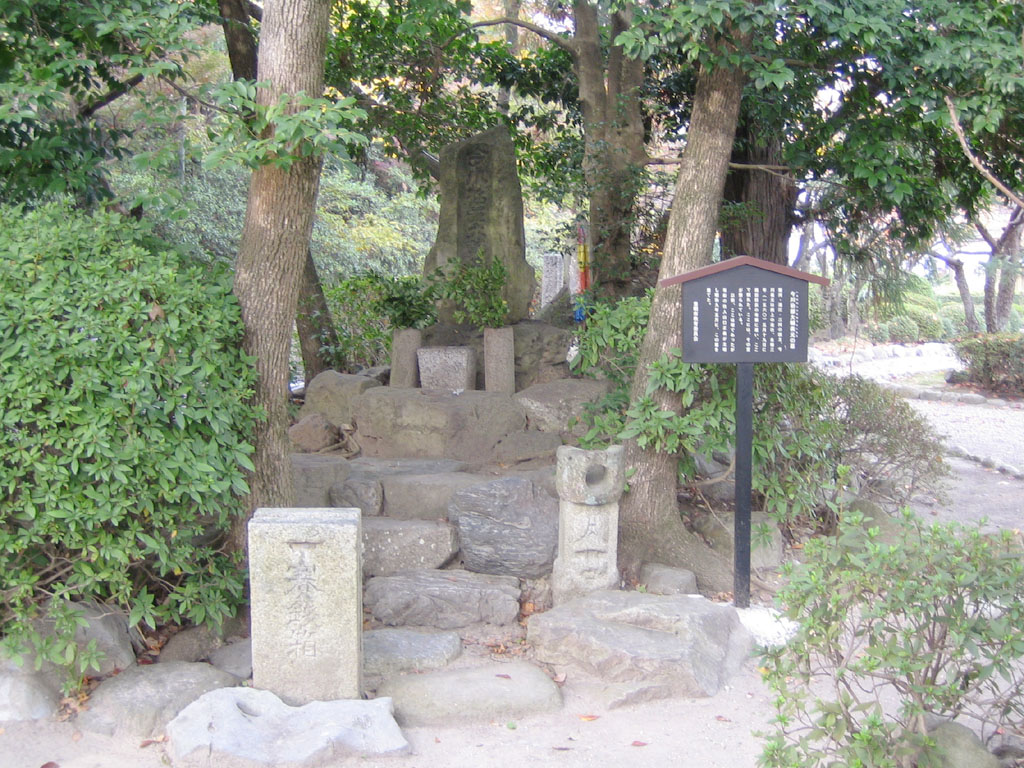
Today the battlefield is a quiet park in Toyoake City, just south of Nagoya. In 1937, Japan's Ministry of Education designated the site as a National Historic Site. Seven granite pillars stand in a row at Minamiyakata, each one representing one of Yoshimoto's seven warlords. The first pillar bears the inscription: "Imagawa Yoshimoto was killed here." The narrow valley where 25,000 troops once camped is now suburban neighborhood, the Tokaido highway replaced by modern roads. But the geography still reads clearly -- the confined space, the surrounding hills, the terrain that favored a smaller force willing to take an outrageous risk. Standing among the pillars, it is easy to picture the rain falling and the banners going down.
From the Air
Located at 35.05°N, 137.00°E in Toyoake City, just southeast of Nagoya. The battlefield park sits in a narrow valley visible as a green patch amid suburban development. Best viewed at 2,000-4,000 feet AGL. Chubu Centrair International Airport (RJGG) lies approximately 15 nautical miles to the south-southwest. Nagoya Airfield / Komaki (RJNA) is approximately 12 nautical miles to the north-northwest. The Tokaido Shinkansen line runs nearby and provides a useful visual reference.