Battle of Ong Thanh
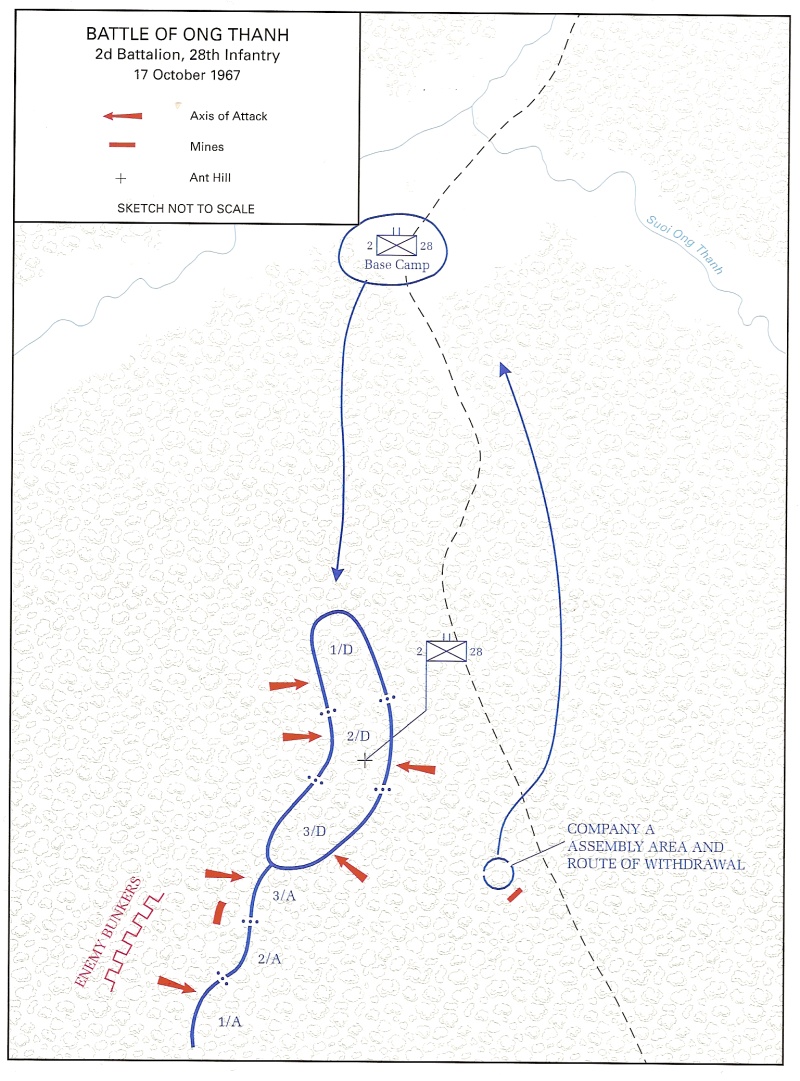
They found the bunkers on October 16, 1967, just south of the Ong Thanh Stream in Binh Duong Province. A short firefight, then silence. The commander of the 2nd Battalion, 28th Infantry Regiment pulled his men back, preferring to prepare a deliberate assault for the following morning rather than stumble into a prolonged engagement in fading light. It was a reasonable decision. What he could not know was that the Viet Cong 271st Regiment had also spent the night preparing, positioning hundreds of fighters along the route they knew the Americans would take at dawn.
A Strategy Born of Desperation
By mid-1967, the Viet Cong and North Vietnamese forces in South Vietnam were bleeding. American operations like Cedar Falls, Junction City, and Manhattan had hammered their infrastructure and depleted their ranks throughout the first half of the year. General Tran Van Tra proposed a grim recalculation: if conventional engagements were proving catastrophic, then the objective should shift to inflicting maximum American casualties in smaller, sharper actions. The logic was political as much as military. Each body bag that arrived stateside eroded public support for the war. The VC 7th and 9th Divisions returned to the field in III Corps with this singular purpose, and by October, the 271st Regiment had slipped into the Long Nguyen Secret Zone to rest, refit, and wait for an opportunity. Meanwhile, Major General John H. Hay launched Operation Shenandoah II to clear Highway 13 between Chon Thanh and Loc Ninh, unknowingly pushing his men toward that waiting regiment.
Seventeen Minutes of Morning
On the morning of October 17, two rifle companies of the 2nd Battalion marched back toward the bunker complex they had found the previous day. The jungle along the Ong Thanh Stream was dense, visibility measured in meters rather than miles. The 271st Regiment had anticipated the return and positioned itself along both flanks of the American approach. When the ambush sprung, the effect was immediate and devastating. Automatic weapons fire, rocket-propelled grenades, and mortars poured into the column from prepared positions. The Americans were caught in a crossfire with almost no room to maneuver. Among those killed was Don Holleder, a former All-American football player from West Point who had traded athletic fame for a commission and a place in the jungle. The fighting was close, confused, and merciless. Soldiers who survived would later describe the chaos of trying to return fire at enemies they could hear but not see, of dragging wounded comrades through undergrowth while rounds shredded the canopy above.
The Battle That Was Not a Victory
In the aftermath, General Hay's official report presented Ong Thanh as an American victory. The cited figure was 101 enemy dead. American veterans who survived the stream crossing found this characterization difficult to reconcile with what they had experienced. They were adamant: they had been ambushed, outmaneuvered, and defeated by a force that held every tactical advantage. The body count of 101, as with so many statistics from the Vietnam War, was likely inflated to support the narrative of progress. The actual American losses were severe, and the survivors carried not only physical wounds but the bitter knowledge that the official story bore little resemblance to what had happened along that stream. This gap between the reported version and the lived experience became one of the defining features of the war itself.
Prelude to a Larger Storm
Ong Thanh did not exist in isolation. While the 271st Regiment was bloodying the 2nd Battalion along the stream, the rest of the VC 9th Division was massing for a far more ambitious objective. The 272nd and 273rd Regiments, reinforced by elements of the 165th Regiment and the PAVN 84th Artillery Regiment, were converging on Loc Ninh with plans to overrun both the district town and the Special Forces Camp. American intelligence had detected the buildup, and Hay planned to insert four battalions around Loc Ninh to trap the attacking force. On the evening of October 28, the VC regiments moved into position. At 01:15 on October 29, the assault on the Loc Ninh Special Forces Camp began. The battered survivors of Companies B and C from the 2nd Battalion, 28th Infantry, the same unit devastated at Ong Thanh just days earlier, were airlifted onto the Loc Ninh airfield to help establish a firebase.
A Stream That Remembers
Today, the Ong Thanh Stream flows through what is now Binh Phuoc Province, the administrative boundaries having shifted since 1967. The jungle has reclaimed much of the terrain where the ambush unfolded. There are no grand monuments along the stream, no visitor centers explaining what happened on that October morning. The battle lives primarily in the memories of those who survived it, in military histories that argue over casualty figures and tactical decisions, and in the names etched on the Vietnam Veterans Memorial in Washington. For the soldiers of the 2nd Battalion, 28th Infantry, Ong Thanh was the place where the war stopped being an abstraction and became something they would carry for the rest of their lives.
From the Air
Located at 11.37N, 106.54E in what is now Binh Phuoc Province, Vietnam, formerly part of Binh Duong Province. The terrain is low-lying jungle interspersed with streams, typical of the III Corps tactical zone. Highway 13 (Thunder Road) runs north-south through the area between Chon Thanh and Loc Ninh. Nearest significant airfield is Phuoc Vinh (formerly a major U.S. base). Tan Son Nhat International Airport (VVTS) in Ho Chi Minh City is approximately 90 km to the south. Best viewed at 3,000-5,000 ft AGL. The Long Nguyen Secret Zone, a former VC stronghold, lies to the west.