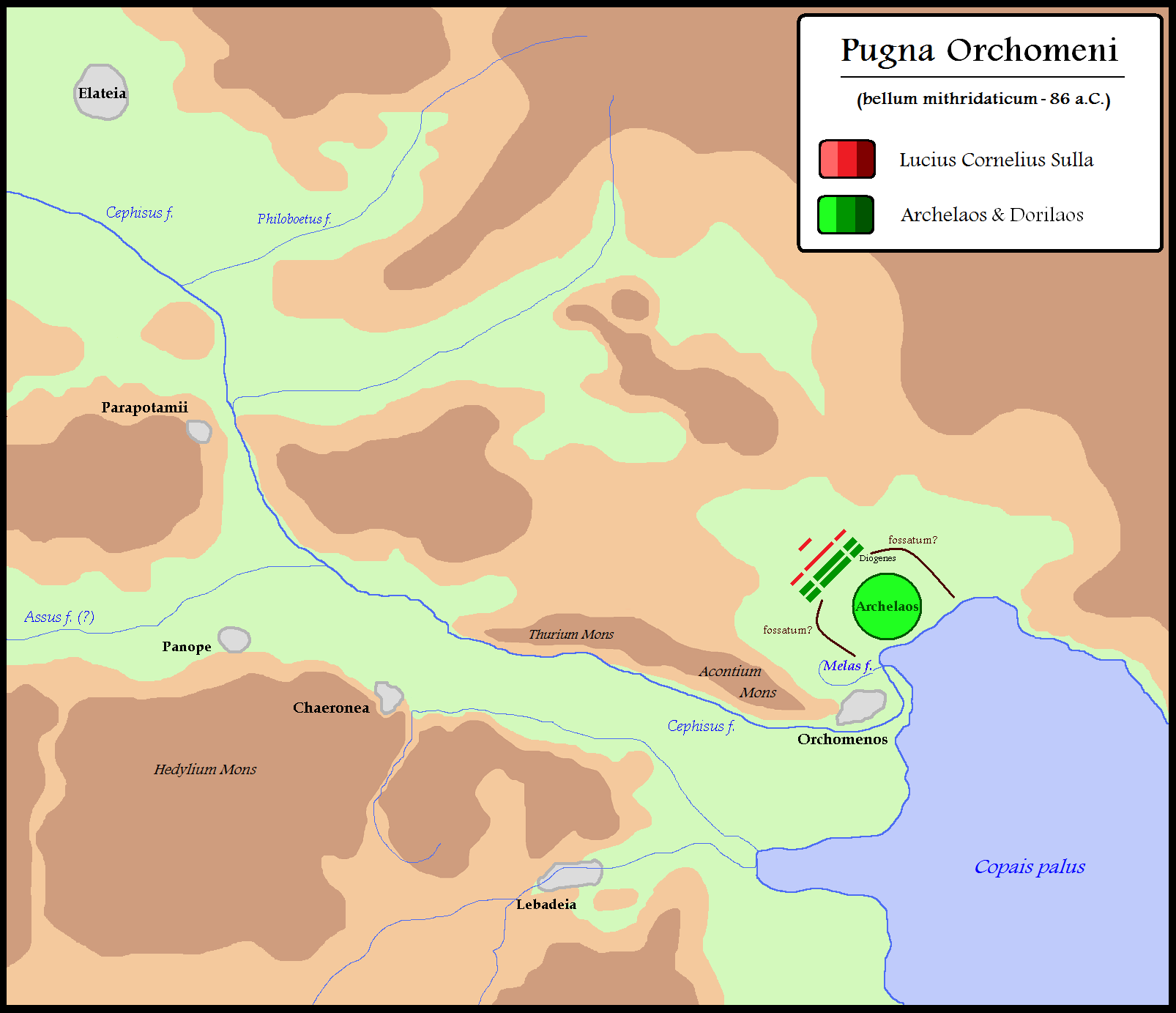
Battle of Orchomenus
Sulla stood on the earthworks his men had been building all morning and shouted a sentence Plutarch was still quoting a hundred fifty years later. His soldiers had begun to break for the safety of camp under the pressure of an Asian cavalry attack, and the Roman general - who would soon become dictator of Rome - planted himself in their path. 'Orchomenos!' he yelled. 'Remember the name. I'm ready to fight and die here. When people ask you where you ran away and left your general, tell them: at Orchomenos!' The men stopped running. They turned around. They went back to work with their shovels.
The War That Brought Romans to Boeotia
Mithridates VI of Pontus, king of a Hellenized realm on the Black Sea coast, had spent the late 90s BC organizing a revolt against Roman extortion in Asia. In 88 BC, on a single coordinated day, he had eighty thousand Romans and Italians massacred in the cities of Asia Minor - civilians, businessmen, families - in what came to be known as the Asiatic Vespers. He then crossed into Greece, where many cities welcomed him as a liberator. Rome sent Sulla. Sulla was already a controversial figure, having marched on Rome itself the year before to keep his command. He arrived in Greece short of money, short of supplies, and confronting a foe with deep pockets and a vast army. He sacked Athens, defeated Mithridates' general Archelaus at Chaeronea, and was preparing to move north when news arrived that a fresh Pontic army of eighty thousand men had landed at Chalcis to reinforce Archelaus.
The Ground at Orchomenus
Archelaus chose his ground carefully. The plain around Orchomenus, in Boeotia, was flat, open, and well watered - perfect for the cavalry that had always been the Pontic strength. The Romans were short of horse. Sulla's solution, on arrival, was to dig. His men spent days cutting trenches and ditches across the plain, channeling the line of any Pontic advance into ground where horses could not maneuver. Archelaus understood at once what Sulla was doing and tried to interrupt him. The Pontic cavalry attacked the digging parties, broke them, and very nearly broke the army. That was the moment Sulla bellowed his line and turned his men back to face the enemy. The earthworks were finished. The plain had become a Roman trap.
Stakes and Scythes
When the main attack came, Archelaus put his scythed chariots in front, followed by a Macedonian-style phalanx and supporting units. Scythed chariots had been a terror weapon since Persian times - blades on the wheels, blades on the yoke, designed to drive horses through a wall of infantry. Sulla had arranged his legions in three lines with intentional gaps in the front rank. As the chariots charged, the front line stepped backward and revealed sharpened stakes driven into the ground at an outward angle. Some chariots impaled themselves. The rest were brought down by Roman pila. The survivors, now without coordination, turned in panic and crashed into their own advancing phalanx. Archelaus tried to rescue the situation with a cavalry charge, but Sulla's small mounted force tied them up long enough for the legions to roll forward. The phalanx, never able to reform, broke.
The Camp and the Marsh
What happened next is the part of Orchomenus that does not read well today. The Romans pursued the broken Pontic army back to its camp on the edge of the marsh. A junior officer named Basilus led a section through a breach in the ramparts; in the close ground, Roman short swords had every advantage. The Pontic soldiers, trapped against the water with nowhere to retreat, were killed in numbers that contemporary sources call a massacre. They were, by then, soldiers who had given up. Among the dead earlier in the battle was Diogenes, the stepson of Archelaus - a young man who had distinguished himself in one of the cavalry charges and was killed leading from the front. He was somebody's son and somebody's stepson. The plain at Orchomenus, on the morning after, held tens of thousands of bodies, mostly belonging to people who had come from the far side of the Aegean to fight for a king they had probably never met.
What Sulla Did Next
Archelaus survived; he would later defect to Rome and broker a peace. Sulla punished Boeotia for its support of Mithridates by destroying three Boeotian towns - Anthedon, Larymna, and Halae. The story of Halae is small and humanizing: when Sulla later met fishermen from the destroyed town who gave him fish, he expressed surprise that any of them were left, and let them go without further harm. The town's survivors took this as permission to rebuild, and Halae was repopulated. Meanwhile, in Italy, Sulla's domestic enemies had taken Rome and his wife Metella had fled with their children to his camp. He used the victory to negotiate peace with Mithridates so he could return home and start a civil war. The plain at Orchomenus is now a quiet stretch of farmland in Boeotia. Lake Copais, which once made the marshy ground that trapped the Pontic army, was drained in the nineteenth century. The earthworks are gone. What remains is the question Plutarch saw clearly enough to write down: what does a general say when his army has decided to run?
From the Air
Battle site near ancient Orchomenus at 38.48N, 22.98E, in the Boeotian plain about 17 km northwest of modern Livadeia and roughly 100 km northwest of Athens. Athens International Airport (LGAV) is to the southeast; Tanagra (LGTG) is the closest military airfield. The plain was once dominated by Lake Copais, drained in the 1880s, which leaves a distinctive flat agricultural basin visible from cruise. Best viewing 6,000-10,000 ft on a clear day, when the surrounding ring of hills (Helicon to the southwest, Parnassus to the north) makes the basin's old role as a marsh-trap obvious.