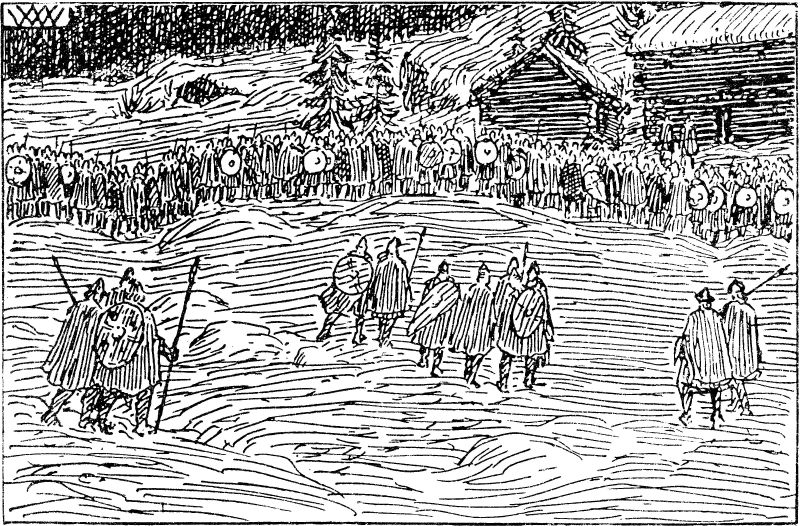
Battle of Oslo (1161)
Norway in the 12th century was a kingdom tearing itself apart. Three half-brothers, sons of King Harald Gille, had been declared kings simultaneously, and for years they ruled together in an arrangement as unstable as it sounds. By 1157, two of them were dead. The survivor, Inge I, seemed to have consolidated power at last. Then, on a February night in 1161, his illegitimate half-brother Haakon brought an army to Oslo, and the fragile peace collapsed in the snow outside the city walls.
Sons of a Murdered King
Harald Gille, king of Norway, was murdered by Sigurd Slembe in 1136, leaving behind a contested succession. Inge, the only legitimate son, born to Ingirid Ragnvaldsdottir, was named king while still a child. His half-brothers Magnus and Sigurd received the same title, creating a tripartite rule over Norway that functioned only because none of the brothers was strong enough to eliminate the others. Inge was physically disabled from birth, described in the sagas as hunchbacked and with one leg shorter than the other, earning him the byname Krokrygg, meaning crookback. Despite his condition, he proved politically capable. He outlasted both brothers: Magnus fell in 1145, and Sigurd died in 1155. For a brief period, Inge ruled Norway alone.
A Night Battle in Winter
Haakon, an illegitimate son of Harald Gille, had been raised as a potential claimant but lacked the legitimacy Inge held. By 1161, Haakon had gathered enough support to challenge his half-brother directly. On the night of February 3, the two forces met outside Oslo. According to the Heimskringla, the great saga compilation of Snorri Sturluson, Inge commanded approximately 4,800 men. The details of the battle are sparse in the surviving sources, but the outcome was decisive: Inge I was killed. The king who had survived childhood disability, outlived two rival brothers, and held Norway together through decades of civil strife fell in a night engagement on frozen ground outside his own capital.
A Kingdom Still Fractured
Inge's death did not end Norway's civil wars. Haakon II assumed power but ruled for only two years before he too was killed, in 1162, at the Battle of Sekken. The cycle of succession violence, rival claimants, and shifting alliances that had defined Norwegian politics since the early 12th century continued for decades. The battle outside Oslo was one episode in a longer pattern: a kingdom rich in coastline and resources but lacking the institutional structures to manage peaceful succession. The saga writers recorded these events with a mix of admiration and fatalism, treating the violence as both tragic and inevitable. Oslo itself, not yet the fortified capital it would become when Akershus Fortress was built a century later, was simply the stage on which one more king fell.
From the Air
The Battle of Oslo (1161) took place outside the medieval city of Oslo (59.91N, 10.74E), near where Akershus Fortress would later be constructed. The exact battle site is not precisely known but is traditionally placed in the area surrounding the old town. Oslo Gardermoen Airport (ENGM) lies 47km north. From above, the medieval city occupied a smaller area near the eastern shore of the Bjorvikafjord inlet. At 2,000-4,000 feet, the promontory where Akershus Fortress now stands provides a reference point for the medieval settlement.