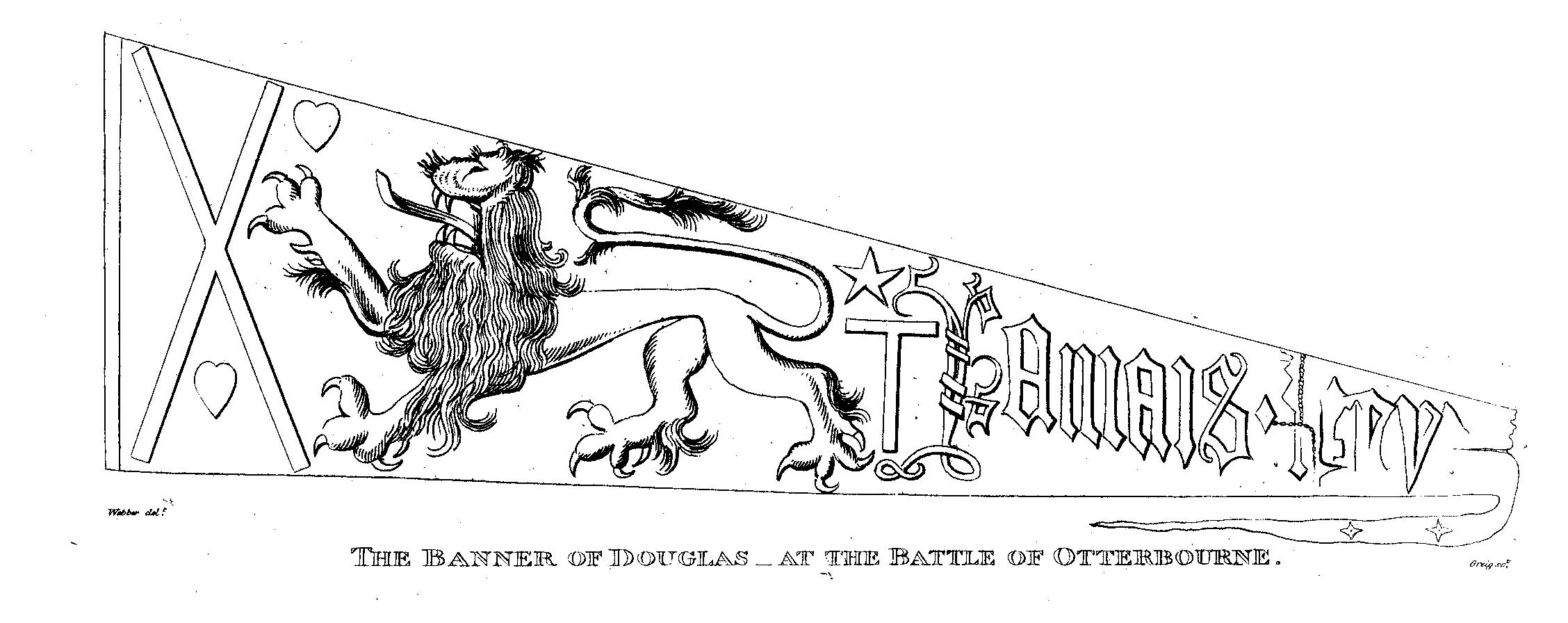
Battle of Otterburn
The Earl of Douglas was already dead when his army won the battle. Killed during the fighting on a moonlit August night in 1388, his death went unnoticed by his own men until the engagement was over and the English were in full retreat. It was the kind of outcome that begged to be immortalised in verse, and the balladeers obliged. The Battle of Otterburn, also known as Chevy Chase, produced at least two of the greatest medieval ballads in the English language -- poems that would be admired for centuries afterward.
A Stolen Pennon
The battle grew from a border raid with aristocratic swagger. James, 2nd Earl of Douglas, and John Dunbar, Earl of Moray, led a Scottish force south toward Durham and Newcastle, coordinating with a second army under Archibald Douglas attacking Carlisle to the west. The raid was timed to exploit divisions among the English lords and to avenge King Richard II's invasion of Scotland three years earlier. According to the French chronicler Froissart, the first skirmish included hand-to-hand combat between Douglas and the young Henry Percy -- the future "Harry Hotspur" -- in which Douglas captured Percy's personal pennon, his triangular banner. The insult was deliberate and devastating. Douglas taunted that he would fly it from his castle in Scotland.
Moonrise Over Otterburn
Douglas withdrew northward, destroying Ponteland Castle and then laying siege to Otterburn Castle. Percy, stung by the loss of his pennon, rode north from Newcastle with a force that outnumbered the Scots roughly three to one. He arrived in the late afternoon and attacked immediately -- too eagerly, as it turned out. His men had ridden hard and were tired and disorganised. Worse, Percy's advance guard stumbled into the Scottish camp followers rather than the main army, giving Douglas time to muster his forces and strike the English on their flank. The fighting continued into the night, illuminated by moonlight. Douglas led the Scottish left wing personally while Dunbar commanded the right.
A Victory Without Its Victor
Douglas fell during the fighting, but his death had no influence on the outcome. The Scots fought on, unaware their commander was down, and overwhelmed the English force. Both Percy brothers -- Harry Hotspur and Sir Ralph -- were captured. Sir John Montgomery of Eaglesham took Henry Percy prisoner and later used the ransom money to build Polnoon Castle in Scotland. Froissart recorded staggering English losses: 1,040 captured and 1,860 killed, against only 100 Scottish dead and 200 captured. The Westminster Chronicle gave higher Scottish casualties of around 500, but even by that reckoning, the smaller Scottish force had delivered a crushing defeat to an army with a three-to-one numerical advantage.
Hotspur's Reckoning
Why did the English lose so badly? Percy's rashness was the most obvious factor. He attacked before his full force had assembled, allowing the Scots to fight his army in pieces rather than as a whole. His troops were exhausted after the ride from Newcastle. But the reasons may have run deeper. The Scots had chosen their ground well, and Douglas had demonstrated tactical cunning in using his camp followers as an inadvertent screen while his main body prepared to counterattack. The moonlit conditions, unfamiliar to the English, may also have played a role. Whatever the combination of causes, the defeat was thorough enough to keep the two nations at peace for some time afterward.
The Ballads Remember
Otterburn's real legacy is literary. The battle inspired two famous Child Ballads: "The Battle of Otterburn" and "The Ballad of Chevy Chase." The latter mingles the events of 1388 with other border conflicts and is not strictly accurate, but it was celebrated for centuries as one of the finest narrative poems in English. Sir Philip Sidney wrote that it stirred his heart "more than a trumpet." The Percy Cross, erected before 1400 just off the modern A696 road, still marks the battlefield. The valley itself has changed little -- still sparsely populated, still remote, still the kind of place where a medieval army could be surprised at dusk and a dead man's soldiers could fight on by moonlight without knowing they had already lost their leader.
From the Air
The Battle of Otterburn battlefield is located at approximately 55.237N, 2.195W in the Redesdale valley of Northumberland. The Percy Cross memorial is visible near the A696 road. The terrain is rolling moorland with sparse settlement -- the landscape has changed little since 1388. Best viewed at 2,000-4,000 ft AGL. The village of Otterburn and Otterburn Tower (the former castle) are nearby landmarks. Nearest ICAO: EGNT (Newcastle) approximately 30nm southeast.