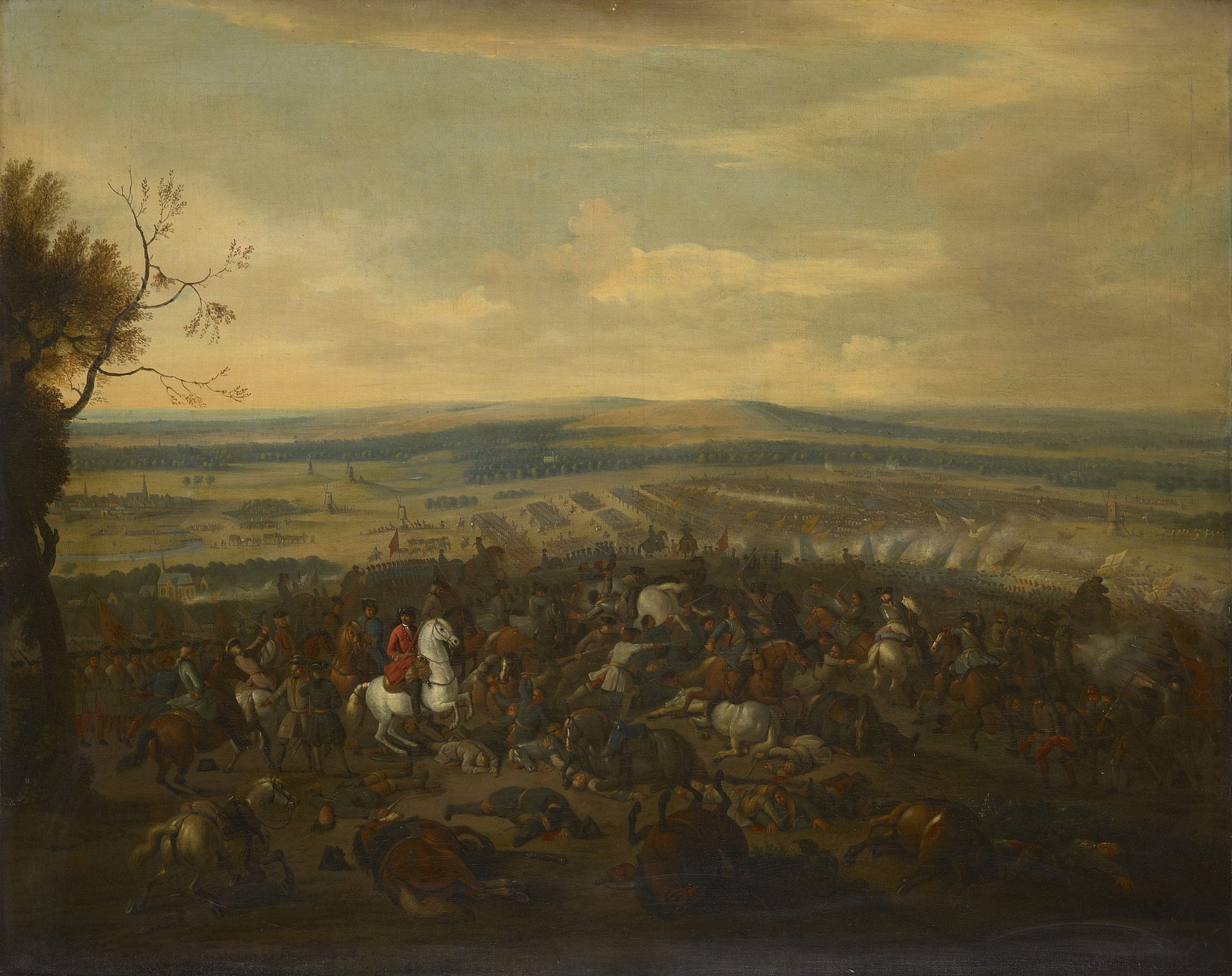
Battle of Oudenarde
The two French commanders could not agree on anything. The Duc de Bourgogne, grandson of Louis XIV, wanted one approach. The Duc de Vendome, the experienced soldier, demanded another. Their squabbling had already cost the campaign precious time, and now, on July 11, 1708, their 85,000-man army faced the Duke of Marlborough and Prince Eugene of Savoy near the city of Oudenaarde in the Spanish Netherlands. What followed would become a textbook example of how divided command destroys armies. 'Prince Eugene and I,' Marlborough would later write, 'shall never differ about our share of the laurels.'
A Race to Oudenaarde
The campaign of 1708 had not started well for the Grand Alliance. A month before the battle, the French army had moved westward and captured the Allied-held fortresses of Bruges and Ghent, an unexpected blow that threatened to cut Marlborough's communications with England. The French now aimed to take Oudenaarde itself, which would sever Allied supply routes entirely. Marlborough, recognizing the danger, waited for Eugene to join him with reinforcements before making his move. When he divined the French plan, he force-marched his army toward Oudenaarde to defend the city. The race across the Flemish countryside would determine whether the Allies could stop the French advance.
Command in Chaos
When the two armies met, Burgundy made the fateful decision to attack, overruling Vendome's objections. The French right wing launched an assault on Allied positions near Eine around 4:00 pm, but inexplicably, the left wing remained stationary near Huise. Twenty-eight Allied cavalry squadrons protected Cadogan's infantry as Prussian cavalry under Dubislav Gneomar von Natzmer absorbed the French assault. Then Vendome made his own disastrous decision: he personally led an attack of twelve infantry regiments, fighting hand-to-hand with a half-pike. This meant one commander sat at headquarters with no view of the battle while the other fought in the melee, unable to direct his forces. When Vendome requested permission to attack with the left wing, Burgundy sent a messenger with a refusal, but the messenger never delivered the message.
Reserves That Never Came
Approximately half of the French forces never entered the battle. A great mass of cavalry and infantry sat on raised ground north of the Norken River, along with many of Burgundy's personal troops, watching their countrymen struggle without advancing to help. The cavalry commanders had been advised that the ground before them was impassable for horses, so they held position even as the tactical situation turned against France with the arrival of Lord Overkirk's Dutch troops. The battle ended as a rout. French casualties numbered approximately 6,000 killed or wounded and 8,000 captured, while Allied losses stood at roughly 6,000 killed or wounded.
The Road to Lille
The victory at Oudenarde restored the strategic initiative to the Allies. Marlborough and Eugene, who had cooperated seamlessly throughout the engagement, now turned their attention to Lille, considered the strongest fortress in Europe. While Marlborough commanded the covering force, Eugene oversaw the siege. The town surrendered on October 22, 1708, though the resolute Marshal Boufflers held the citadel until December 10. The campaign of 1708, for all its difficulties, proved a remarkable success. The Allies repelled an assault on Brussels, retook Bruges and Ghent, and drove the French from almost all of the Spanish Netherlands. 'He who has not seen this,' wrote Eugene, 'has seen nothing.'
From the Air
The battlefield is located at 50.85N, 3.43E near the city of Oudenaarde (Oudenarde) in East Flanders, Belgium. The Scheldt River runs through the area and was a key geographic feature in the 1708 battle. The terrain is gently rolling farmland typical of Flanders. Nearest airports: Kortrijk-Wevelgem (EBKT) 25km west, Ghent (EBGT) 30km north. The city of Oudenaarde is visible along the river with its historic center and church spires serving as landmarks.