Battle of Pailin
Rubies made Pailin worth fighting for. The small town in northwestern Cambodia, ringed by tropical forest and straddling some of the richest gemstone fields in Southeast Asia, became the final stronghold of the Khmer Rouge after their overthrow in 1978. For nearly a decade, the remnants of Pol Pot's regime had hidden in the dense forests of the northwest, waging guerrilla war against the Vietnamese-backed government. But as resources dwindled, the sapphire and ruby deposits around Pailin offered something the revolution could no longer provide: money. What followed was an eight-year siege that outlasted the UN peacekeeping mission, defied multiple ceasefire attempts, and left behind a landscape so saturated with landmines that it became one of the most heavily mined zones on earth.
Gems in the Killing Fields
After Vietnamese forces toppled the Khmer Rouge on Christmas Day 1978, ending the genocide that had killed an estimated two million Cambodians, the regime did not vanish. Thousands of fighters retreated into the forests of northwestern Cambodia, where they regrouped alongside monarchist forces under Prince Norodom Ranariddh and nationalist troops led by Son Sann. The Khmer Rouge committed two full divisions -- the 320th and 412th -- to capturing Pailin, whose abandoned sandstone houses sat atop gem deposits said to rival any in the world. The government garrison under General Ke Kim Yan was outnumbered, fielding only about 6,000 men. On 24 October 1989, the Khmer Rouge claimed victory over the town, seizing tanks and artillery in what the international press called a major turning point. The gems of Pailin soon began flowing across the Thai border, financing continued resistance and earning comparison to blood diamonds for the way their trade prolonged the war.
The UN Departs, the Fighting Resumes
The United Nations Transitional Authority in Cambodia arrived to broker peace, but Pailin proved beyond its reach. In May 1993, Khmer Rouge guerrillas ambushed and killed Haruyuki Takata, a Japanese policeman serving with UNTAC, in Banteay Meanchey province. His death accelerated the withdrawal of the Japanese contingent and, eventually, all UN military presence. When UNTAC Force Commander Lieutenant General John Sanderson attempted to reach Pailin for truce negotiations, the blue helmets were forced to retreat -- an outcome described at the time as a massive embarrassment for the United Nations. The last UNTAC forces left Cambodia on 15 November 1993, and the newly formed Royal Cambodian Armed Forces inherited both the fight and many of the UN's unused weapons and landmines. Peace talks between King Norodom Sihanouk and the Khmer Rouge, held as far afield as Pyongyang, went nowhere.
A City Taken and Lost in Days
In March 1994, the government launched its most ambitious assault on Pailin: 7,000 troops, tanks, heavy artillery, and armed helicopters. After two days of intense combat, they captured the town. The victory lasted barely a month. As government soldiers stretched their supply lines thin and ran short of food and funding, the Khmer Rouge counterattacked on 19 April, retaking Pailin almost without resistance. Government troops fled through the minefields along Route 10 while Khmer Rouge forces under Ieng Sary pushed toward Battambang, halting only ten kilometers from the city center. Their scorched-earth advance displaced another 60,000 civilians -- families who had already endured years of bombardment, only to be caught again between armies that neither fed nor protected them. Thailand, meanwhile, refused to open its border to the flood of refugees, even as it was accused of allowing the cross-border gem trade that kept the Khmer Rouge solvent.
Three Plagues After the Guns
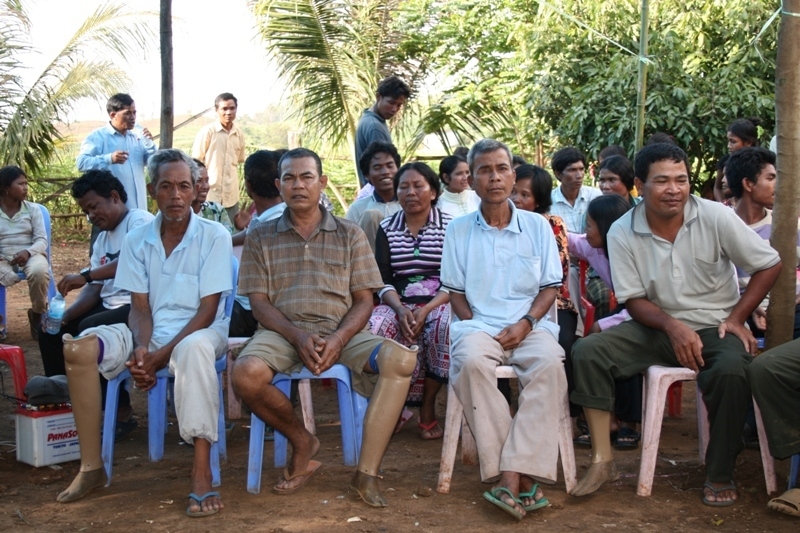
When the conflict finally ended with Ieng Sary's defection and Pailin's normalization as a Cambodian municipality in November 1997, the town's suffering was far from over. Landmines blanketed the surrounding countryside so densely that the International Campaign to Ban Landmines, which received the 1997 Nobel Peace Prize, cited Pailin specifically in its advocacy work. A 1995 Human Rights Watch report documented murder, rape, hostage-taking, and deliberate starvation used as weapons during the Khmer Rouge's scorched-earth campaigns. Drug trafficking, already entrenched under the lawless Khmer Rouge occupation, worsened through the 1990s. And because the remote tropical forests offered almost no healthcare, Pailin became the epicenter of malaria in Cambodia -- spawning three drug-resistant strains that eventually spread as far as Africa. The weapons surplus from the war flooded Cambodian markets, with automatic rifles and bazookas available at open stalls in Phnom Penh's Toul Tompung market.
From Guns to Casinos
General Ke Kim Yan eventually led a campaign to collect the weapons flooding the country. Three tons of crushed firearms were melted into a national monument erected on the roundabout of the Chroy Changvar Bridge in Phnom Penh. At the unveiling, Prime Minister Hun Sen symbolically surrendered his own golden gun. Pailin itself has undergone what observers call a mini-economic boom since the late 2000s, though its population still lags behind Cambodian averages. Tourism has trickled back, drawn not by conventional attractions but by the town's haunted recent history and the forested hills that once concealed an army. A casino now operates where guerrillas once planted mines. Most of Pailin's population consists of former Khmer Rouge -- people who benefited from agrarian cooperativism in the countryside rather than the urban terror of Phnom Penh. The omerta around those years persisted until Pol Pot's death in 1998, an event many Cambodians regarded as the true end of the Khmer Rouge, long after the military defeat at Pailin had already become history.
From the Air
Pailin (12.85N, 102.61E) sits in the far northwest of Cambodia, approximately 20km from the Thai border. The town occupies a valley surrounded by forested hills in the Cardamom Mountain foothills. From altitude, the cleared gem-mining areas contrast sharply with dense tropical forest. Nearest significant airport: Battambang Airport (VDBG), approximately 80km east. Phnom Penh International Airport (VDPP) is roughly 370km southeast. Route 10, the road along which government troops retreated through minefields, runs east toward Battambang and is visible as a thin cleared corridor through forest.