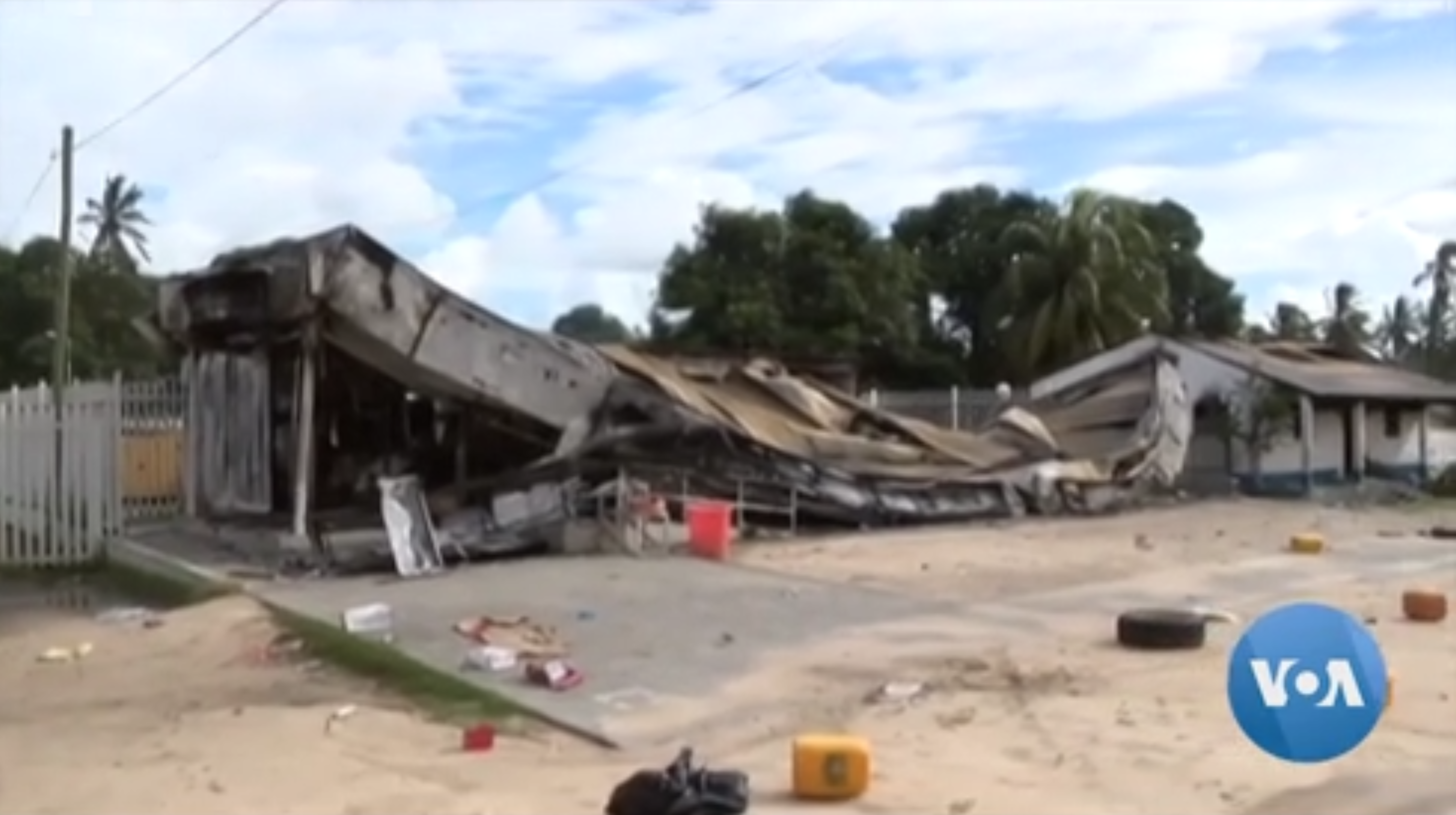
Battle of Palma
"As I sit here, Palma is lost." Lionel Dyck, director of the South African private military contractor Dyck Advisory Group, delivered this assessment on 27 March 2021, three days into an assault that had overwhelmed Mozambican security forces, trapped hundreds of civilians and foreign workers, and turned a small coastal town in Cabo Delgado province into a war zone. Palma -- a quiet settlement near one of Africa's largest natural gas deposits -- had become the focal point of an insurgency that had been tearing through northern Mozambique since 2017, killing thousands and displacing hundreds of thousands more.
A Slow-Burning Crisis
The insurgency in Cabo Delgado had been escalating for years before it reached Palma. Beginning in 2017, Islamist rebels -- loosely associated with the Islamic State through its Central Africa Province -- carried out attacks across the northern province, massacring civilians in 2020 and capturing the port city of Mocimboa da Praia in August of that year. They declared it their capital. The Mozambican government hired private military companies, most prominently the South African Dyck Advisory Group, to supplement its overstretched armed forces. Meanwhile, the French energy giant Total SE was developing a massive liquefied natural gas project near Palma, representing billions of dollars in investment and the promise of economic transformation for one of the world's poorest countries. The civilians who remained in Palma as the insurgency crept closer faced growing food shortages. Early warning intelligence about a possible attack went unheeded.
Three Directions at Once
On 24 March, more than a hundred militants attacked Palma from three directions in coordinated strikes. They had infiltrated the town beforehand, disguised as civilians, soldiers, and police -- some wearing uniforms of the Rapid Intervention Unit, the Mozambican police's special operations wing. The assault targeted police stations and checkpoints first, then the town's two banks, which were blown open with explosives and robbed. As the town fell into chaos, about 220 people sought refuge at the Amarula Hotel, roughly half of them locals. DAG helicopters intervened, but confusion on the ground led to a friendly-fire incident in which Paramount Group-affiliated aircraft mistakenly fired on Mozambican soldiers. By 25 March, the insurgent force had swelled to over 300 fighters. They cut off four additional hotels where foreign workers were sheltering, and began targeting boats attempting to evacuate people along the coast with small arms and mortar fire.
Escape and Abandonment
The evacuations from Palma became a story of triage under fire -- and of who was prioritized for rescue. The vessel Sea Star, protected by a Mozambican navy craft, pulled out mostly Total SE staff. DAG helicopters continued flying missions to extract people hiding in the bush around the town. Some survivors fled into forests and mangroves, eventually crossing into Tanzania despite that government's initial refusal to accept refugees. A May 2021 Amnesty International report alleged that white contractors were airlifted from Palma before its Black inhabitants, based on interviews with eleven Black survivors. The New York Times reported similar findings, suggesting foreign contractors had been prioritized over local civilians. DAG rejected the allegations. What is not disputed is that the Mozambican armed forces were slow to respond. At least 21 Mozambican soldiers were killed during the operation, and it was not until 31 March that the FADM moved into the town to begin retaking it.
Palma After the Battle
On 4 April, the Mozambican government declared Palma fully recaptured. But a Sky News team reporting from the town was hastily evacuated after hearing gunfire, and sporadic rebel raids continued through April and May. By August 2021, just one hundred civilians were living in what had been a functioning town months earlier. The streets were plundered and largely destroyed. Total SE suspended all operations at its nearby gas facility, freezing a project that had represented Mozambique's best hope for economic development. The international response was swift but revealed the depth of the crisis: Portugal finalized training missions for Mozambican forces, Brazil offered assistance, and Britain considered deploying its newly created Rangers regiment. The beheaded bodies of twelve foreign workers were found on 8 April. For the first time in the insurgency, rebels had deliberately targeted foreigners -- a calculated escalation that brought global attention to a conflict the world had largely ignored.
From the Air
Palma, Cabo Delgado Province, Mozambique at approximately 10.78S, 40.47E. The town sits on the northern Mozambican coast near the Tanzanian border. The Total SE (now TotalEnergies) Afungi LNG site is visible to the south of the town. The coastal mangroves and forests where survivors hid are visible from altitude. Nearest major airport is Mocimboa da Praia Airport, though operations have been disrupted by the insurgency. Pemba Airport (FQPB) in the provincial capital is a more reliable option. Best viewed at 5,000-8,000 feet to see the town layout and surrounding terrain.