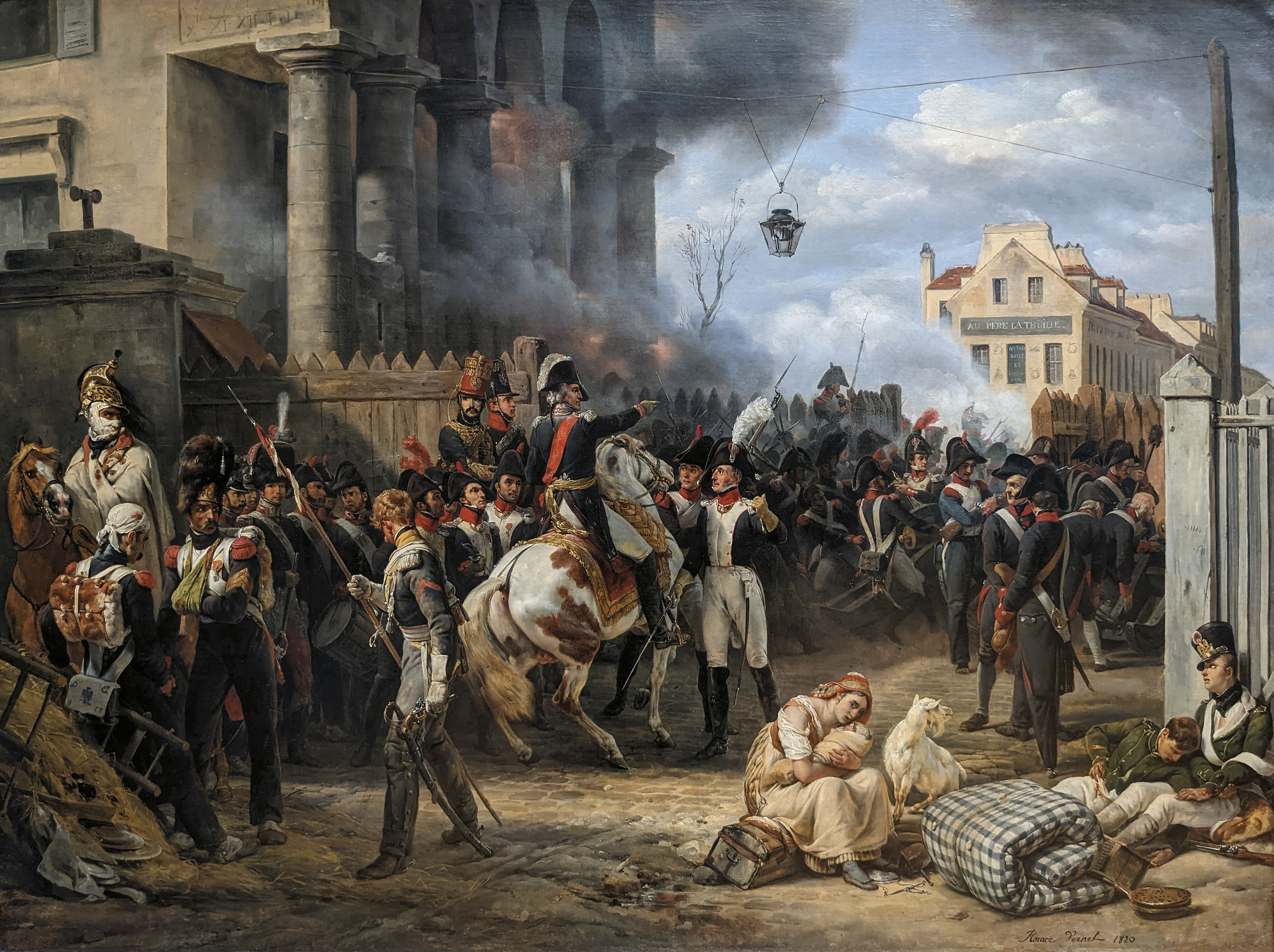
Battle of Paris (1814)
On the morning of March 30, 1814, Parisians woke to the sound of cannon fire from the hills northeast of the city. For the first time since the Hundred Years' War, a foreign army was at the gates of Paris. The forces converging on the French capital numbered roughly 100,000 men from Russia, Austria, Prussia, and Wurttemberg, arrayed against fewer than 30,000 French defenders - a mixture of regular troops, National Guard, and students from the Ecole Polytechnique who had volunteered to man the guns. Napoleon himself was not there. He was racing back from a campaign in eastern France, still believing he could save his capital. He would arrive too late.
An Emperor's Gamble Gone Wrong
By early 1814, Napoleon's strategic position had collapsed. The catastrophic losses in Russia in 1812 and the defeat at Leipzig in October 1813 had shattered the Grande Armée and emboldened a coalition determined to end French dominance of Europe. Napoleon fought a brilliant defensive campaign across northeastern France that winter, winning several small engagements against separated Allied columns. But the strategy depended on keeping the coalition forces divided, and on March 25, Austrian Prince Schwarzenberg and Prussian Field Marshal Blucher united their armies near Meaux, just 40 kilometers from Paris. Napoleon had gambled on drawing the Allies eastward by threatening their supply lines. Instead, they ignored him and marched on the one prize that mattered.
The Heights of Montmartre
Joseph Bonaparte, Napoleon's elder brother and nominal commander of Paris's defense, had done little to prepare. The fortifications were incomplete, the garrison undermanned. Yet the French soldiers who held the ridgeline from Montmartre to Belleville fought with a ferocity that surprised the Allied commanders. Artillery batteries on the heights of Montmartre raked the attacking columns, and the students of the Ecole Polytechnique served their guns with cool discipline despite having no combat experience. Russian and Prussian troops storming the village of La Villette suffered heavy casualties before pushing through. At Belleville, French troops held their positions through repeated assaults before the weight of numbers forced them back. By afternoon, perhaps 9,000 Allied soldiers and 4,000 French defenders lay dead or wounded across the northern suburbs.
Two Marshals and a White Flag
As the afternoon wore on, Marshals Auguste de Marmont and Edouard Mortier recognized the mathematics of their situation. They were outnumbered roughly three to one, their ammunition was running low, and no reinforcements were coming. Joseph Bonaparte had already fled the city, carrying with him Napoleon's authorization to negotiate if the situation became hopeless. At around five in the evening, Marmont sent a flag of truce to the Allied lines. The negotiations that followed were conducted with Tsar Alexander I of Russia, King Frederick William III of Prussia, and Austrian Field Marshal Schwarzenberg. The terms permitted the French army to evacuate Paris with their arms and march south. On March 31, the Allied armies entered a city that had not seen foreign occupation in four centuries.
The Emperor Arrives Too Late
Napoleon reached the post house at Juvisy, just south of Paris, at six in the morning on March 31 - hours after the capitulation. General Belliard, retreating south with the remnants of the garrison, delivered the news. By some accounts, Napoleon wanted to attack immediately, to fight his way back into his own capital. His marshals talked him out of it. The emperor withdrew to Fontainebleau, where over the next two weeks the coalition's diplomatic pressure and his own marshals' refusal to continue fighting forced the abdication he had sworn would never come. On April 6, 1814, Napoleon abdicated unconditionally. The empire that had redrawn the map of Europe from Madrid to Moscow was finished, and the battle for Paris - a single day of fighting on the city's northeastern heights - had sealed its end.
Scars Beneath the Streets
Today, the neighborhoods where the battle raged - La Villette, Belleville, Montmartre - show no obvious evidence of the fighting. The 19th-century transformation of Paris under Haussmann erased most physical traces of 1814. But the battle left a deeper mark on the French psyche. For the first time since Joan of Arc's era, a foreign army had conquered Paris, and the humiliation shaped French military thinking for generations. The fortifications built around Paris in the 1840s, the obsessive defense planning before 1870, the construction of the Maginot Line - all reflected the determination that no enemy would enter Paris again. That determination failed in 1940, but the impulse behind it was born on the heights of Montmartre on a March morning in 1814, when cannon smoke hung over a city learning that empires end.
From the Air
The battle took place across the northeastern heights of Paris (48.86°N, 2.35°E), primarily along the ridgeline from Montmartre to Belleville. From altitude, the terrain advantage the French defenders held is clearly visible - the hills rise noticeably above the surrounding plain. Key landmarks include the Butte Montmartre (topped now by Sacré-Coeur), the Parc des Buttes-Chaumont (near the Belleville fighting), and the Canal de l'Ourcq area around La Villette. Nearest airports: Paris Charles de Gaulle (LFPG) 25km northeast, Paris Le Bourget (LFPB) 12km north, Paris Orly (LFPO) 14km south. Best viewed at 3,000-5,000 feet to appreciate the topography that shaped the battle.