Battle of Pasir Panjang
Second Lieutenant Adnan Saidi had 42 soldiers, a hilltop, and no way out. Behind his position, oil from the bombed Normanton depot burned on the surface of a canal, cutting off any retreat. Ahead, 13,000 Japanese troops were advancing through southwestern Singapore, having already swept through the island's defenses in a campaign that would end with Britain's greatest military humiliation. What Adnan and his men did on that hilltop between 13 and 15 February 1942 would become one of the most celebrated acts of defiance in Southeast Asian military history.
The Tide Rolls South
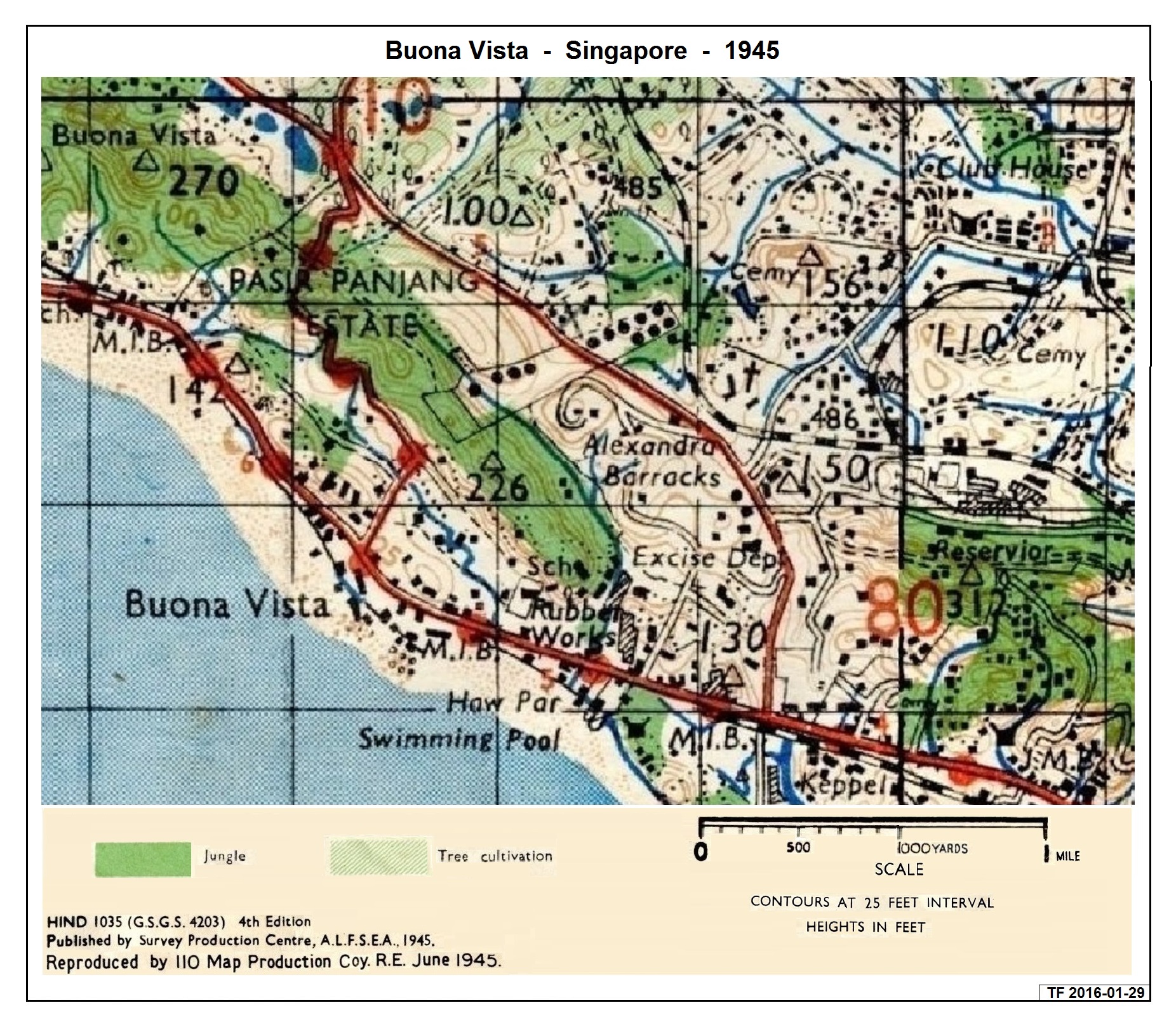
By mid-February 1942, the fall of Singapore was effectively a matter of hours. Japanese forces had landed 36,000 troops on the island, with 13,000 of them making an amphibious assault near Sarimbun Beach in the northwest before driving south toward the Pasir Panjang ridge. They had already seized Tengah Airfield along the way. The 1st Malaya Infantry Brigade, a patchwork force including the British 2nd Loyal Regiment and the 1st Malaya Regiment, was tasked with holding the approach to the ridge, a position known as "The Gap." The 44th Indian Brigade guarded the right flank. These defenders were badly outnumbered and outgunned, facing an enemy with artillery, tanks, and air superiority. When the Japanese 18th Division attacked on 13 February, B Company of the Malay Regiment fought hand-to-hand with bayonets before being overwhelmed. The survivors withdrew after dark to a fallback line near present-day Buona Vista.
Opium Hill
Bukit Chandu means "Opium Hill" in Malay, named for the opium-processing factory that once stood at its base. On 14 February, the eve of Chinese New Year, C Company of the Malay Regiment received orders to fall back to this hilltop position. It was a place of grim strategic logic: high ground overlooking the island to the northwest, and the last barrier before the Alexandra area, where the British had concentrated their ammunition depots, supply stores, and Alexandra Hospital. If the Japanese took the ridge, they would have a direct path to these installations. C Company dug in under the command of Lieutenant Adnan. The canal behind them, choked with burning oil from the shattered Normanton Oil Depot, made retreat impossible. They would hold or die where they stood.
The Trick That Failed
The Japanese tried deception before they tried brute force. A group of soldiers dressed in captured British Indian Army uniforms approached C Company's line, their faces smeared with soot, wearing turbans to pass as Punjabi troops. It might have worked against a less observant defender. But Adnan's men noticed something wrong: British soldiers marched in columns of three. These supposed Punjabis were moving in columns of four. When the disguised soldiers reached the defensive line, C Company opened fire. Twenty-two of the imposters were killed, and the survivors fled downhill. The deception had failed, but the real assault was coming.
The Last Stand
Two hours after the failed ruse, the Japanese launched an all-out attack with artillery, tanks, and waves of infantry charging uphill in a banzai assault. C Company was nearly out of ammunition. They had a few grenades, not many rifle rounds, and almost no medical supplies. The defense line broke under the sheer weight of numbers, and the fighting devolved into hand-to-hand combat with bayonets and fists. Adnan, seriously wounded, refused to surrender. He urged his men to fight to the end. When he was finally captured, the Japanese did not take him prisoner. According to accounts preserved in Singaporean and Malaysian textbooks, they beat him, tied him to a tree, and stabbed him to death with bayonets. Some sources describe an even more brutal end. He was 26 years old. Singapore surrendered to Japan at 6:10 PM on 15 February 1942. Fighting continued in pockets around Alexandra Hospital and Sentosa even after the formal capitulation.
Memory on the Ridge
Today, Bukit Chandu is a memorial site. The hilltop where C Company made its stand is preserved as a museum honoring the Malay Regiment's sacrifice. In both Singapore and Malaysia, Adnan Saidi is taught in school textbooks as a national hero, the young officer who noticed the enemy's marching error and who chose death over surrender. The ridge itself, once a battlefield of burning oil and bayonet charges, is now part of a peaceful residential neighborhood in Singapore's southwest, surrounded by parks and walking trails. On 9 February 2021, Ujang Mormin, the last surviving veteran of the battle, died at age 100 in a hospital in Selangor, Malaysia. He had been a 21-year-old private in the Malay Regiment when he fought on that ridge. With his passing, the Battle of Pasir Panjang moved fully from living memory into history.
From the Air
Located at 1.283N, 103.767E on Singapore's southwestern coast. Pasir Panjang ridge runs roughly parallel to the shoreline, with Bukit Chandu visible as a low wooded hill amid the residential Kent Ridge area. Singapore Changi Airport (WSSS) is approximately 10 nm to the east. The ridgeline and nearby Kent Ridge Park are identifiable from 2,000-4,000 ft AGL. The former Alexandra Hospital and Normanton area lie just to the northeast of the ridge.