Battle of Pea Ridge
Three Confederate generals died or received mortal wounds at Pea Ridge. That fact alone distinguishes this battle from nearly every other engagement of the Civil War. On a cold March morning in 1862, Brigadier General Samuel Curtis found his Union army of 10,250 men facing the largest Confederate force ever assembled in the Trans-Mississippi theater -- a combined army under Major General Earl Van Dorn that included Missouri State Guard troops, Texas cavalry, Arkansas infantry, and a brigade of Cherokee, Chickasaw, Choctaw, Creek, and Seminole warriors. Against the odds, Curtis held his ground on the first day and drove Van Dorn from the field on the second. The Confederates would never again seriously threaten Missouri.
The Night March That Unraveled
Van Dorn's plan was elegant on paper: a flanking march around Curtis's fortified position along Little Sugar Creek, striking the Union rear via the Bentonville Detour. The problem began on the night of March 6, when Colonel Grenville Dodge felled trees across the road between Twelve Corner Church and Cross Timber Hollow. Van Dorn's army, already exhausted, had no engineer corps to clear the obstructions efficiently. By dawn on March 7, only the head of Sterling Price's division had reached Cross Timber Hollow. Van Dorn was forced to split his army, sending Benjamin McCulloch's division down the Ford Road to Leetown while Price continued toward Elkhorn Tavern. The flanking march that was supposed to deliver a coordinated blow instead created two separate battles fought miles apart.
Death in the Timber Belt
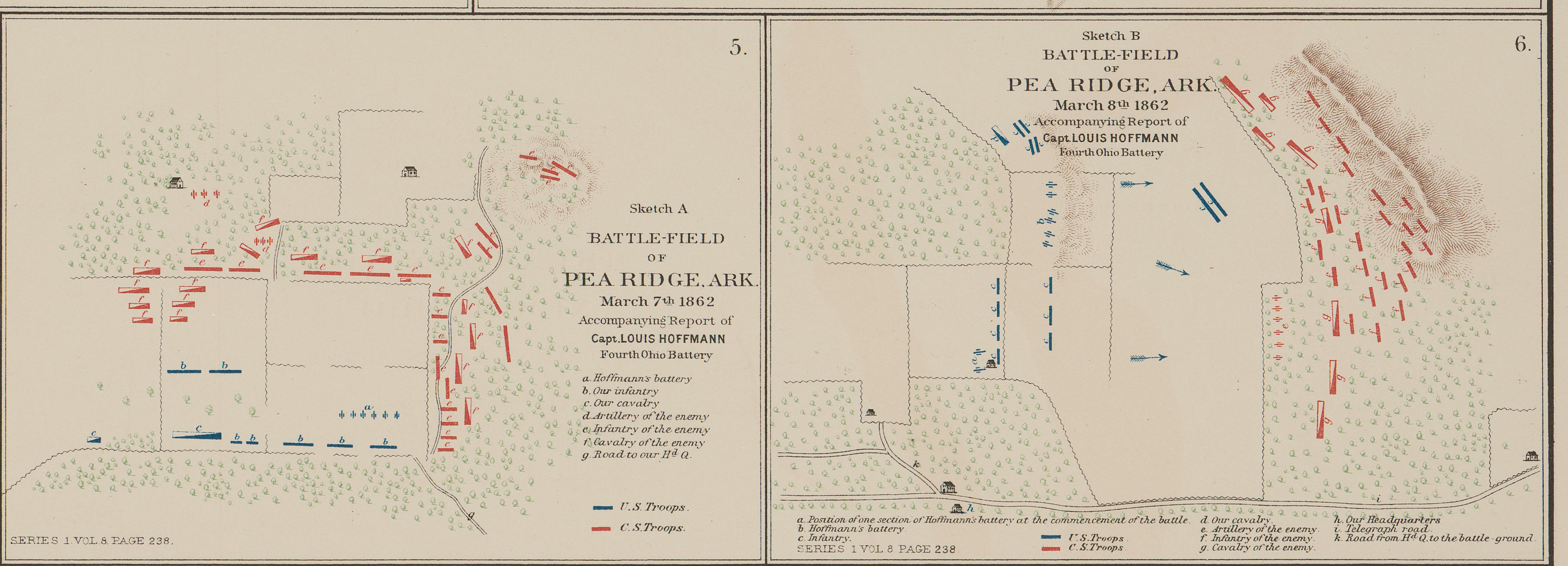
At Leetown, McCulloch's division ran into Colonel Peter Osterhaus's reconnaissance force. McCulloch had 3,000 cavalry under James McIntosh, 4,000 infantry under Colonel Louis Hebert, and a brigade of Native American cavalry under Albert Pike. The initial Confederate charge overwhelmed Union cavalry and captured three cannons. Two companies of the 3rd Iowa ran into Pike's Cherokee and were routed with an unusual killed-to-wounded ratio -- 24 killed and 17 wounded -- suggesting that wounded Northerners were killed where they lay. Then the battle turned. McCulloch rode forward to reconnoiter and was shot through the heart by Illinois skirmishers. McIntosh, told he was now in command, impulsively led his old regiment into an attack and dropped dead from a massed volley. Hebert, unaware he commanded the division, was eventually captured stumbling through the woods. In the space of a few hours, McCulloch's entire chain of command had been destroyed.
Elkhorn Tavern and the Long Afternoon
At Elkhorn Tavern, Colonel Eugene Carr's badly outnumbered 4th Division fought with extraordinary tenacity. Carr spread his regiments along the plateau's edge and sent four guns forward to slow Price's advance. Van Dorn grew cautious instead of rushing the outnumbered defenders, ordering Price to fully deploy -- a decision that cost precious hours. Carr was wounded three times -- in the ankle, neck, and arm -- but refused to leave the field. In 1894, he would receive the Medal of Honor for his actions that day. By 4:30 p.m., Price's men outflanked Carr's line from Williams Hollow. Dodge's brigade collapsed after a terrific fight at Clemon's farm. The Confederates pushed the Union forces south of the tavern to Ruddick's field, where Curtis personally rallied his men as darkness fell.
The Morning Everything Changed
Curtis refused to retreat. On the morning of March 8, General Franz Sigel massed 21 cannons on an open knoll west of Elkhorn Tavern and began a devastating bombardment against 12 Confederate guns. The Southern artillery could not answer effectively. Near the base of Big Mountain, shells created a lethal combination of rock shrapnel and wood splinters that drove an entire Confederate brigade from its positions. It was one of the few times in the Civil War when a preparatory artillery barrage effectively softened up an enemy position for an infantry assault. Van Dorn discovered his reserve ammunition was six hours away with a wagon train that had been mistakenly ordered to the rear. With no hope of victory, he ordered a retreat. By noon, Union soldiers met near Elkhorn Tavern and sent up a great cry of 'Victory.' Nobody was whipped at the Battle of Pea Ridge but Van Dorn, the soldiers said afterward.
The Field That Remembers
Federal forces suffered 1,384 casualties. Confederate losses were approximately 2,000, including three generals killed or mortally wounded. Van Dorn's army retreated through sparsely settled country for a week, living off whatever food they could take from inhabitants. Thousands of Price's troops deserted and returned to Missouri. Within weeks, Van Dorn's remaining forces were transferred across the Mississippi to bolster the Army of Tennessee, leaving Arkansas virtually defenseless. The battlefield is now Pea Ridge National Military Park, established in 1956 and recognized as one of the best-preserved Civil War battlefields in the nation. A reconstruction of Elkhorn Tavern stands at the original location. The park also preserves a section of the Trail of Tears.
From the Air
Located at 36.454N, 94.035W on the Pea Ridge plateau in Benton County, northwestern Arkansas. Pea Ridge National Military Park encompasses rolling terrain between 1,300-1,600 feet MSL with distinctive features including Big Mountain, Cross Timber Hollow, and the plateau where Elkhorn Tavern stood. Northwest Arkansas Regional Airport (KXNA) is approximately 15 nm to the southwest. The park's open fields and wooded ridges are visible from moderate altitude. Best viewed at 3,000-5,000 feet AGL in clear conditions.