Battle of Pease River
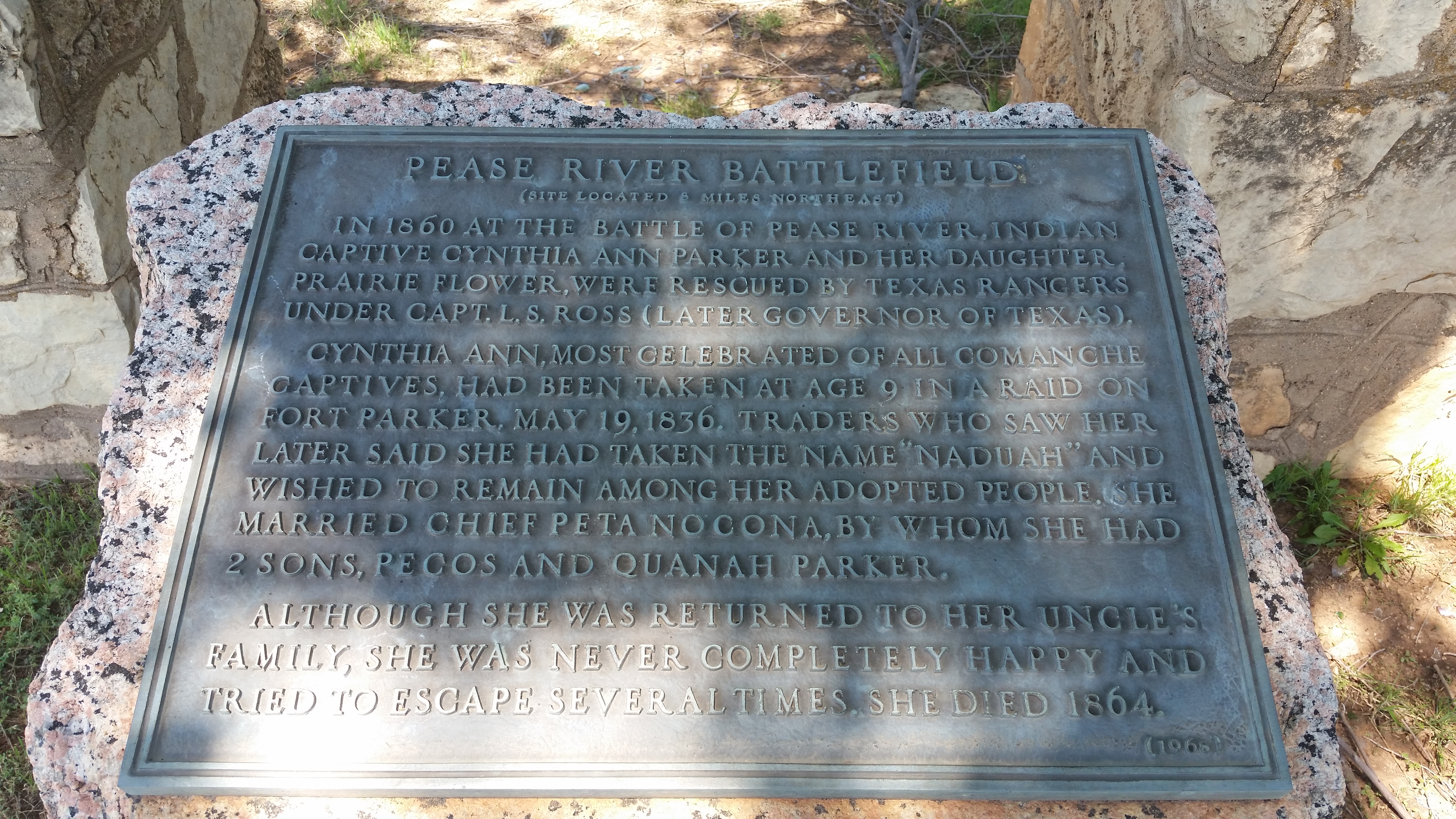
She pointed at herself and said two words: "me Cynthia." On December 19, 1860, beneath the sandstone bluffs where Mule Creek meets the Pease River in what is now Foard County, Texas, a blue-eyed woman clutching an infant was pulled from the chaos of a Comanche camp under attack by Texas Rangers. Cynthia Ann Parker had been taken from her family at age nine during the Fort Parker massacre of 1836. She had grown up Comanche, married war chief Peta Nocona, borne three children, and spent 24 years as Na'ura. Her uncle James Parker had exhausted his fortune searching for her. Now, through violence, she was being "rescued" -- though she never wanted to leave.
The Wanderer's Wife
Cynthia Ann Parker's story began with one raid and ended with another. In 1836, Comanche warriors attacked Fort Parker in east-central Texas, killing five settlers and taking five captives. Nine-year-old Cynthia Ann was among them. She grew up fully Comanche, eventually marrying Peta Nocona, a feared war chief of the Nokoni band whose name meant "the Wanderer." Nocona had formed his own Comanche band and controlled territory along the Red River. Their first son, Quanah, was born around 1850. He would become the last great Comanche war chief. Cynthia Ann's photograph with her daughter Topsannah at her breast was carried in newspapers across the country, making her a symbol of frontier captivity and cultural transformation.
Ranger Captain Sul Ross's Gambit
By 1860, Comanche raids had made the Texas frontier desperate. Governor Sam Houston commissioned Ranger Captain Lawrence Sullivan "Sul" Ross to organize 40 Rangers and 20 militia from Fort Belknap in Young County to stop the attacks. Ross decided offense was the only option. After Peta Nocona led a raid through Parker County -- named, ironically, for his wife's family -- Ross tracked the Nokoni band to their camp beneath the Pease River bluffs. The site was a traditional Comanche refuge, offering protection from the fierce northers and forage for their ponies. Ross struck on December 19. The popular account, first published in 1886, portrayed a dramatic chase and personal combat between Ross and Nocona. But the truth proved far more complicated.
Two Truths on the Prairie
The battle's central controversy endures: did Sul Ross kill Peta Nocona? Ross claimed he did, and the story helped launch a political career that eventually made him governor of Texas. But Quanah Parker adamantly denied it. He told anyone who would listen that he and his father had left camp the night before to hunt, and that Nocona escaped, living another four years before dying of an infected wound. Colonel W.S. Nye, writing in 1890, supported Quanah's version, saying Ross had actually pursued and killed Nocona's Mexican slave. A 2012 study by Texas Tech professor Paul H. Carlson and Tom Crum debunked most of the 1886 account, documenting primary sources who verified Nocona was not present at the massacre and died around 1865. Modern scholarship treats the event not as a battle but as an attack on a camp populated largely by women and children.
A Rescue That Destroyed
Cynthia Ann's "rescue" was her second captivity. Though lovingly cared for by her white relatives, she was devastated. Her remembered English was nearly gone. Her sons were lost to her -- both had escaped the attack, though she did not know it. Famous scout Charles Goodnight trailed the boys' horses 50 miles to a Comanche camp of more than 1,000, but with only a dozen men, turned back. Cynthia Ann's daughter Topsannah died of influenza in 1864. According to neighbors, Cynthia Ann "would take a knife and slash her breasts until they bled and then put the blood on some tobacco and burn it and cry for hours." She starved herself to death shortly after. Quanah Parker later had his mother's and sister's remains disinterred and reburied beside him at Fort Sill, Oklahoma.
The Place He Would Not Visit
A Texas historical marker now stands near the site along Mule Creek. John Wesley of Foard County acquired the land in 1880 and befriended Quanah Parker in the early 1880s when the chief came to trade in nearby Vernon. Wesley invited Quanah to visit the site. Quanah declined. He told Wesley that he never went to Mule Creek because his father was killed there and his mother and sister were captured and carried off. "He said he never wanted to see the place." The landscape is still quiet, open rangeland between Crowell and Vernon, within sight of the Medicine Mounds just outside the town of Quanah, Texas -- a town named for the last Comanche war chief, who never returned to the ground where his family was torn apart.
From the Air
Located at 34.07N, 99.60W in Foard County, Texas, on flat to gently rolling ranchland near where Mule Creek flows into the Pease River. The Medicine Mounds, four distinctive dome-shaped hills sacred to the Comanche, are visible to the northwest near Quanah, Texas. Nearest airports: Childress Municipal Airport (KCDS) approximately 40 nm northeast; Wichita Falls Municipal Airport (KSPS) approximately 60 nm east. Best viewed at 3,000-5,000 feet AGL. The terrain is open prairie with scattered mesquite -- the sandstone bluffs along the river are the most prominent terrain feature.