Battle of Peking (1900)
On the night of August 13, 1900, as armies of eight nations moved into position five miles from Beijing's walls, they could hear the heavy thud of artillery and the staccato crackle of machine guns from inside the city. The sounds had been continuous for nearly two months. Inside the Legation Quarter, 900 foreign diplomats, citizens, and soldiers -- along with 2,800 Chinese Christians who had sought refuge there -- had held out since June 20 against Boxer militants and Imperial Chinese Army troops. Three miles away, a second siege was underway at the Peitang Cathedral, where 28 foreign priests and nuns, 43 French and Italian soldiers, and 3,400 Chinese Catholics were dying of starvation behind crumbling perimeter walls. The relief force, reduced by heat exhaustion to perhaps 10,000 effective troops, feared they had arrived one day too late.
The Race Through the Gates
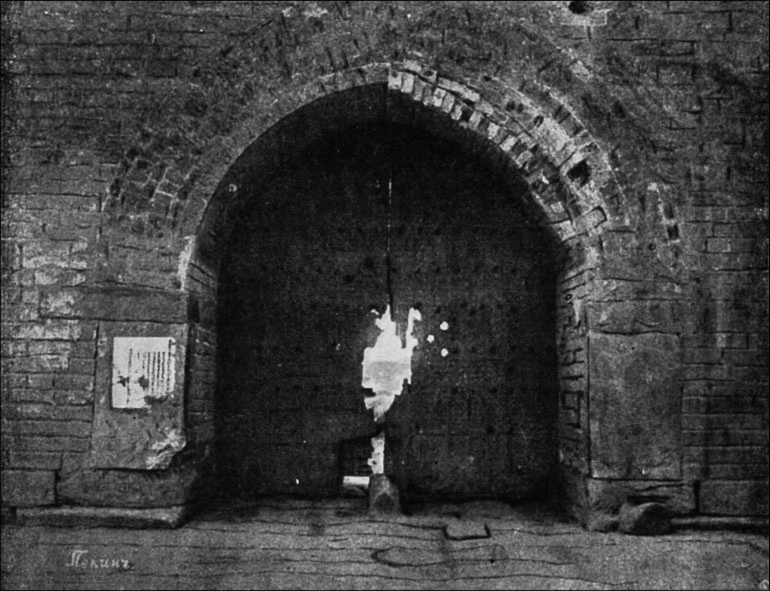
What followed was less a coordinated military operation than a competition. The commanders of the Japanese, Russian, American, and British contingents each agreed to assault a different gate in Beijing's formidable defenses -- walls 21 miles long, the inner wall 40 feet tall and 40 feet wide at the top. The French were apparently left out of the planning entirely. The plan collapsed almost immediately. Russian troops arrived at the Americans' assigned gate around 3:00 a.m. on August 14, blasted through the outer door, and walked into a murderous crossfire in the courtyard between the inner and outer gates. Twenty-six Russians died and 102 were wounded before the survivors were pinned down for hours. When the Americans arrived and found Russians in their gate, they moved 200 yards south, and Trumpeter Calvin P. Titus volunteered to scale the 30-foot wall. He succeeded, and at 11:03 a.m. the American flag went up on the Outer City wall.
Through the Water Gate
The British found the quickest path. Approaching their assigned gate -- the Guangqui, at the southern end of the assault -- they encountered virtually no opposition and passed through without casualties. But the legations lay inside the Inner City, behind a second wall. The fastest route in was a drainage canal running beneath the Inner City wall -- the "Water Gate." British Indian troops waded through the canal's muck and emerged inside the Legation Quarter at 2:30 p.m., greeted by a crowd of the besieged dressed in their Sunday best. Among the Americans who arrived two hours later was Smedley Butler, a young Marine who would become the most decorated Marine of his era. Chinese forces around the quarter fired a few final shots, wounding a Belgian woman, and then melted away. The siege was over.
The Empress Flees at Dawn
The next morning, August 15, Empress Dowager Cixi, Emperor Guangxu, and members of the court slipped out of the Forbidden City in three wooden carts, the Empress dressed as a peasant woman. Chinese authorities called her flight to Shanxi province a "tour of inspection." Behind her, the Kansu Braves -- Muslim troops from Gansu province -- fought a fierce rearguard action at Zhengyang Gate against the British. General Ma Fulu and four of his cousins died charging the Alliance lines; a hundred Hui and Dongxiang Muslim soldiers from his home village fell at the same gate. These troops were later described as "the bravest of the brave, the most fanatical of fanatics: and that is why the defence of the Emperor's city had been entrusted to them." American artillery blasted through successive walls into the Imperial City but halted at the gates of the Forbidden City itself.
The Biggest Looting Expedition
The occupation that followed was devastating. An American journalist called it "the biggest looting expedition since Pizarro." Each nation accused the others of being worst. American missionary Luella Miner wrote that "the conduct of the Russian soldiers is atrocious, the French are not much better, and the Japanese are looting and burning without mercy." The British formalized the plunder, auctioning loot at the British Legation every afternoon except Sunday. American General Chaffee banned looting, but his own Army chaplain reported the rule was "totally ineffectual." The civilians and missionaries who had been besieged -- familiar with Beijing's layout -- proved among the most prolific looters. The Eight-Nation Alliance then launched punitive expeditions into the countryside where, as Chaffee himself acknowledged, for every genuine Boxer killed, "fifty harmless coolies or laborers on the farms, including not a few women and children, have been slain."
The Price of Defeat
The peace treaty of September 7, 1901, imposed an indemnity of $335 million -- over $4 billion in today's currency -- payable over 39 years with interest. Government supporters of the Boxers were executed or exiled. Chinese forts and defenses across northern China were destroyed. On August 28, 1900, foreign armies had marched through the Forbidden City in a symbolic demonstration of their complete control -- a space where even most Chinese were forbidden to tread. Empress Dowager Cixi returned from her "tour of inspection" on January 7, 1902, and the Qing dynasty limped on, mortally weakened. The Empress died in 1908. The dynasty collapsed in 1911.
From the Air
The Legation Quarter was located at approximately 39.91°N, 116.40°E, just southeast of the Forbidden City in central Beijing. The Forbidden City, Zhengyang Gate, and Tiananmen Square are all visible from the air and were key locations in the battle. Beijing Capital International Airport (ZBAA/PEK) is 15 nm to the northeast. Best viewed at 3,000-5,000 feet AGL.