Battle of Pensacola (1814)
Governor Mateo Gonzalez Manrique had a problem no diplomat could solve. It was the autumn of 1814, and three nations were pulling at his small Spanish outpost on Pensacola Bay. The British wanted to use his harbor and forts to arm Creek refugees and launch raids against the Americans. The Americans, led by the volatile General Andrew Jackson, threatened to attack if Manrique did not expel the British. And from Havana, the Captain General of Cuba and Florida sent nothing -- no reinforcements, no instructions, no help. Manrique chose the British. Jackson chose war. What followed was the only battle of the War of 1812 fought on soil belonging to the Kingdom of Spain.
A Governor Between Empires
Manrique's predicament began months earlier, when British Royal Marine officer Edward Nicolls arrived on the Gulf Coast with 100 marines, 300 uniforms, and 1,000 muskets. His mission was to arm and train Creek refugees who had fled south after their defeat at the Battle of Horseshoe Bend. Captain Woodbine of the Royal Marines had already made contact with Native leaders aboard HMS Orpheus, distributing weapons and accepting the title of British Agent to the Creek Nations. Manrique, watching the Americans mass on his borders and receiving no aid from Havana, made a fateful calculation. In August 1814 he invited the British into Pensacola, breaking Spain's policy of strict neutrality. Jackson, upon learning the British flag flew over a nominally neutral city, wrote to Manrique that he would hold the governor personally responsible for any harm to American citizens.
Bluffs and Bluster
Nicolls was a master of theatrical exaggeration. From Pensacola on August 26, 1814, he issued a proclamation describing a "numerous British and Spanish squadron" and a "good train of artillery" backing his battalion. The reality was four small Royal Navy vessels, three cannons, twelve gunners, and a company of 100 marines. He recruited 500 Native warriors and 100 freed Blacks, then marched this force against Fort Bowyer near Mobile in a bold demonstration. The attack failed spectacularly. Manrique began to doubt whether the British could actually defend his city. Meanwhile, over 100 enslaved people in Pensacola alone fled to join Nicolls, and British-allied forces looted the Forbes Company store at Bon Secour. Relations between the governor and his British guests deteriorated. The British withdrew from the town proper and consolidated in the outlying Fort San Carlos and the Santa Rosa battery.
Jackson Moves Without Orders
Secretary of State James Monroe explicitly told Jackson to handle Pensacola through diplomacy, not force, and to prepare instead for an expected British attack on Louisiana. The letter arrived too late. Jackson had already written to Monroe on October 26, explaining his rationale for attack. He assembled up to 4,000 men, waited for Brigadier General John Coffee's volunteers, and reached Pensacola on November 6. The Anglo-Spanish garrison numbered roughly 700 -- about 500 Spanish infantry and the remaining British forces. Jackson offered to garrison the forts with American troops until Spanish reinforcements arrived, preserving the appearance of neutrality. Manrique refused.
Dawn Assault Along the Beach
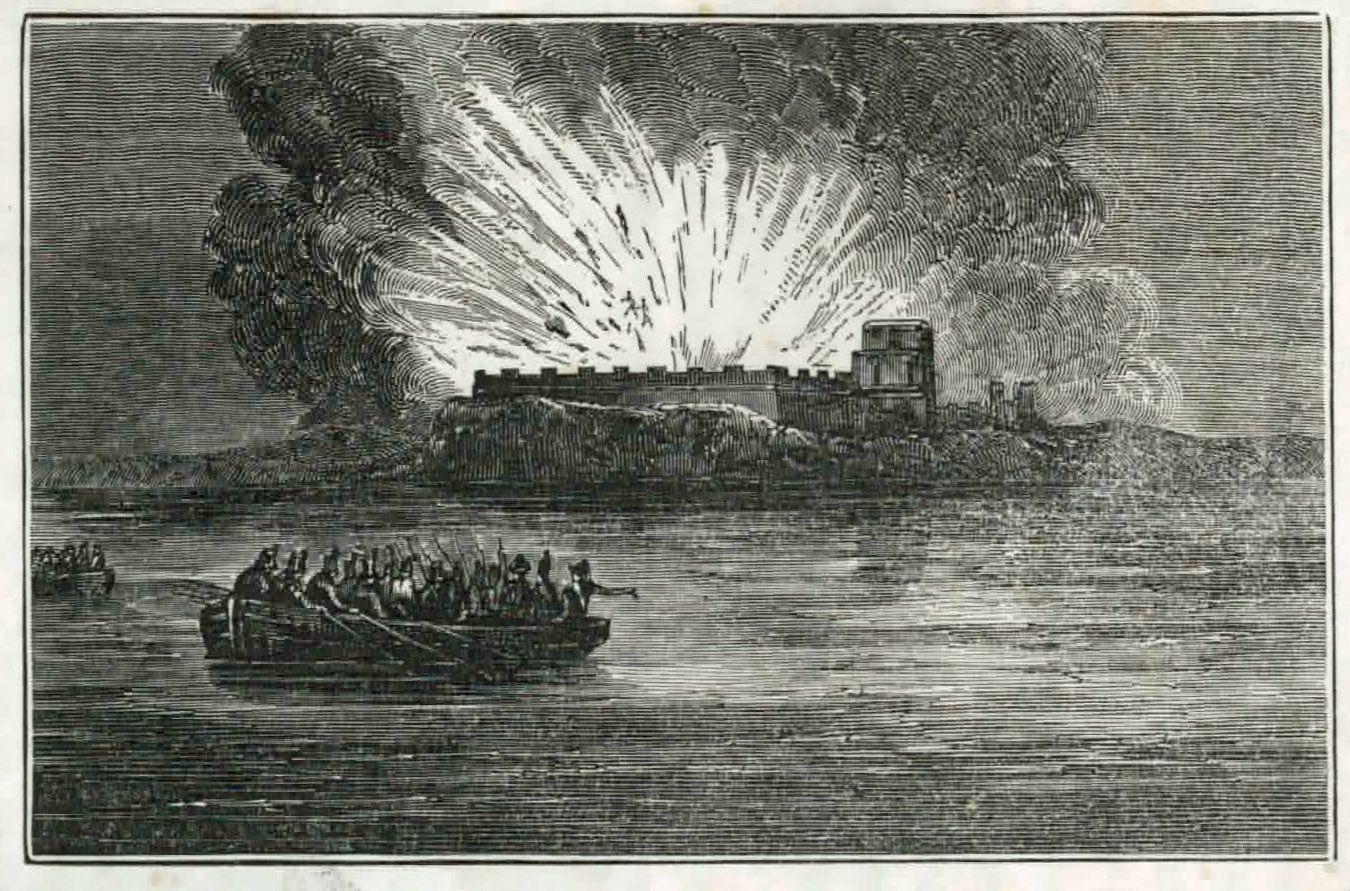
At dawn on November 7, Jackson sent 3,000 troops marching from the east to avoid the forts' artillery. They moved along the beachfront, where the sandy terrain slowed the cannon but not the infantry. Resistance materialized in the center of town: a line of infantry backed by an artillery battery. The Americans charged and took the battery. Fort San Miguel and its 268-man garrison surrendered the same day. Jackson planned to storm Fort San Carlos the following morning, but the British denied him the chance. Overnight, they blew up the fort and withdrew their squadron -- five warships carrying Nicolls, his forces, and 363 Spanish soldiers who would not return to Pensacola until 1815.
The Road to New Orleans
Jackson was furious. The destruction of Fort San Carlos violated the surrender terms, and he wrote to Manrique expressing his disappointment. He chose not to repair or garrison the captured fortifications, acknowledging his attack had been carried out without government sanction. Instead, he withdrew his troops to protect the frontier. Within days, intelligence confirmed a British task force in Jamaica destined for New Orleans. Jackson marched to Mobile, arriving November 19, and from there raced to defend the city that would make his legend. American casualties at Pensacola were negligible -- about seven dead and eleven wounded. The Spanish suffered fourteen dead and six wounded. Admiral Cochrane later remarked to General Lambert that Jackson's strike at Pensacola had dealt a significant blow to British momentum in the Gulf. The battle had alienated Britain from Spain and, ironically, drawn the Spanish closer to the Americans -- a diplomatic shift that helped pave the way for American acquisition of Florida five years later.
From the Air
The Battle of Pensacola took place across what is now downtown Pensacola and the surrounding fortifications along Pensacola Bay. The battle site is at approximately 30.41N 87.21W. Fort Barrancas (the rebuilt Fort San Carlos) is preserved at NAS Pensacola and visible from the air on the bluffs overlooking the bay entrance. Fort Pickens, rebuilt on the site of the Santa Rosa battery, stands on the western tip of Santa Rosa Island across the harbor. The downtown Pensacola grid where the main engagement occurred is visible northeast of the bay. Nearest airports: Pensacola International (KPNS) and NAS Pensacola (KNPA). Best viewed at 3,000-5,000 ft AGL to appreciate the strategic relationship between the bay, the bluffs, and the barrier island fortifications.