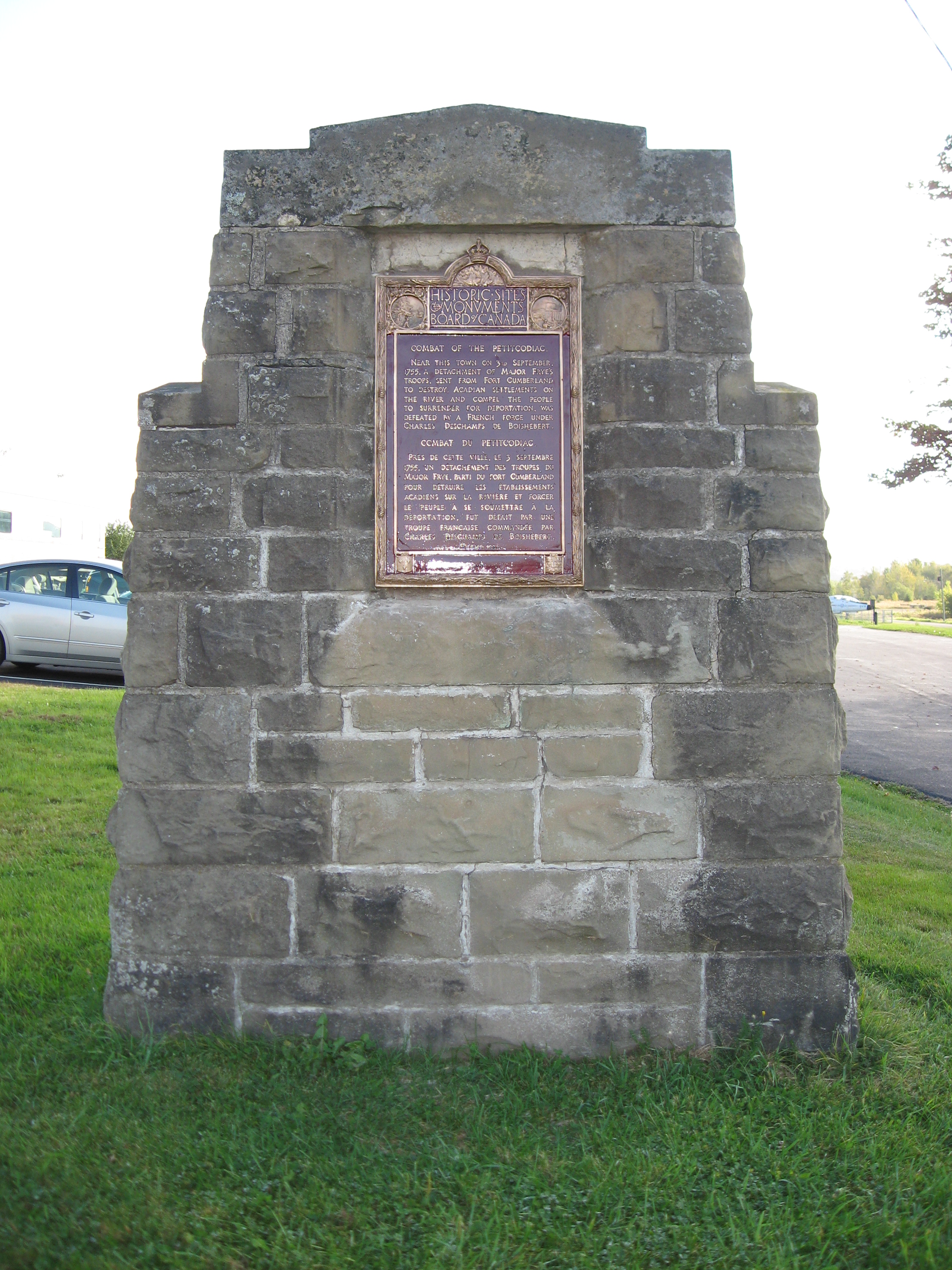
Battle of Petitcodiac
When the British soldiers set fire to the village church at Village-des-Blanchard on September 4, 1755, they did not know that three hundred armed men were watching from the tree line. The Acadian militia, Mi'kmaq warriors, and Maliseet fighters had been waiting. As the flames rose, they attacked -- and what followed was not just a defeat for the British expedition, but the first successful act of armed resistance during one of the most painful chapters in Canadian history: the expulsion of the Acadians.
A People Facing Erasure
The battle did not emerge from a vacuum. In June 1755, British forces captured Fort Beausejour on the border between Nova Scotia and New Brunswick, and almost immediately began the systematic deportation of the Acadian population -- French colonists who had lived in the region for generations. Using the renamed Fort Cumberland as their base, British troops fanned out across the countryside, rounding up Acadian families for deportation and burning their settlements. Some Acadians surrendered. Others fled inland from the coastal communities, joining with Mi'kmaq and Maliseet peoples who had their own reasons to resist British expansion. The deportation, known as the Expulsion of the Acadians or le Grand Derangement, would eventually displace thousands of people across the Atlantic world. But along the Petitcodiac River, resistance was gathering.
The Commander from the Miramichi
Charles Deschamps de Boishébert et de Raffetot was a French militia officer based in the Miramichi River valley who had been helping Acadian refugees escape to Quebec. When the British sent a naval squadron to seize his fort at the mouth of the Saint John River, Boishébert recognized he could not hold it and ordered it destroyed. But when he learned that Major Joseph Frye was leading 200 provincial militia from Massachusetts up the Petitcodiac River in two armed sloops, he moved quickly. Hurrying to the village of Chipoudy, Boishébert organized 120 Acadians, Maliseet, and Mi'kmaq fighters into a guerrilla force. By the time the British reached Village-des-Blanchard in early September, Boishébert's force had swelled to nearly three hundred, positioned and waiting in the dense forest along the riverbank.
Three Hundred Against Two Hundred
Major Frye's orders from Robert Monckton were blunt: clear the Acadian settlements along the Petitcodiac. When his men torched the village church, the ambush was sprung. Boishébert's fighters attacked from the forest with devastating effect. The ranger Joseph Gorham was wounded in the fighting. For many of the Massachusetts provincials, this was their first experience of combat, and it showed -- twenty-two were killed and six more wounded in the fighting. Abbe Le Guerne, a French missionary who documented the event, wrote that the battle "made the English tremble more than all the cannons of Beausejour." It was the first French military success in Acadia during the war, and it proved that the deportation would not go unanswered.
Rescue and Refuge
The immediate aftermath brought tangible results for the resistance. Boishébert's fighters rescued thirty Acadian families who had been captured for deportation and seized large quantities of British military supplies and food. He then established a refugee camp called Camp de l'Esperance on Beaubears Island, near present-day Miramichi, New Brunswick, where displaced Acadians could shelter. Other refugees made their way to camps along Chaleur Bay and the Restigouche River, where Boishébert created another settlement at Petit-Rochelle. These camps became lifelines for a scattered population. Boishébert himself went on to lead Acadian forces at the Battle of the Plains of Abraham, carrying the resistance forward to the war's climactic confrontation.
First in the Nation's Memory
The British returned to the Petitcodiac in 1758 and destroyed what remained of the village. But the battle's significance outlasted the settlement it was fought to defend. On May 16, 1918, the site was designated a National Historic Event -- the earliest such designation in Canada, made before the Historic Sites and Monuments Board was formally established. A plaque near present-day Hillsborough, New Brunswick, marks where the fighting took place. The monument stands along a quiet stretch of the Petitcodiac River, a place where the forest has long since reclaimed the ground that Boishébert's fighters once defended. For the Acadian people, the battle represents something more than a military engagement. It is evidence that in the face of forced removal, there were those who fought back.
From the Air
Located at 45.93N, 65.17W along the Petitcodiac River near present-day Hillsborough, New Brunswick. The battle site lies in the river valley with gently rolling forested terrain. Best viewed at 2,000-3,000 feet. The Petitcodiac River is clearly visible from altitude, winding through farmland and forest. Nearest airports: CYQM (Greater Moncton International) 30 km northeast, CYSJ (Saint John Airport) 110 km southwest. The tidal bore of the Petitcodiac is sometimes visible from altitude.